Android Audio-serial Connection

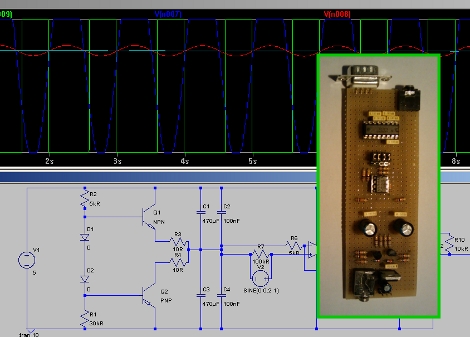
This seems like something of a throwback hack. [WilinNeofoxx] has built an audio modem interface for use with his Android phone. A program running on the Android device takes the accelerometer data and converts it into a 9600bps audio signal, kind of like a dial-up modem. His custom circuit board takes that sound in through the headphone jack and demodulates it for use on the serial port of a PC. This connection to controls a flight simulator using the G1‘s motion sensors. In the video at the bottom of his post he unplugs the audio cable for a few seconds and you can hear the audio datastream coming from the phone. It’s pretty annoying so you might want to turn down those speakers before viewing it.

Ask A Winner Updates Day 3: Answers

Not too long ago we asked our readers what they would like to hear about from the PUSH N900 winners and their hacks. We got some silly questions, and some serious, we asked both and now the PUSH teams have answered.

The days are getting closer and closer to the N900 PUSH Showcase, and as such the teams are getting more and more stressed. But the team from Sketch Your World was willing to take time of out of their busy day for our interview. As always, keep up to date on the team at their blog – they’ve started drawing on the Etch a Sketch(tm), and it even (okay, it doesn’t really, but it’s still progress) looks like a circle!

Continue reading “Ask A Winner Updates Day 3: Answers”

IM-ME Screen Reverse Engineered

[Dave] figured out the command set for the IM-ME terminal. It took a bit of sleuthing to get this pink plastic peripheral to give up these secrets. He used an oscilloscope to sniff out the SPI connections, then used a hacked IM-ME to capture the traffic from a factory-fresh unit. He managed to extrapolate how write data was being sent but he still couldn’t figure out how commands were differentiated from that data. With the info at hand he searched around the interwebs to find that the screen uses an ST7565S controller. Now he’s got custom firmware to make the LCD display do his bidding and we’re wondering what’s next?

Wii Motion Plus Direct PC Interface

You can pick up a Wii Motion Plus module for under $20 and that’s not bad for an I2C gyroscope. This hack taps into the device through a PC parallel port. The connection calls for some level conversion to step down to the 3.3v needed by the module. The communication protocol borrows from the Wii on Arduino code examples that we saw last year. You can see the Wii Motion Plus controlling a virtual cube in the video after the break.

Continue reading “Wii Motion Plus Direct PC Interface”

120v Switching

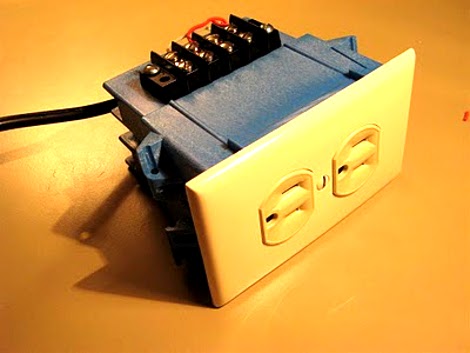
[Kenneth] built a 5v controlled power outlet inside of a junction box. We’ve seen plenty of projects that can switch 120v outlets using 5v logic for refrigerator controllers, lighting controllers, or grow systems, but they almost always use solid state relays to facilitate the switching. This iteration uses mechanical relays along with the necessary protection circuitry. The project is housed in an extra deep single-gang box and allows for individual switching of the two outlets. You can see this connected to an Arduino switching two lamps after the break.

Continue reading “120v Switching”

Hacking A Digital Bathroom Scale

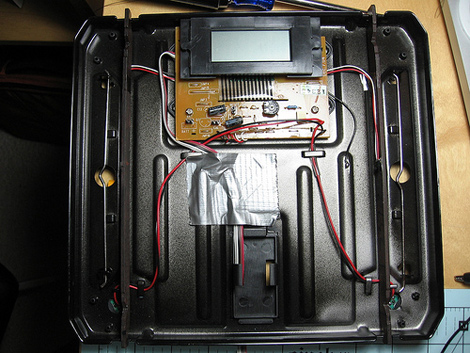
[Micah] was inspired by projects he had seen of people using the Wii balance board as an input. He realized the balance board was overkill, and pricey for many applications. Since it is basically just 4 weight sensors, he thought, why not just use a scale? Often, only one sensor is needed and they’re really cheap from big box stores. He picked up a digital scale and cracked it open. As he moved forward, he wanted to keep this pretty simple. There are other ways of getting the information from a scale, but they have been generally more complicated than what he had in mind. He ended up bypassing the internal unknown microcontroller and just connecting the analog sensors to his parallax setup. You can read all about the process an download some source code on his site.

[via Flickr]

Recycled Cat Feeder

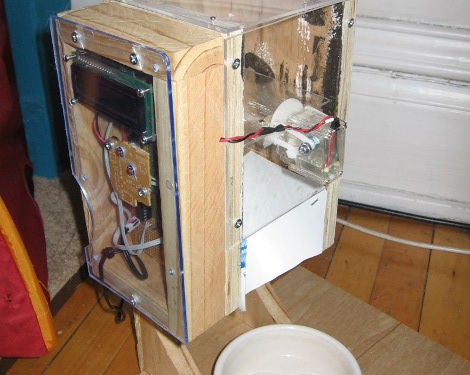
I find that I do a lot of fun projects but I’m very bad about documenting them when I’m done. Holidays are for hacking (in my mind) so I usually plan ahead and do something cool during my time off. This project, which I loving call the Autodine-2009, was a spontaneous event over Thanksgiving that I’m just getting around to writing about.

Our cat’s want to be fed at 6am and are very insistent about it. Like most folks, I’d rather be sleeping at that time of day so I built an automatic cat feeder. Now we sleep while the cats eat. We don’t want to rely on a hack to feed our cats when we’re away so I didn’t go the route of an Internet-enabled multiple-dose feeder. Instead, I used parts on hand to create a single-serving dispenser on a timer. A servo rotates a false bottom to gravity-feed the cat food. The servo doesn’t have control circuitry so it is controlled through an h-bridge (I did have to buy 2 transistors for that) by an AVR ATmega8 microcontroller. There are two salvaged tactile switches to set the time and timer, and a serial LCD display that I’ve had sitting around for years. Power comes from an old cell phone charger a friend had just given me that spawned the feeder idea when I asked myself “hmmm, what can I use this for”?

I’ll demonstrate this recycled device for you in a video after the break. This wasn’t as hardcore as my AVR Tetris build but I’m much happier now that I can sleep in a bit.

Continue reading “Recycled Cat Feeder”