Chumby One Becomes A 3g Router

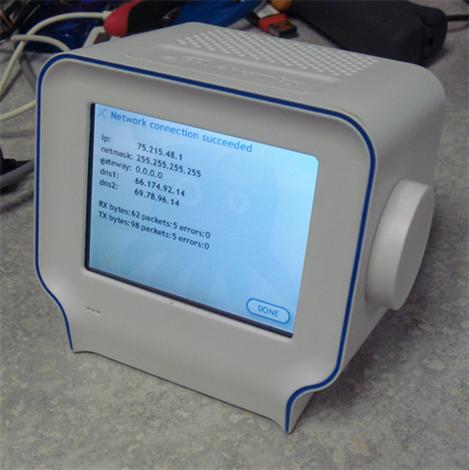
[bunnie] has taken a few moments to show us how to turn our Chumby One into a 3g router. As it turns out, there is an easter egg that allows it to communicate with certain models of 3g dongles. There’s no GUI for this trick, so you’ll be doing most of your configuration via SSH. That shouldn’t be a problem for this crowd though. The Chumby One just got a lot more appealing.

Forget The Rovio, Drive A Taxi With Your Mind.

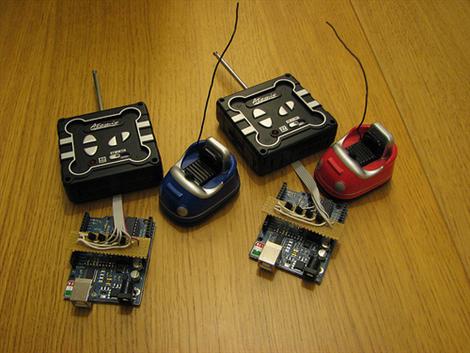
While browsing through flicker this morning, we spotted this interesting image. Two radio controlled cars hooked to Arduinos. What was going on? What is [knolleary] doing with them? We couldn’t find any information so we clicked through to his personal site. What we found was a quite interesting story about how he set up a race between two taxi cabs being controlled by the Emotiv headsets for the BBC. Yeah, forget driving a Rovio around with your mind. We’re still a bit curious about the two bumper cars in the picture. We can see that his tests were done on a blue radio controlled mini, so what are the bumper cars for? Did any of you catch this on the air? How well did the taxis drive? Was he using the facial expressions or the concentration?

Aerial Photography platforms

[Eric Austin] is using a Canon 7D with this RC helicopter to capture some amazing HD video. His success has manifested itself in a company that is now manufacturing these platforms ready-to-use. Take a look at their blog to see some of the hardware they’re working on, such as a tricopter and hexacopter photo platforms. We’ve also embedded a video after the break of the unit seen above and the stunning shots it’s able to grab.

Continue reading “Aerial Photography platforms” →

Mind Controlled Rovio

[youtube=http://www.youtube.com/watch?v=NNkkuMO5l7A]

[Robert] at Extremetech was going to write a review of the Emotiv EEG headset but found the bundled software lacking. He decided to write something to really show off what could be done with an EEG in your home. He is now controlling his Rovio with his mind. He had already written a new control program for the Rovio, so redoing the same program with the EEG controls would give him a great comparison. If you recall from the mind controlled TV, meditating on a single thought can be cumbersome for quick controls. Instead, he used facial expression recognition. Maybe this should be called “face controlled Rovio” instead.

Printable mecanum wheel

[Zaggo] developed a printable mecanum wheel. These are designed to allow a wheeled vehicle to move in any direction. He uses parts printed with a Makerbot along with commonly available bearings, bolts, washers, and nuts. Download the STL files need for printing and watch the assembly video after the break. We’ve also included a clip of an unrelated robot project using mecanum wheels so you can see what [Zaggo] will have once he fabricates the rest of the of the wheels. Continue reading “Printable mecanum wheel” →

Learn console hacking

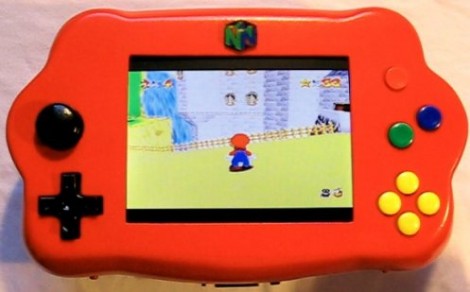
This bright red handheld is [Bacteria’s] portable N64 console. We’re beginning to feel a bit saturated with N64 portable hacks, having seen one that looks like a Game Boy, another in a shiny black case, and yet another in a white case. This time around it’s not just the end product, but [Bacteria] has posted a saga discussing the build progress. Check out the 20 videos on his worklog page. If you’re looking to take existing hardware and put it into a different enclosure you should pour over this resource for ideas you can use.

Bonfire – Interactivity Using Pico Projectors And Cameras

[youtube=http://www.youtube.com/watch?v=O3MZYRAZJNk]

This video shows a demonstration of Bonfire, an additional interface for computers. It consists of a pico projector and camera hang on the back of either side of a laptop. The projector displays information on the table top and the camera monitors the area for interaction. It can recognize your hand or objects such as a smartphone or headphones and react accordingly. An accelerometer in the laptop picks up tapping (we’d guess you have to tap pretty hard) and there is also support for gestures. This was presented at 2009 UIST and unfortunately the published article is not available for free [Thanks for the link Ciflet].

We hope to see this kind of thing, as well as skin based input, come to the market some day. Until then, you’ll have to build your own.

[via Procrastineering]