Polymorph In Practice

[youtube=http://www.youtube.com/watch?v=gxy22VfZq0E&feature=player_embedded]

[Leesam] tipped us off to this cool tutorial for shaping Polymorph. For those who haven’t, it is pretty cool stuff. It is a plastic that comes in little pellets. You can melt it down at relatively low temperatures and mold it to the shape you need. We’ve seen it used on several projects, most notably CrabFu’s swashbot3. Generally, we see it hand shaped, so it is fairly organic and imperfect. It can be used for more precise shapes though. This tutorial walks us through the easiest way to produce sheets of the stuff to be cut and bent into brackets as well as some helpful tips on getting the best results.

The Most Complicated, And Simplest Binary Clocks.

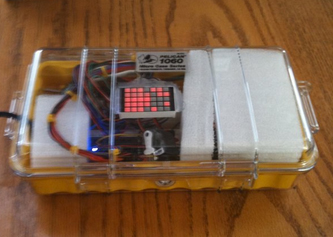
We were going to take a break from posting clocks. Really we were. This one came in the tip line today though, and we just couldn’t pass it up. [Alex] has built, what might be the most complicated clock we’ve seen. At least, it would appear that way initially. This Binary clock shows Hours, Minutes, Seconds, Days, and Months. He started with a picaxe, but eventually settled on an Mbed. Yes, he knows it is overkill, but it worked out pretty well.

As for the simplest, that came into our tip line as well. [Toby] sent this in, and agrees with us that it is hardly worthy of being called a hack. However, in light of the complicated one above, we didn’t see any harm in posting its opposite. Check it out after the break.

Continue reading “The Most Complicated, And Simplest Binary Clocks.” →

The Pololu 3 Servo Hexapod

[youtube=http://www.youtube.com/watch?v=cqI-sDJTyuo&w=470]

Here’s a great tutorial on how to make a tiny hexapod walker. While this was written specifically for a kit that is sold by pololu, we like the simple layout. You could implement your own electronics if you prefer something else.  If you want to follow along with their components, you’ll end up with a fairly small and decently agile hexapod. Sure the legs aren’t articulated at every joint, but  the effect is workable. This is probably the first 3 servo walking hexapod we’ve encountered and we’ve seen a pretty decent amount of hexapods.

[Via HackedGadgets]

Wii Nunchuk Train Controls

While we’ve been told all of our lives Wiis and trains just don’t mix, they never said anything about Wii Nunchuks. One terribly abused joke later, [Ken] tipped us off about his Wii Nunchuk controlled train set.

By utilizing Digital Command Control (think pulse-width modulation) with an Arduino, he is able to have full control over the trains direction and speed. The other part of the equation is a Wii Nunchuk and adapter. The setup should be pretty self explanatory, but there is an Instructable for those that need more help.

Robot Waits For No Man When Recharging

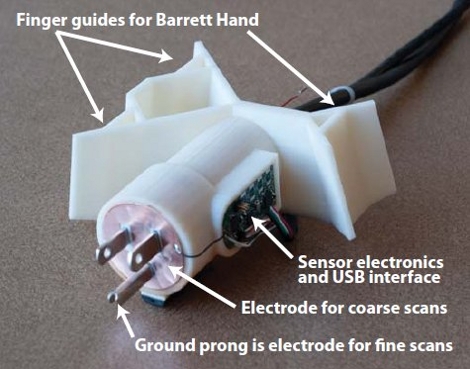
Yikes, that power connector certainly wasn’t designed by Apple. Ugly as it may be, it’s the charging cable for a robot and acts as a sensor that allows the robot to properly align and plug into a power receptacle.

We’re going to go off on a tangent for just a second. We often think of the Rat Things from Snowcrash when considering robot power. They were nuclear powered (or something) and instead of recharging required constant cooling. Those day’s aren’t exactly around the corner but we think they’ve been realized in the lawn mowing robots that have a little nests to recharge in. Base stations work but they require the machine to return to the same place, or to have multiple charging stations.

The point is, this specialized cable makes base stations for robots obsolete. Now a robot can plug into any outlet it can get near, a great thing for robots roving large facilities. After the break you can see a video of this process. The robot arm zeros in by scanning horizontally and vertically and measuring the magnetic field put out by the AC in the wires of the outlet. Take a look, it’s a pretty neat piece of engineering.

Continue reading “Robot Waits For No Man When Recharging” →

More AVR Tetris

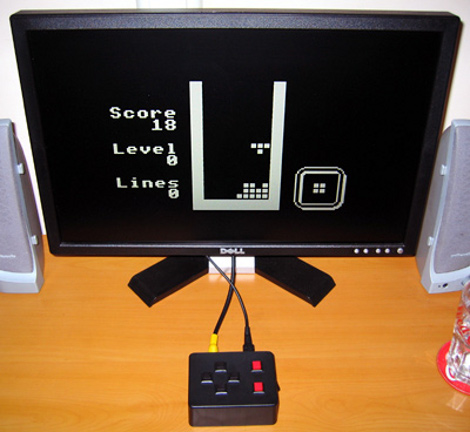
[Ben] built an AVR based Tetris game that uses a TV as the display. He linked his project in a comment from the AVR Tetris project featured last week. His work taps the power of his own tvText library to handle the composite video out. Using a TV takes all of the hardware work out of the equation, leaving just the composite jack and a few buttons to connect to the ATmega168 and its 20MHz clock. We’ve embedded the game play video after the break. It’s black and white but also clean and crisp.

[Ben] didn’t include music with his build but another commenter, [Eric], has started to work on that. We can’t help but think that they both should have tipped us off sooner about their projects.

Continue reading “More AVR Tetris” →

Multichannel Music Generation For Arduino

[youtube=http://www.youtube.com/watch?v=liRF4alsvaI]

[Drew] wrote a library for playing multichannel music on an Arduino. The project connects multiple piezo buzzers to the popular prototyping platform and handles the dirty work involved in modulating multiple buzzers at the same time. The video above starts with an explanation for the first three minutes but if you’re impatient you can jump directly to the music demonstration. The results are magnificent. We’re going to check out the code and see what we can make happen just as soon as we can round-up multiple piezos.