Light Up Your Ride With An LED Mohawk

[Garrett Birkel’s] weekly ride usually features some pretty wild costumes. He wanted something to step up his own look so he make this LED mohawk bike helmet. He had an LED strip to start with and found a way to use acrylic and clear plastic tubing to fold the lights into the appropriate shape. From there he designed a PCB for some DC-DC converters to provide regulated power. The juice comes from Lithium Iron-Phosphate cells, the same kind we saw in the electric bike assist battery a few days ago. We find it a bit wild that you can pick out the PWM of the LEDs in the lens effect of that photograph.

More Functional GPS In Minutes

[Sparky] notified us of his hack to allow interaction with the core of an Aldi GO Cruise 4300 GPS Windows CE OS. All that’s required is a few programs and registry edits to the GPS, which anyone can accomplish within a few minutes. But we suggest you go slow and double-check your work; nobody wants a bricked system. After you’re done you can run such great programs like the one [Sparky] suggest for 4WD enthusiasts, Ozi Explorer.

PIC Based USB Input Devices

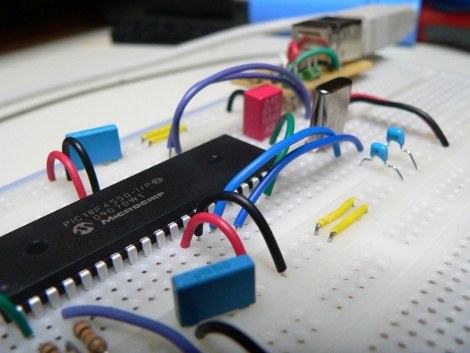
USB is convenient and that makes it desirable in many many projects. [Simon Inns] has the process down and is sharing it with his recent PIC based USB tutorial. Prompted by requests for help on the matter after having published a post about his Commodore 64 interface, he set out to detail the particulars when it comes to using the PIC 18F family as USB input devices. This example uses a PIC 18F4550 with the circuit built on a breadboard. There’s not much required here, an oscillator, a few passives, and a USB B connector. The magic really happens in the code. Take a look at this well-written guide and give it a try with your next project.

Don’t need USB? [Simon’s] game hack, the Ultimate Simon is always worth another look too.

Ask Hackaday: Now A Regular Occurrence

A while back, we announced that we would be bringing new features to Hackaday. One in particular that garnished a lot of interest was our question answer type thingy. Well, in case you hadn’t noticed, that has not happened yet. Without divulging too much into the secret machinery that lies underneath Hackaday, I’ll just say that we(the writers) don’t necessarily have control over all aspects of the site. An example would be the copyright. Yes, we finally got it updated. Thanks for all of your emails. No, none of us had access to that part of the site, so don’t bother letting us know how simple that change should have been.

We are as eager as you to see some good ideas and good feedback flowing through this site, so we’re going to start a regular post, entitled “Ask Hackaday”. This isn’t entirely new, we’ve done it before actually. This is just to let you know that we intend to do it regularly, and to set some ground rules.  “Ask Hackaday” will mostly center around you, our readers, and your ideas. We will publish a question, and possibly our thoughts, but the main content will be your responses. We have a huge collective of intelligent creative readers and it would be a shame not to tap into that pool of knowledge.  When you are offering an answer, be thorough, give details, and please be kind.

Send your questions to askHAD@hackaday.com for consideration. They will be chosen based on a complicated system of random number variation involving furry woodland creatures and how we feel at the moment that we read them. Do not get offended if you question does not get published. We get tons of questions already and we don’t intend to publish them all.


Balancing Skateboard/segway

[youtube=http://www.youtube.com/watch?v=7UKxuVliaIA]

[XenonJon] got a lot of attention for a skateboard/segway style balancing platform he took to the Makerfaire in Newcastle. He decided to try to build it the cheapest and easiest possible way in an attempt to help others build their own. The build is documented very well, however you have to email him to request the code for the Arduino. Maybe after enough requests, he’ll just pop it online. We thought this looked familiar, so we searched the archive and found this very similar setup from back in 2005. Unfortunately, that project page appears to be gone now.

POV Clock Inside Acrylic Block

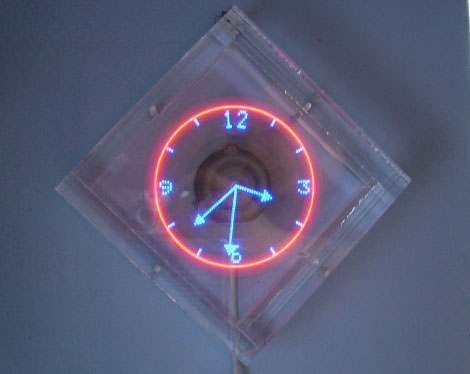
This gorgeous persistence of vision clock was built a couple years back by [mb1988]. The housing is made of acrylic with a hard drive motor mounted in the center of the back panel to spin a PCB. The two-sided circuit board is home-made and includes a battery for power, ATmega32 for the brain, 32 LEDs, four display drivers, and a real time clock module. The spinning hard drive motor is nearly silent and already has threaded mounting holes on it. [mb1988] uses an optoelectric sensor to sync the display with the rate of rotation. The forum post includes download for the code and hardware details. Don’t miss the demonstration after the break.

Continue reading “POV Clock Inside Acrylic Block” →

By Popular Demand: The OK Go Rube Goldberg Machine

We’ve received many tips regarding the OK Go video that features a Rube Goldberg machine. If you haven’t seen it yet, check out their video after the break. This is the rare instance when a YouTube video features an audio track with the full endorsement of the artists that recorded it.

Our first thought when watching this? Who are the lucky dogs who got paid to design and build that contraption? You don’t have to scratch your head over that one, the Band has posted a four-part video series talking about the machine and documenting the design meetings and build process (those videos also after the break). The engineer artists at Syyn Labs were tapped to pull off the meticulous mayhem and we think they did a stellar job. There’s been a lot of press about the work, but our favorite was over at Wired because it details the process, not the end product.

The best part about Rube Goldberg Machines is that asking “why?” is the wrong questions. The sheer joy of the build makes taking over a house or over-complicating the fulfillment of hunger worth it.

Continue reading “By Popular Demand: The OK Go Rube Goldberg Machine” →