X11 On Android

x11

[ghostwalker] has put together instructions for running X11 on your Android device. This means you can run a full-blown Linux desktop environment on your phone. It requires you to already have a Debian shell on the phone, which we covered earlier. Instead of having to come up with a custom display driver, it’s hooked to a VNC server. You can connect to it using an Android VNC viewer on the phone or via any other VNC client. The how-to suggests either IceWM or the even lighter-weight LXDE for a window manager. You could potentially install Gnome or KDE, but we’d be surprised if it was any faster than dog slow. Let us know if you have any success with this and what you think the best use is.

QRSS: Radio Amateurs’ Slow-speed Narrowband

qrss

Host of the Soldersmoke podcast, [Bill Meara], contributed this guest post.

While the rest of the world is moving toward high speed broadband, some hams—including one Nobel Prize winner—are going in exactly the opposite direction. Our ‘QRSS’ mode makes use of an unusual mixture of modern digital signal processing (DSP), ancient Morse code, and simple homebrewed transmitters. Very narrow bandwidth is desirable because this reduces the noise in the radio communication channel, greatly improving the S/N ratio.  But Shannon’s communication theory tells us that narrow bandwidth comes with a cost: slow data rates. In QRSS, beacon transmitters using only milliwatts churn out slow speed Morse ID signals on 10.140 MHz that are routinely picked up by DSP-based receivers on the other side of the globe. Many of the receivers, ‘grabbers’, have visual outputs that are available online in real time. QRSS has been getting a lot of attention on the Soldersmoke podcast and on the Soldersmoke Blog. For more information check out this overview and the hardware involved. Here’s a gallery of received signals.

NES Controller On A DS

nesds

You can get most of the old NES games for the DS, but they just don’t feel the same. Sure your hands still cramp up, but its just not the same cramp we remember. What is the solution? Put an old Nintendo Entertainment System controller on your DS.  [Parker] did exactly that. The method he used is fairly strait forward. He opened the DS, wired extensions onto the buttons he wanted to use to a controller. Instead of making it permanent though, he chose to wire it through the GBA slot. This allows him to plug the controller in whenever he wants to use it.  This reminds us of the PSP with a SNES controller we covered back in October.

You can see a video of it in action after the break. You’ll notice in the video, he has also modded his buttons to have LEDs behind them.

In the comments, [tri-edge] points out that you can follow his build in the acidmods forum. There seem to be some other variations as well, including an SNES controller.

Continue reading “NES Controller On A DS”

Dell Mini 9 OSX Install

dellosx

Installing OSX on commodity PC hardware has advanced a lot since the early days of OSx86 when Apple switched to Intel. With the advent of netbooks, a new target platform has emerged; one that doesn’t have an official Apple equivalent. The small subset of models means that it’s easy to find someone else that has the same machine as you, but it still takes some forum walking to bring all the pieces together. Gizmodo has done this and compiled a comprehensive guide for the Dell Mini 9. The Mini 9 is a very nice machine and according to Boing Boing Gadgets’ chart, one of the most compatible with OSX. Earlier this week you could purchase a new one for just $200.

For Gizmodo’s install, they used a Leopard retail DVD with [Type11]’s bootloader. They’re breaking the EULA, but at least it’s not piracy. They had to use both a DVD drive and a USB hard drive because device recognition was flakey. Despite this, the actual install process doesn’t appear to be too difficult. They say all the hardware works, “The Mini 9 is a beautiful OS X machine.” Check out this Hackit to learn about netbook OSX experiences from other Hack a Day readers.

High Quality Macro Lens

alligator

[Chris] wanted to do some macro photography, but found the price tag off putting. He was looking at roughly $800 for a decent macro lens. Instead, he decided to build his own. He wanted to build a lens that could be removed and used just like his normal lenses. He picked up a standard Canon AF lens for $10 to start with. He has posted detailed steps on how he modded it to work, and you can see the results are quite stunning. Great job [Chris]. If you want to try your hand at macro photography but don’t think you can pull of a job like this, you might want to check out the pringles can macro lens.

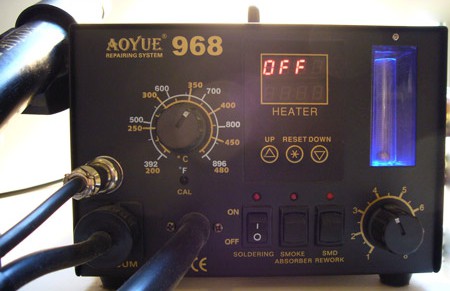
Tools: Aoyue 968 3-in-1 Soldering And Rework Station

The $10 “fire-starter” is the most common beginner soldering iron. These are simple irons with a hot end, a handle, and little else. There’s no temperature control or indication. Despite their simplicity, they’ll do just about anything. You can solder any legged chip type with this type of iron. We used fire-starters in the lab for years.

Eventually, we wanted a hot air rework tool to salvage SMD parts and solder QFN chips. Aoyue is a relatively unknown Chinese brand that makes soldering stations very similar in appearance and function to Hakko. Aoyue stations are recommended and used by Sparkfun Electronics, something that factored heavily in our decision to buy an Aoyue. Read more about our experiences with this tool after the break.

Continue reading “Tools: Aoyue 968 3-in-1 Soldering And Rework Station”

Non-von1 Supercomputer

nonvon_box_small_comp

[Chris] sent us this project, where he built a tiny supercomputer called the Non-von1. Wanting a supercomputer, but lacking space and funds, he opted to go after the supercomputers of the 80s. His system was patterned after the “Von Neumann” systems developed at Columbia university. His system has 31 8 bit processors to crunch numbers for him. The whole unit communicates with the computer using a19.2 kbps serial link.  He does talk about its limited capabilities, stating that he could use it as a way to store roughly half of his cell phone’s phonebook. This reminds us of the Basic stamp supercomputer we covered back in November.