Rear Projection TV Multitouch

proj

[Dave] sent us these fantastic instructions on how to hack a rear projection tv to be a multitouch interface. They’ve converted a 67″ inch TV by adding a couple of PS3 eye cameras and an infrared laser plane. There’s lots of great information, like how to replace the lenses on the PS3 eye cameras and how to create the custom fittings needed to make it all fit nicely. You can download the code, but it is Mac only.  They claim that this is the first conversion of a commercial rear projection TV to multitouch, but we know better. You can see a video of it in action after the break.

Continue reading “Rear Projection TV Multitouch”

Flexible Circuit Valentine

valentine

[xander] built this LED valentine for his loved one. It’s interesting because he used Pyralux, a flexible circuit board material from DuPont. He describes the consistency as “tough plastic tissue-paper”, but had no trouble using standard toner transfer etching. It has an ATtiny45 microcontroller that pulses the 16 LEDs at an approximation of his heart beat. To avoid soldering a bunch of surface mount resistors, he used two constant current shift registers.

Voice Controlled Home Automation

stephanie

[Brian] sent in this writeup on his voice controlled home automation system. Starting with the Microsoft SAPI, a voice recognition system, he programmed some basic home automation. In a move that makes this project decidedly more awesome, he decided to build a physical representation of his automation system. This disembodied head is “Stephanie”. She responds to her name, has an articulated jaw that moves with the syllables in the words, and even ejects her “brain tray” on command. We want one.

There is lots of information on his site about the circuitry involved, as well as source code and a video. You can see the video after the break.

Continue reading “Voice Controlled Home Automation”

Tools: Smart Tweezers

We’re big fans of surface mount parts. SMD components are cheaper, take less board space, and don’t require drilling; all the coolest new parts are only available in SMD packages.

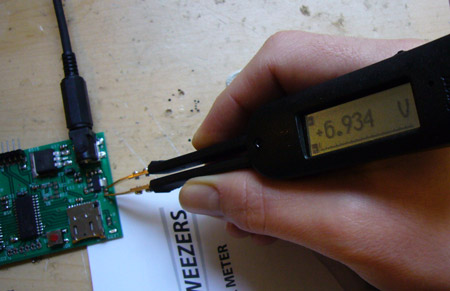
Smart Tweezers are an advanced multimeter tool specifically designed to test and troubleshoot SMD circuits. It automatically identifies resistors, capacitors, and inductors, and displays the relevant measurements. Advanced Devices sent us a pair of Smart Tweezers to review. We used them while building our last few SMD projects, read about our experience with this tool after the break.

Continue reading “Tools: Smart Tweezers”

Missile Launcher, IPhone Interface

[youtube=http://www.youtube.com/watch?v=htd3s50Zhk8]

[Pedram] Sent us his USB missile launcher interface project. He happened to have some of the USB missile launchers lying around. having lost their initial draw, he wanted to do something to spice it up. He wrote an interface in python so he could control the launcher via his iPhone. We don’t see how this is any different than controlling them by the computer, but he seems to have put a decent amount of work into it.

Vaio P HSDPA Mod

sim

[tnkgrl] has concluded her Sony Vaio P by adding GSM support. We covered the switch to XP earlier, but this should work on Vista too. The Vaio P is sold in the US with support for Verizon’s EVDO wireless broadband, but it uses the same hardware as the European model that uses GSM. This is possible because of the the Qualcomm Gobi radio module. To get GSM support, you trick the VZAccess Manager into loading a different firmware than the stock EVDO. The difficult part is that the Vaio P doesn’t come with a SIM card slot, so you’ll have to solder in your own. When you’ve got the computer reassembled, just change VZAccess Manager to use your carrier.

UPDATE: Wired has an article on the Gobi chipset.

MCU Controllable Camera Mount

head

[psymansays] needed a panning head for his robotics projects. Already being familiar with the NXP LPC2148 from work, so he wanted to use that to control it.  he built his own carousel out of old CDs. The axle of the carousel is a potentiometer. This is what he’s using to determine position. The gear motor was actually cobbled together with bits from a windup toy and an old motor. This may be a bit bulky, but it seems not only functional, but fairly versatile.