We’ve seen numerous products geared toward tracking the location and activities of your pets, two in the last month, but we feel sure you can make more functional devices than those you can purchase. Let’s look at a few and consider our options.
Intervalometers And Timelapse Photography
Time lapse photography can seem out of reach for many of us who don’t have fancy cameras(or a hacked cannon point and shoot). We recently covered using a TI-83 as a timer, and now we’ve gathered a collection of DIY intervalometers to help you get clicking.
Up first, for those of you who don’t want to dismantle your camera, here are some mechanical ones that will work on any camera.
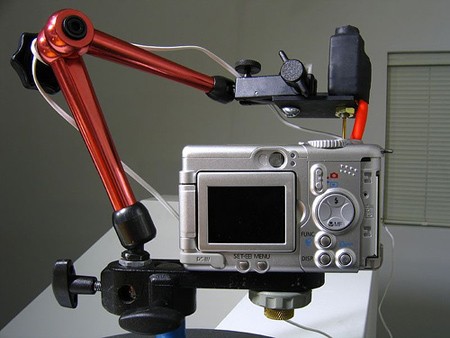
[Simplesimon] has done a fantastic job with this integrated system pictured above. He’s added an adjustable solenoid to click the shutter release. By including a second kit board to handle an RF remote, it has remote single shot capabilities too!
Continue reading “Intervalometers And Timelapse Photography”
Laser Exposing PCB Resist
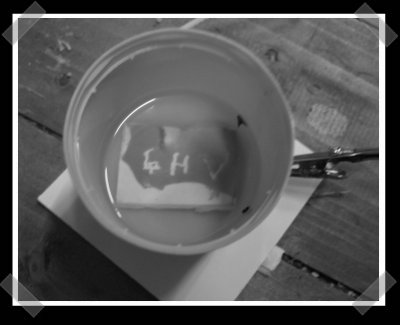
[andre] sent in his first attempt at using a HD-DVD laser diode to expose photosensitive resist to create PC boards. We’ve been meaning to give this a shot with the ol’ Epilog laser cutter. For the test, he coated the board with some resist and hand exposed it with the laser. Finally, he etched it with some sodium hydroxide.
Touchkit – IR Multitouch Screen
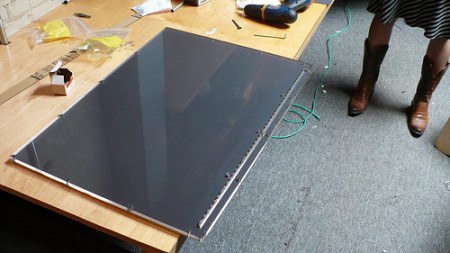
If you’ve got an extra grand laying around, you can pre-order one of [nortd]’s touchkits. It features a unique custom made acrylic screen with a crap ton of IR LEDs embedded in it. An included IR camera provides the input and a projector (you get to supply your own) is used to light the surface. We mentioned this in our multitouch roundup and you can find a video of it embedded after the break.
Microwaving RFID Cards

Buzzsurf microwaved an RFID card so you don’t have to. Pointless, but real, unlike those piles of $20s.
[via Synaptic Seepage]
Nokia Haptikos Patent Application Reveals Its Technology
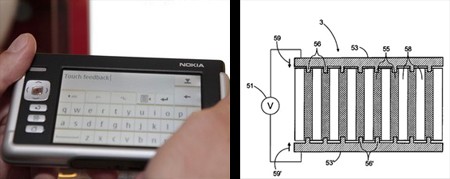
We’ve been waiting for more information on the Nokia Haptikos, the haptic feedback touchscreen announced last October and largely forgotten until now. We knew that it would be a device that could raise sections
of its touchscreen to simulate the feel of buttons or keys, we just weren’t sure how Nokia would pull that off.
Now we have a better idea, as Nokia’s recent patent filing for the Haptikos gives away some juicy details.
The secret behind the device’s feedback is a “plurality of closely spaced voltage controllable protuberances,” or in other words, several small fluid filled compartments just under the screen’s surface. Under them are several piezoelectric members that can be controlled independently; when they extend upward, they apply pressure to the fluid compartments, raising the surface of the screen in that area.
Nokia has yet to work out all the kinks, but you can see the parts that do work by downloading the Haptikos patent application (PDF file).
[via Engadget]
Guide To Creating Small Planets

We at Hackaday often dream of having our own personal planets where we wouldn’t have to deal with other people, but our spaceships aren’t quite ready. While we figure that out, you can do the next best thing: render small planets using Photoshop or GIMP with a few other graphics apps and this guide to making small planets like the one pictured above.