DIY Filament: The Filabot Wee

filabotwee

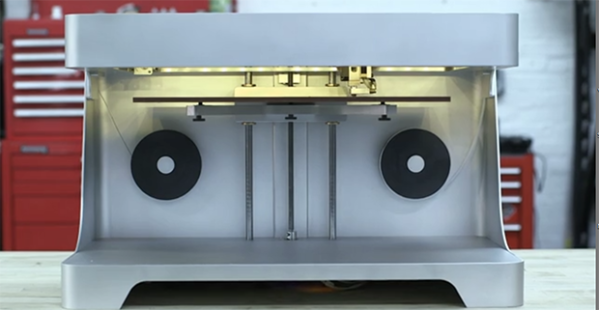
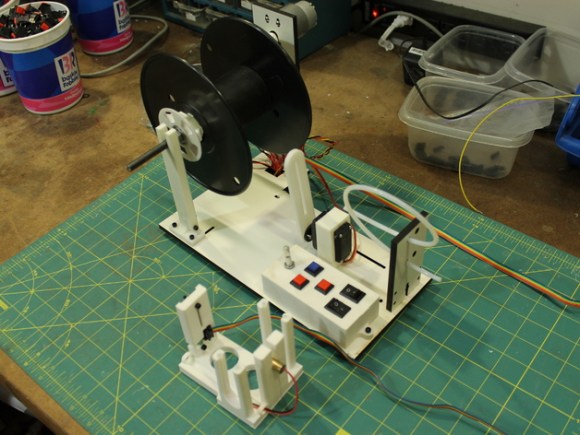
Now there’s yet another option for making your own 3D printer filament: the Filabot Wee. It looks like their once open source model that they pulled from Thinigiverse earlier this year has received a significant makeover, though we aren’t sure what parts may have changed. (EDIT: Filabot says the Wee is still open source, and that once they’ve updated the files they will be available again.)

As you would expect, the Wee has a PID temperature controller and is capable of extruding both ABS and PLA pellets into either 1.75mm or 3mm-diameter filament. Speed varies depending on materials and thickness, but can reach 5 to 20 inches per minute of filament extrusion. Though the Filabot gang is selling the extruder as a kit, you can probably save a few bucks if you have access to a laser cutter and some other basic materials.

You should expect to spend more for Filabot parts ($649) than you would for the original Lyman extruder, though perhaps a more fair comparison would be the new third version of the Lyman extruder, whose bill of materials approaches $900. Considering Lyman’s recent comments that indicate an extrusion rate of 40-50 inches per minute, the extra bucks may be worth it. You can check out a demonstration video of the Filabot Wee after the break.

Continue reading “DIY Filament: The Filabot Wee”

A Six Part CNC Machine

CNC

CNC machines are impressive pieces of kit. We’re all for seeing the big, burly, impressive machines, but there’s something to be said about seeing how small they can get. [Jay] has what is probably the most minimal CNC plotter we’ve ever seen, built from only six 3D printed parts.

[Jay]’s plotter is based on the Piccolo, an exceedingly small-scale CNC platform that can be built for $70 with laser-cut parts. This version, though, uses only six parts that can be downloaded from Thingiverse. Powered by an Arduino and two micro servos, this CNC plotter would be a great introduction to CNC for any robotics club or hackerspace tutorial series.

[Jay] has been doing some awesome work with CNC plotters; we saw his large format Plotterbot earlier this month, and his giant plotted HaD logo with HaD infill poster was a great submission to our Trinket contest.

Video of [Jay]’s plotter in action available after the break.

Continue reading “A Six Part CNC Machine”

3D Printering: Wherein ABS Is Dangerous

printering

A lot of the ‘prosumer’ – for as much as I hate that word – 3D printers out there like the Makerbot Replicator and countless other Kickstarter projects only officially support PLA filament. This has a few advantages from a product development standpoint, namely not necessitating the use of a heated build plate. There are other reasons for not supporting ABS and other filaments, as one of the Kickstarter updates for the Buccaneer printer elucidates (update available to backers only, here’s a mirror from somebody on reddit).

The main crux of the Buccaneer team’s decision not to support ABS is as follows:

We spoke to our legal counsel about it and they told us that if we officially support a certain “material” type then our printer has to go through massive certification to prove that it is totally safe to use or we will/can get sued badly.

Despite the Buccaneer team’s best efforts, we’re sure, their lawyers were actually able to find some studies that showed ABS could affect a person’s health. The issue isn’t with the ABS itself – LEGO are made of ABS and kids chew on blocks all the time. The issue comes from the decomposition of ABS when it is heated.

Continue reading “3D Printering: Wherein ABS Is Dangerous”

Google Glass? How About This Home-brew Solution?

[Codeninja] has been sending us some great hacks over the years, and we’ve just learned that his attention has been on building wearable computers lately! He’s currently on his third iteration of a Google Glass-like prototype, which features a motorized element which allows for the retraction of the screen.

There’s not too much info on his blog about them, but we do know he’s using a Raspberry Pi, a few small servos, and a pico LCD screen. Most of the frame is 3D printed, and it also features a hidden camera, accelerometers, and a few environmental sensors.

He’s uploaded an animated gif of the mechanism that moves the display away from his eye, and it looks straight out of some science fiction movie — check it out after break!

Continue reading “Google Glass? How About This Home-brew Solution?”

3D Printed Velcro

Velcro

With new materials comes new possibilities in fabrication, and with 3D printers, this observation is no different. In the past year or so, there have been a few very interesting new filaments that have come into mainstream use – a printable sandstone, high impact polystyrene, and a flexible PLA. When [Rich] saw a bike light that had an integrated hook-and-loop fastener – think Velcro – built in to its enclosure, he thought to himself, ‘I could do that too.’

[Rich]’s “ElastoStraps” are printed with Makergeek’s Flexible PLA, and the entire device works surprisingly similar to other hook and loop fasteners with a registered trademark. The design is up on Thingiverse, and since the object was designed with OpenSCAD, the 3D printed Velcro can also be opened up in the Customizer for hook-and-loop straps that perfectly suit your needs.

Why You Shouldn’t Care About The All-Metal 3D Printed Gun

Solid Concepts, one of the world’s largest rapid prototyping outfits, just printed a gun. Unlike previous 3D printed guns like the Liberator, this 3D printed version of an M1911 is made out of metal. It’s a real gun, with rifling in the barrel – something the Liberator doesn’t have – and has the look and feel of what the US military has been using as a service pistol for decades.

The Solid Concepts 1911 was made using the selective laser sintering process, using a combination of stainless steel and nickel-chromium alloys. Every single part of the gun, save for the spring, was 3D printed without any machining. It’s an impressive feat of rapid manufacturing – firing .45 ACP rounds, this gun will see 20,000 psi every time the gun is fired. It’s already chewed through a few magazines so far, and it apparently shoots pretty well, to boot.

Here’s why you shouldn’t care.

Solid Concepts business is to make things using rapid prototyping. They make everything from plastic baubles, tooling for injection molds, architectural models, and stuff that doesn’t get past the prototype stage. This 3D printed 1911 is simply a demonstration of Solid Concept’s capabilities, nothing more.

The printer used to manufacture this printer is an EOS SLS printer that costs many tens of thousands of dollars. Our limited research can’t pin the price of the printer down more than that, but let’s just say you could buy a very, very nice sports car for the same price, and we’re not talking about that awesome ‘vette down at the Chevy dealership.

This is just a neat little advertisement, that’s it. Someone at Solid Concepts realized if they made a gun using 3D printed parts, it would be picked up by blogs and wire services. They were right. It’s an excellent demo of what Solid Concepts’ capabilities are, but that’s just about it. You’re still not able to manufacture an M1911 on a desktop 3D printer, and even if you could, you could set up a machine shop in your garage and end up with a similar product for less money.

As an aside, and this is just me throwing an idea out there, can we please stop using guns as an example of what 3D printing can do? I respect your right to manufacture, own, and operate a gun, but as I write this paragraph, I’m cringing at the thought of all the pro and anti-gun comments this post will see.

If you’re looking for a way to demonstrate your 3D printing prowess, how about something like an engine? Given the right design, they’re more complicated than a gun, and a really small Wankel engine would be really cool.

Video of the Solid Concepts 1911 available below.

Continue reading “Why You Shouldn’t Care About The All-Metal 3D Printed Gun”

3D Printing With Metal… At Home!

[Bam] from the LulzBot forums  has successfully printed metal using his 3D printer and a Budaschnozzle 1.1 hot end. Well, solder to be specific — but it’s still pretty awesome!

He’s making use of 3mm solder purchased from McMaster (76805a61), which has a blend of 95.8% tin, 4% copper and 0.2% silver. It took quite a few tries to get it extruding properly, and even now it seems to only be able to print about 15mm before jamming up — a more specific hot end with a larger thermal mass might help. He plans on trying a thinner filament (1.75mm) as it might help to keep it at the proper extrusion temperature, which in this case is around 235C.

During our research we found another user from the RepRap blog who has also been experimenting with printing low-melt point alloys — and he’s even successfully created an Arduino compatible Sanguino board using the printer!

If you want to try this yourself, you’ll need a nozzle you don’t care about, bored out to about 1mm — any smaller and it won’t extrude at all. Be warned though, the solder will corrode brass and aluminum, and [Bam] notes that after going through 1lb of solder, the nozzle was closer to 2mm in diameter when he was done! Oh and for the love of hacking — use ventilation!

Stick around after the break to watch a video on a professional version of this system — which is essentially a repurposed welding robot, using electron beam direct manufacturing. These technologies can’t make nicely finished parts, but they excel when considering they can make near net-weight parts, requiring only a small amount of machining to finish.

Continue reading “3D Printing With Metal… At Home!”