Fail Of The Week: Arduino Sand Matrix Printer

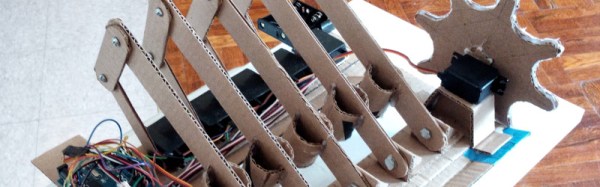
NYC beaches are where tropical beaches addicted to meth go to die. So says [Vije Miller] in his write-up for his Arduino sand matrix printer. It’s a clever idea, five servo-operated cardboard plungers that indent a pattern of dots in the sand as the device is pulled forward, resulting in something not unlike a dot matrix printer that can write messages in the sand.

He’s submitted it to us as a Fail Of The Week, because it doesn’t do a very good job of writing in the sand, and it’s burned out a servo. But we feel this isn’t entirely fair, because whether or not it has delivered the goods it’s still an excellent build. Cardboard isn’t a material we see much of here at Hackaday, but in this case he’s mastered it in a complex mechanism that while it may have proved a little too flexible for the job in hand is nevertheless a rather impressive piece of work.

You can see a brief video below the break showing it in action. He tells us his motivation has waned on this project, and expresses the hope that others will take up the baton and produce a more viable machine.

Continue reading “Fail Of The Week: Arduino Sand Matrix Printer”

Friday Hack Chat: Making In Shenzhen

China is an amazing land of opportunity, and if you want to build anything, you can build it in Shenzhen. This city that was just a small fishing village a few decades ago has grown into a cyberpunk metropolis of eleven million and has become the manufacturing capital of the world. You’re probably reading this on a device made somewhere around Shenzhen.

For this week’s Hack Chat, we’re going to be talking about manufacturing in Shenzhen. We’re bringing in a very special guest for this one: [Naomi Wu] is a Cantonese DIY maker, professional web dev, transhumanist, electronics reviewer, occasional Hackaday contributor, vlogger, 3D printerer, advocate of women in STEM, SexyCyborg, and a riot on Twitter. [Naomi] also lives and works in Shenzhen, and is tapped into the DIY and maker culture there. She’s created 3D printed pen testing shoes, a Raspberry Pi cosmetics case, and infinity skirts.

This Friday (or Saturday, depending on which side of the date line you’re on), [Naomi] is going to be talking about manufacturing, making, DIY, and Shenzhen culture. Of particular interest will be electronics purchasing and manufacturing in Shenzhen, designing wearable projects with an emphasis on power and thermal design, documenting projects, and Shenzhen culture. This is basically an AMA, so if you have any questions you’d like to ask, throw them up in this spreadsheet.

Here’s How To Take Part:

join-hack-chatOur Hack Chats are live community events on the Hackaday.io Hack Chat group messaging. Hack Chats are usually at noon, Pacific time on Friday. This week we’re doing the Hack Chat a little later, because timezones. This week’s Hack Chat will be at 6 pm PDT Friday / 9 am CST Saturday. Confused? Here’s a time and date converter!

Click that speech bubble to the right, and you’ll be taken directly to the Hack Chat group on Hackaday.io

You don’t have to wait until Friday; join whenever you want and you can see what the community is talking about.

How To Do PCB Art In Eagle

Last month I had the pleasure of creating a new piece of hardware for Tindie. [Jasmine], the queen bee of Tindie, and I designed, developed, and kitted three hundred Tindie badges in ten days leading up to DEF CON. The badges were a complete success, they introduced soldering to a lot of people, and were loved by all.

This badge was such a rousing success, it’s now official Tindie swag. We’ll be handing out a few of these blinky badges at upcoming events. But as of right now we’ve already handed out our entire stock, that means we need to build more. The second run meant ordering a thousand PCBs.

We could just do another run, and order a few more PCBs from the Gerbers I’ve already designed. I’m not really happy with the first version of this badge, though, and this is an opportunity to improve my design. This also gives me an opportunity to demonstrate my workflow for creating artistic boards in Eagle.

Effectively, what I’ll be demonstrating here is the creation of the Benchoff Nickel. A few months ago, [Andrew Sowa] took a portrait of yours truly, changed the colors to what is available on a normal OSHPark PCB, and turned that into different layers in KiCad. There are a few differences here. Firstly, I’ll be using a blue solder mask, although the same technique can be applied to green, red, yellow, white, or black soldermask. Secondly, this is Eagle, and I’m going to do the majority of the work with a BMP import. This is the fast and easy way to do things; if you want a KiCad tutorial, check out [Andrew]’s work, or my overly-involved multiple silkscreen process for KiCad. I don’t recommend this overly-involved process if you can help it. It took 20 hours to do the art for my previous project in KiCad, and I estimate it would have taken two in Eagle.

With that said, here’s the easy, cheap, and fast way of doing artistic boards in Eagle.

Continue reading “How To Do PCB Art In Eagle”

Ourselves As Others See Us Through The Lens Of Traditional Media

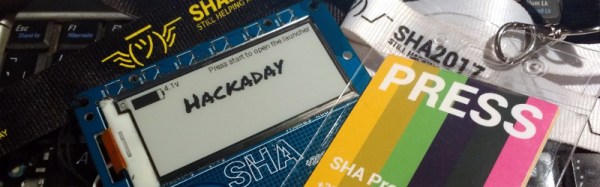
When I presented myself at the SHACamp 2017 info desk bright and early on the first full day of the camp, I was surprised to find that I was to be assigned a volunteer along with my press badge. Because of the way our community is sometimes covered by the traditional media, it was necessary that any journalists touring the site have a helping hand to ensure that they respect the privacy of the attendees, gain permission from people likely to be in any photographs, and generally not be idiots about the whole Hacker thing. I pointed out that I was working for Hackaday and not The Sun, and that as an active hackspace member and former hackspace director I was very much a part of the community attending SHA 2017 who would simply be wasting the valuable time of any volunteer assigned to me. Fortunately for the next volunteer in line they agreed with my point of view, so one of the angels was spared a day of my breakneck walking pace and impenetrable British colloquialisms.

It’s interesting therefore a few weeks after the event, to investigate how it was portrayed through the eyes of people who aren’t coming as Hackaday is, from within the bubble. To take a look at that disconnect between what we know about our community and its events, and how the traditional media sometimes like to portray us. Are they imagining the set of a Hollywood “hacker” movie in which assorted geniuses penetrate the computer systems of various international institutions by the simple expedient of banging wildly at a keyboard for a few seconds, or will the reality of a bunch of like-minded technology enthusiasts gathering in a field for several days of tinkering and other fun activities be what makes their reports?

Continue reading “Ourselves As Others See Us Through The Lens Of Traditional Media”

Hackaday Links: August 27, 2017

Hulk Hands! Who remembers Hulk Hands? These were a toy originally released for the 2003 Hulk movie and were basically large foam clenched fists you could wear. Hulk Hands have been consistently been re-released for various Marvel films, but now there’s something better: it’s the stupidest tool ever. Two guys thought it would be fun and not dangerous at all to create cast iron Hulk Hands and use them as demolition and renovation equipment. This is being sold as a tool comparable to a sledgehammer or a wrecking bar.

New Pogs! We’re up to 0x0C. Is your collection complete?

[Peter] is building an airplane out of foam in his basement. He’s also doing it as a five or six-part series on his YouTube channel. Part two is now up. This update covers the tail surfaces, weighing and balancing the fuselage, and a general Q&A with YouTube comments.  Yes, [Peter] still has a GoFundMe up for a parachute, and it’s already about half funded. With any luck, he’ll have the $2600 for a parachute before he builds the rest of the plane. Another option is a ballistic parachute system — a parachute for the whole plane, like a Cirrus. That would be a bit more than $4000, so we’ll see how far the GoFundMe goes.

Hey, remember the Nvidia Jetson TX1? It’s a miniATX motherboard running a fast ARM core with a GPU housing 256 CUDA cores. It’s cool, and the new version — the TX2 — is designed for ‘machine learning at the edge’. They’re on sale now, for only $199.

Primitive Technology has another video out. This time, he’s improving his bow string blower into something that kinda, sorta resembles a modern forge. This time, the experiment was a success when it comes to pottery — he’s now able to fire clay at a much higher temperature, bringing him reasonably close to modern ceramics. At least, as close as you can get starting with the technology of a pointed stick. The experiment was marginally successful when it came to creating iron. He’s using iron-bearing bacteria (!) for his source of ore and was able to smelt millimeter-sized pellets of iron. This guy needs a source of copper or tin. Zinc is also surprisingly possible given his new found capabilities for ceramics.

We’re Hiring

Hackaday has been expanding into all kinds of new areas. We find ourselves stretched a bit thin and it’s time to ask for help. Want to lend a hand while making some extra dough to plow back into your projects? These are work-from-home (or wherever you like) positions and we’re looking for awesome, motivated people to help guide Hackaday forward!

Contributors are hired as private contractors and paid for each post. You should have the technical expertise to understand the projects you write about, and a passion for the wide range of topics we feature. If you’re interested, please email our jobs line, and include:

  • Details about your background (education, employment, etc.) that make you a valuable addition to the team
  • Links to your blog/project posts/etc. which have been published on the Internet
  • One example post written in the voice of Hackaday. Include a banner image, at least 150 words, the link to the project, and any in-links to related and relevant Hackaday features

What are you waiting for? Ladies and Gentlemen, start your applications!

Ask Hackaday: Saving The World With Wacky Waving Inflatable Arm Flailing Tube Men

This is a solution to global warming. This solution will also produce electricity, produce rain in desertified areas, and transform the Sahara into arable land capable of capturing CO2. How is this possible? It’s simple: all we need to do is build a five-kilometer tall, twenty-meter wide chimney. Hot air, warmed by the Earth’s surface, will enter the base of the chimney and flow through turbines, generating electricity. From there, air will rise through the chimney, gradually cooling and transferring energy from the atmosphere at Earth’s surface to five kilometers altitude. This is the idea behind the Super Chimney, It’s an engineering concept comparable to building a dam across the Strait of Gibraltar, a system of gigantic mirrors in Earth’s orbit, or anything built under an Atoms for Peace project. In short, this is fringe engineering.

This is also, ‘saving the world with wacky waving inflatable arm flailing tube men.’

The idea of building tens of thousands of fabric chimneys, placing them all around the globe, and cooling the Earth while sequestering carbon dioxide is fantastic. Ideas are simple, implementation is something else entirely. There are also obvious problems with the physics presented in the Super Chimney presentation, but these problems don’t actually make a Super Chimney impossible. We need more eyes on this, so we’re opening this one up as an Ask Hackaday. What do you think of this audacious scheme, and is it even possible?

Continue reading “Ask Hackaday: Saving The World With Wacky Waving Inflatable Arm Flailing Tube Men”