1964 300baud Modem Surfs The Web

[youtube=http://www.youtube.com/watch?v=X9dpXHnJXaE]

[phreakmonkey] got his hands on a great piece of old tech. It’s a 1964 Livermore Data Systems Model A Acoustic Coupler Modem. He recieved it in 1989 and recently decided to see if it would actually work. It took some digging to find a proper D25 adapter and even then the original serial adapter wasn’t working because the oscillator depends on the serial voltage. He dials in and connects at 300baud. Then logs into a remote system and fires up lynx to load Wikipedia. Lucky for [phreakmonkey] they managed to decide on a modulation standard in 1962. It’s still amazing to see this machine working 45 years later. He’d love to hear from you if you’ve used a similar device.

[via Waxy]
Global Hackdays: Tangible Interfaces

[vimeo=4138521]

June 6th is the date of the upcoming Global Hackday. This time, focusing on cheap tangible interfaces, mainly trackmate. They want as many people to join as possible, even if you’re not comfortable with code. We’ve covered the construction of the trackmate surface before, now build one and get in there and contribute.

Katamari Controller

[blip.tv ?posts_id=2164793&dest=-1]

Remember those days, back in the arcade, where games with a unique control scheme also had a controller best suited for them? There were rolling balls, joysticks, dials, all sorts of inputs. Consoles have maily relied on their standard controllers, relegating alternative inputs to be strange collectors items. Some games just need a specialized controller though. For example, Katamari Damacy. [Kellbot] has made one that we think suits the game very well.

Soldering Headphone Wire

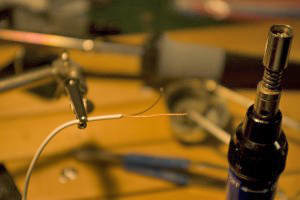
Many people find themselves frustrated when working with headphones. The tiny coated wire can be a real pain to work with. They are so very very small, and usually coated.  We generally just end up doing a quick “sand and tape” which just isn’t very high quality.  [Alex] sent in some tips that can really help you get those repairs or modifications going.

Custom Motorcycle Display

motorcycle_display

[fibra] has been slowly building a custom controller for his motorcycle. It’s an automated chain oiling system that varies application based on RPM. The LCD can show wheel RPM, voltage, time, date, air, and engine temperature. A separate driver board has a MOSFET for controlling the oiling valve. The real gold here is the attention to detail. He built a one off circuit board. The case is laser cut acrylic that he then shaped. The box is molded smoothly into the original instrument cluster using epoxy. It’s excellent work that could be mistaken for a commercial product.

Keyboard Pants

kbpants

[Zach] sent us a link to his keyboard pants. Frankly, we were astonished, not only by his craftsmanship, but by the fact that we were working on a pair ourselves. Admittedly his are much better looking and ours will probably never be finished. The inspiration for both his and ours, was this sloppy version. [Zach’s] pair have been cut in half, and he never really found a convenient way to reconnect the two halves, so only the left works. Watch this video to see him playing some Tetris in his awesome shorts.

Mud Tub: A Tactile Computer Interface

mud

[Tom Gerhardt] has made this very interesting mud interface for a computer.  Follow the link to see a video of it in action. It appears as though he’s using a laser grid of some kind to establish elevation. We might be way off on that though, there aren’t any details on the construction. He does mention that it is an open source hardware and software project, so maybe the details are available on request. In the video you can see it running as a projection surface where people are interacting with items directly on the mud. You can also see it being used as an external input device. People play Tetris using it in that example.

UPDATE: [Moon] reports from the ITP show that the tub has a 16×12 grid of generic pressurs sensors on the bottom. These feed into a MacBook Pro which is projecting on the surface. Despite the sparse grid, [Tom] says he gets good resolution by interpolating between sensors; it can detect a resting hand pivoting on the surface.