A 6502 All In The Data

Emulating a 6502 shouldn’t be that hard on a modern computer. Maybe that’s why [lasect] decided to make it a bit harder. The PG_6502 emulator uses PostgreSQL. All the CPU resources are database tables, and all opcodes are stored procedures. Huh.

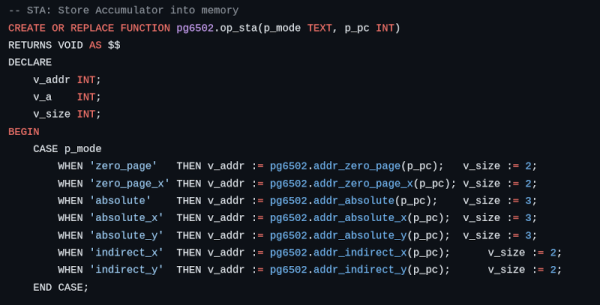
The database is pretty simple. The pg6502.cpu table has a single row that holds the registers. Then there is a pg6502.mem table that has 64K rows, each representing a byte. There’s also a pg6502.opcode_table that stores information about each instruction. For example, the 0xA9 opcode is an immediate LDA and requires two bytes.

The pg6502.op_lda procedure grabs that information and updates the tables appropriately. In particular, it will load the next byte, increment the program counter, set the accumulator, and update the flags.

Honestly, we’ve wondered why more people don’t use databases instead of the file system for structured data but, for us, this may be a bit much. Still, it is undoubtedly unique, and if you read SQL, you have to admit the logic is quite clear.

We can’t throw stones. We’ve been known to do horrible emulators in spreadsheets, which is arguably an even worse idea. We aren’t the only ones.

New Display For Old Multimeter

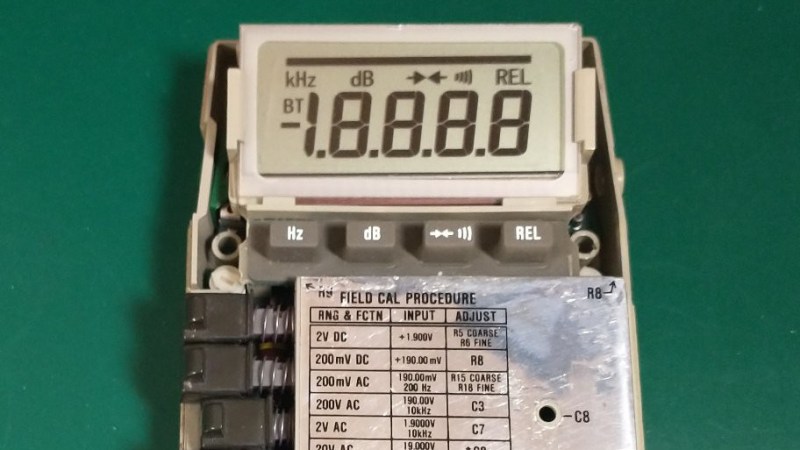
As a company, Fluke has been making electronic test equipment longer than the bipolar junction transistor has been around for. In that time they’ve developed a fairly stellar reputation for quality and consistency, but like any company they don’t support their products indefinitely. [ogdento] owns a Fluke meter that isn’t nearly as old as the BJT but still has an age well outside of the support window, and since the main problem was the broken LCD display they set about building a replacement for this retro multimeter.

Initially, [ogdento] had plans to retrofit this classic multimeter with a modern OLED, but could not find enough space for the display or a way to drive it easily. The next attempt to get something working was to build a custom one-off LCD using a drill press as an end mill, which didn’t work either. But after seeing a Charlieplexed display from [bobricius] as well as this video from EEVblog about designing custom LCDs, [ogdento] was able to not only design a custom PCB and LCD display to match the original meter, but was able to get a manufacturer in China to build them.

The new displays have a few improvements over the old; mostly they are more stylistically inspired by later Fluke models and have a few modern improvements to the LCD itself. There were are few issues during prototyping but nothing that was too hard to sort out, such as ordering the wrong size elastomeric strips initially. For anyone who needs to replace a custom LCD and can’t find replacement parts anymore, this project would be a great starting point for figuring out the process from the ground up.

ESP32 Weather Display Runs Macintosh System 3

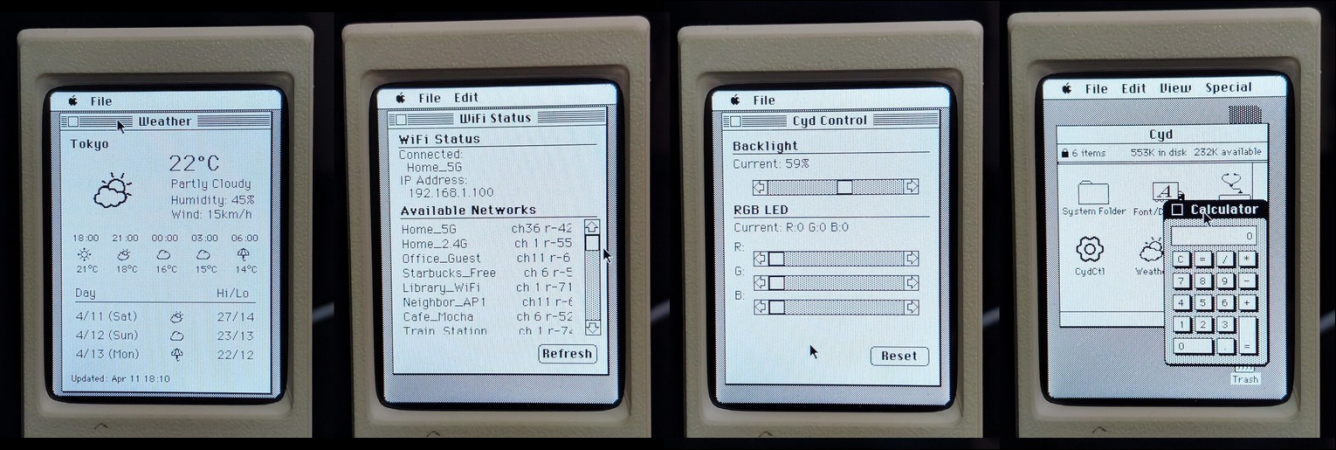
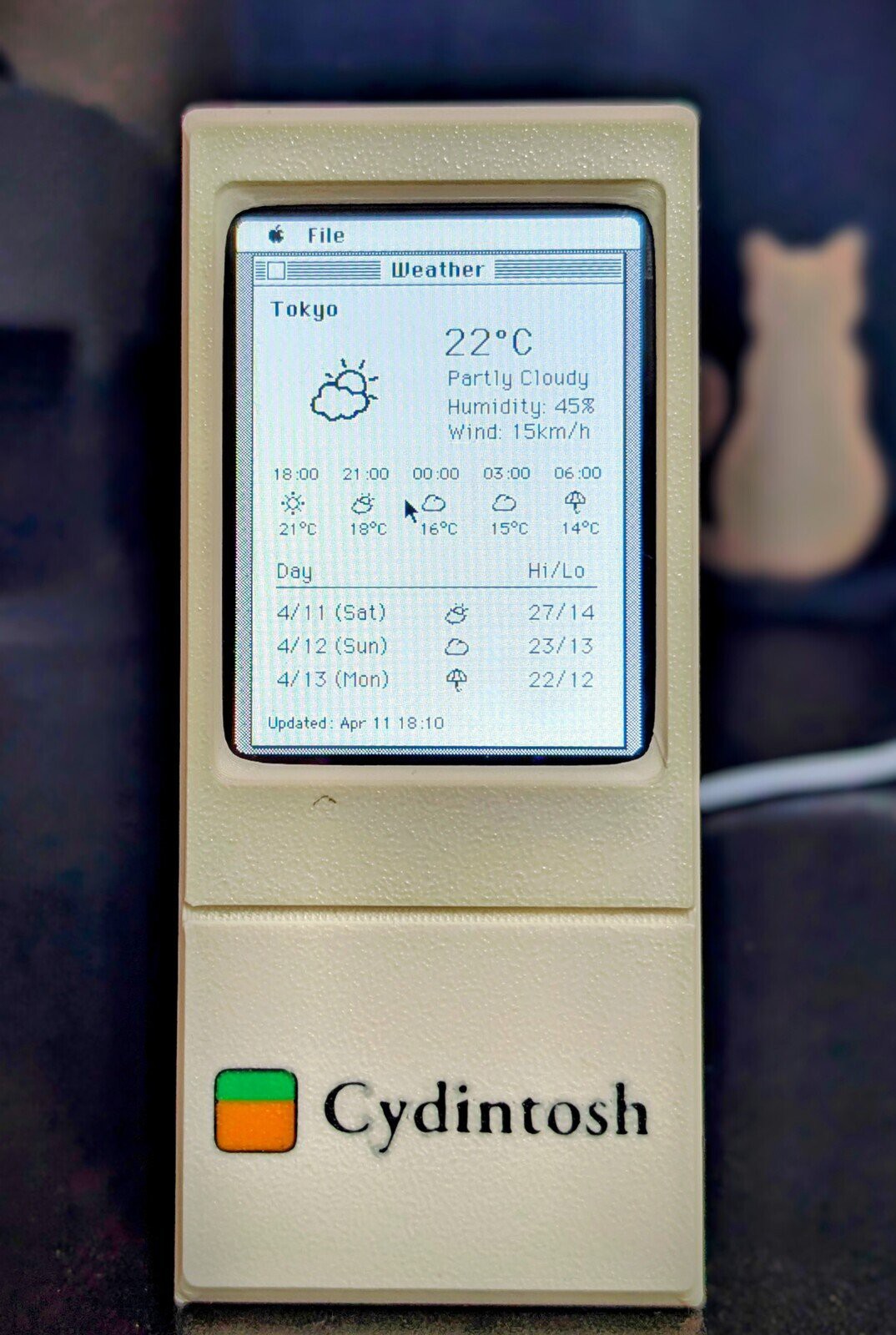
It seems like everybody takes their turn doing an ESP32-based weather display, and why not? They’re cheap, they’re easy, and you need to start somewhere. With the Cheap Yellow Display (CYD) and modules like it, you don’t even need to touch hardware! [likeablob] had the CYD, and he’s showing weather on it, but the Cydintosh is a full Macintosh Plus Emulator running on the ESP32.

Honey, I stretched the Macintosh!

The weather app is his own creation, written with the Retro68k cross-compiler, but it looks like something out of the 80s even if it’s getting its data over WiFi. The WiFi connection is, of course, thanks to the whole thing running on an ESP32-S3. Mac Plus emulation comes from [evansm7]’s Micro Mac emulator, the same one that lives inside the RP2040-based PicoMac that we covered some time ago. Obviously [likeablob] has added his own code to get the Macintosh emulator talking to the ESP32’s wireless hardware, with a native application to control the wifi connection in System 3.3. As far as the Macintosh is concerned, commands are passed to the ESP32 via memory address 0xF00000, and data can be read back from it as well. It’s a straightforward approach to allow intercommunication between the emulator and the real world.

The touchpad on the CYD serves as a mouse for the Macintosh, which might not be the most ergonomic given the Macintosh System interface was never meant for touchscreens, but evidently it’s good enough for [likeablob]. He’s built it into a lovely 3D printed case, whose STLs are available on the GitHub repository along with all the code, including the Home Assistant integration.

Who Had “New OS For The Z80” On Their 2026 Bingo Card?

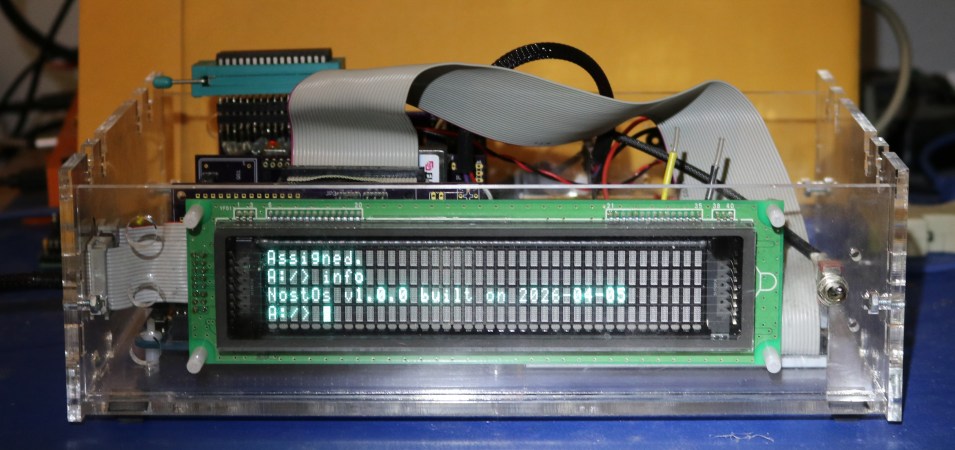
Some might say the venerable Z80 doesn’t need another operating system, but [Scott Baker] obviously disagrees. He has come up with a brand new, from scratch OS called NostOS for the Z80-based RC2014 homebrew retrocomputer. [Scott] describes it as CP/M-like, but it’s not CP/M– in fact, it’s totally incompatible with CP/M–and has a few tricks of its own up its sleeve.

As you might expect of an operating system for this vintage of hardware, it is “rommable” — that is, designed to run from read-only-memory, and fit inside 64kB. It of course supports banking memory to go higher than that 16 bit limit, and natively supports common serial devices, along with the good old WD37C65 floppy controller to get some spinning rust into the game. Of course if you don’t have floppies you can plug in a compact flash card– try that with CP/M– or, interestingly Intel Bubble Memory. [Scott] has a soft-spot for bubble memory, which at one point seemed poised to replace both hard drives and RAM at the same time. We also appreciate that he included drivers for vacuum fluorescent displays, another forgotten but very cool technology. Back in the day, this operating system would have enabled a very cool little computer, especially when you take his implementation of text-to-speech with the SP0256A-AL2 chip. Fancy a game of talking Zork? Yes, he ported Zork, and yes, it talks.

The whole thing is, of course, open-source, and available on [Scott]’s GitHub. Unlike too many open-source projects, the documentation is top-notch, to the point that we could picture getting it in a three-ring binder with a 5 1/4 floppy on the inside cover. If you like video, we’ve embedded [Scott]’s walkthrough but his blog and the docs on GitHub have everything there and more if you’re not into rapidly-flickering-pixels as an information exchange medium.

[Scott] isn’t wedded to Zilog, for the record; this OS should run on an Intel 8080, perhaps like the one in the Prompt 80 he restored last year. 

Thanks to [Scott Baker] for the tip!

Continue reading “Who Had “New OS For The Z80” On Their 2026 Bingo Card?”

Reflecting On Microsoft Windows Vista In 2026

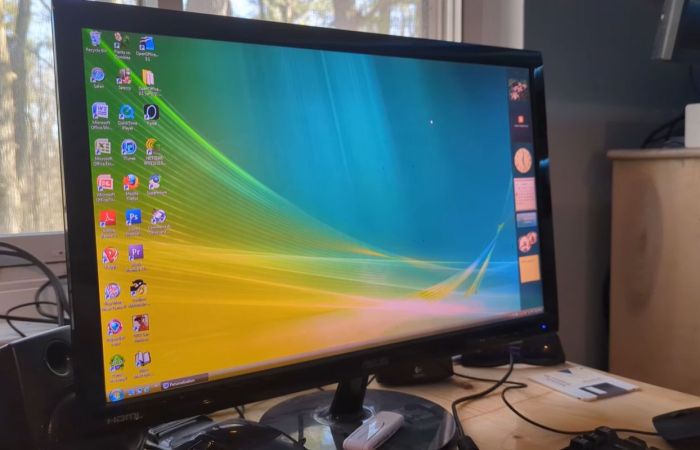
It’s a bit of an understatement that at release Windows Vista rather fell flat. Much of the problem was due to how rushed of a release it was, with incomplete driver support and various glitches in the OS that ought to have been ironed out prior to release. In a retrospective, [SteelsOfLiquid] takes a look at what used to be the most infamous Windows OS until the arrival of first Windows 8 and subsequently the popcorn-fest that is Windows 11.

After a brief re-run of the development history and initial release of Vista, the OS is installed on a Core 2 Duo E8400 with 4 GB of DDR3 and a Geforce 310 card. This being the first NT6-based Windows version (with Microsoft jumping up to version 10 with Windows 10), it’s still got a lot of working software for it in 2026. Some have argued that Windows 7 is basically Vista SE in the vein of Window 98, so it doesn’t face the same software and driver hurdles as e.g. Windows XP does.

Thus the video focuses mostly on the software that was provided with the OS, giving a detailed look at an OS that many of us skipped in favor of sticking to Windows XP to the despair of Microsoft who had to push back that OS’s EOL by a few years as a result. For those of us who joined in the hate-fest against Vista it feels somewhat nostalgic to look back at an experience that in 2026 terms would have been less rough than trying to use Windows 10 or 11 until years of updates made at least the former not entirely terrible to use.

Here’s hoping that Windows 12 will be more of a modern Windows 7, especially in the GUI department, as it’s so nice to have a colorful OS interface with some tasty skeuomorphism rather than monochrome, flat icons.

Continue reading “Reflecting On Microsoft Windows Vista In 2026”

Cleaning An IBM 5150, And The Perfect Period PCB Soldermask

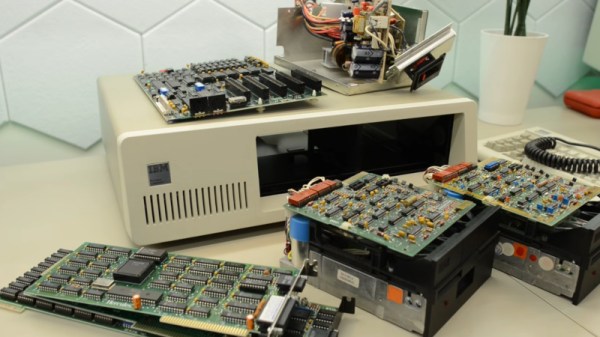
Now that early PCs have moved firmly from the realm of e-waste into being collector’s items, it’s worth putting in some effort to restore them if you find one. [Epictronics] has an early IBM 5150, the ancestor of all today’s PCs, and is bringing it back to life. Along the way, he’s building a replica AdLib sound card, making a useful discovery about how to make new parts look authentic.

The video below the break is a gentle journey through an early PC teardown, followed by the construction of the replica sound card. Here’s the interesting nugget of information: these new cards are careful recreations of the originals, but they just don’t look right. It seems modern soldermask is too shiny, and as luck would have it, there’s another option that is much more period-authentic. We hadn’t noticed matte green was available, but it certainly captures the look of those days much better.

As you might expect, such an old machine has a range of dead capacitors and a few chips. There’s a lucky escape with a Varta battery on an expansion card, having very little leakage, and part of one of the floppy drives needs some surgery. It’s gentle hacking that’s engaging to watch, and of course, at the end, we’re rewarded with the thing booting properly.

You might think reproducing a sound card is unusual, but we’ve seen it a number of times.

Continue reading “Cleaning An IBM 5150, And The Perfect Period PCB Soldermask”

The Smallest Dialup ISP Is A Raspberry Pi And A Prison Phone

There were a plethora of tiny, local ISPs in the days of dial-up internet. Along with the big providers, many cities would have more than one. Some of those have survived broadband, but none of them were as small as [Jeff Geerling]’s Pi ISP — a tiny dialup ISP built so his Aunt’s old G3 MacBook can get online at 36kbps, as God and [Robert Kahn] intended.

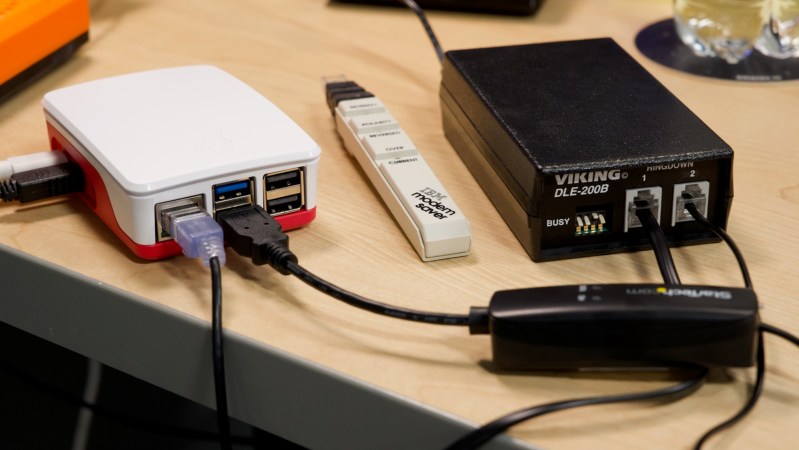
Hardware-wise, the Raspberry Pi is at one end of the chain, and your retrocomputer at another. In between, you’ll have a USB modem plugged into the Pi, and a device called a “two-way line simulator” to create a dial tone for that plain-old-telephone goodness. [Jeff] notes that these were commonly used in prisons for the phones that visitors use to talk to inmates.

Of course, since these devices are designed strictly for voice transmissions, which POTS was built for, you’re not going to get over 36 kbps, and that’s even with high-quality gear. The cheaper options might drop you down to 28k… just like with an ISP back in the day. ‘You get what you pay for’ is very rarely false.

Now, you can use this technology to just connect two computers together — as we’ve featured previously — but [Jeff] has gone the extra mile to put together, via Ansible, an easy-to-install software package that will let the Raspberry Pi act just like your ISP’s servers once did, and connect you to that series of tubes once called the World Wide Web. Of course, the World Wide Web isn’t built for dial-up anymore, so you’re going to be waiting… a while. Hackaday’s front page isn’t especially heavy, weighing about 4MB at the time of this writing, but that’s 15 minutes of load time, and you still aren’t reading the articles.

You also won’t be able to access much on old machines that can’t do HTTPS, but [Jeff] thought of that and bundles [rdmark]’s MacProxyClassic to translate the modern web into HTML tags that Netscape can understand and serve them over HTTP. You’ll still be waiting for our modern bloat, but perhaps not quite so long.

If you want the “authentic” dial-up experience, you’ll need to see the lightweight webpages of Yesteryear, and MacProxyClassic contains a Wayback Machine extension for that purpose. We featured a similar project a while back that did that, but without all the joys of dial-up. Now get off the computer, we’re expecting a call!

Continue reading “The Smallest Dialup ISP Is A Raspberry Pi And A Prison Phone”