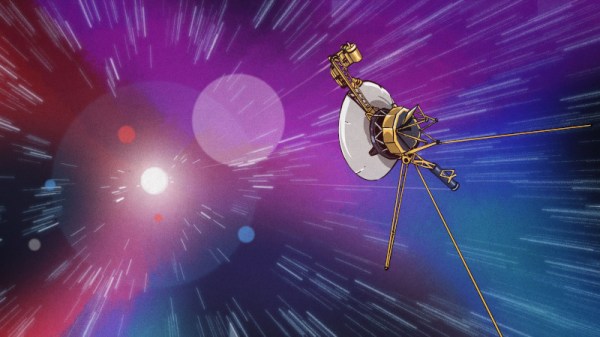
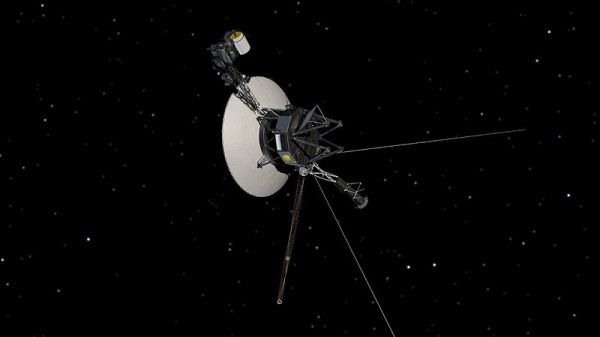
After many tense months, it seems that thanks to a gaggle of brilliant engineering talent and a lucky break the Voyager 1 spacecraft is once more back in action. Confirmation came on April 20th, when Voyager 1 transmitted its first data since it fell silent on November 14 2023. As previously suspected, the issue was a defective memory chip in the flight data system (FDS), which among other things is responsible for preparing the data it receives from other systems before it is transmitted back to Earth. As at this point in time Voyager 1 is at an approximate 24 billion kilometers distance, this made for a few tense days for those involved.
The firmware patch that got sent over on April 18th contained an initial test to validate the theory, moving the code responsible for the engineering data packaging to a new spot in the FDS memory. If the theory was correct, this should mean that this time the correct data should be sent back from Voyager. Twice a 22.5 hour trip and change through Deep Space and back later on April 20th the team was ecstatic to see what they had hoped for.
With this initial test successful, the team can now move on to moving the remaining code away from the faulty memory after which regular science operations should resume, and giving the plucky spacecraft a new lease on life at the still tender age of 46.
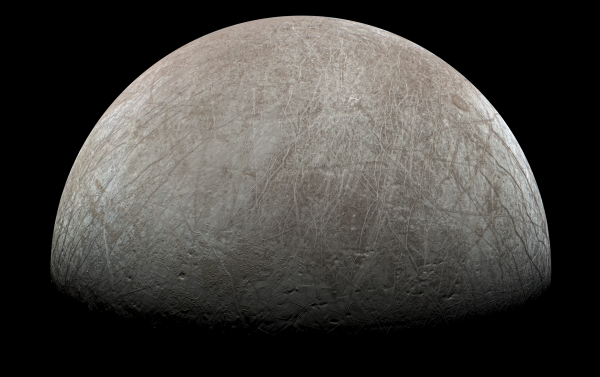
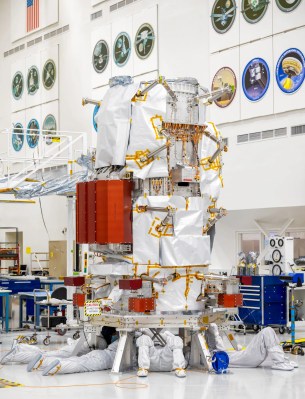 Underneath its icy surface, Europa appears to have a sea that contains twice as much water as we have here on Earth. Launching later this year and arriving in 2030, NASA’s Europa Clipper will provide us with our most up-close-and-personal look at the Jovian Moon yet. In conjunction with observations from the ESA’s Jupiter Icy Moons Explorer (JUICE), scientists hope to gain enough new data to see if the conditions are right for life.