ReactionWare 3D Printed Medicine

The University of Glasgow has released a Chemistry research paper covering the applicational process of printing pharmaceutical compounds.

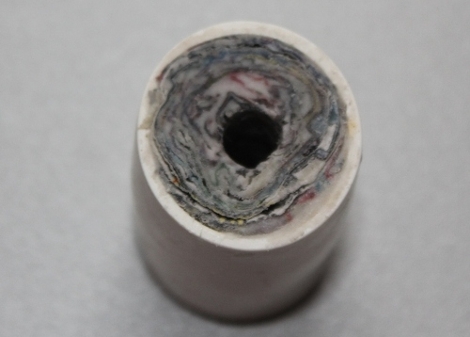
Yes thats correct actually printing medication. Using various feedstock of chemicals they see a future where manufacturing your medication from home will be possible. Using standard 3D printing technology it is possible to assemble pre-filled “vessels” in such a way that the required chemical reactions take place to produce the required medication. This will be like having a minature medication manufacturing facility in your home. The possible implications of this could be far reaching.

There would need to be a locked down software etc or certain chemcials restrictions to prevent the misuse of this technology. Prof [Lee Cronin], who came up with the paper’s principal has called this process “reactionware”

Professor [Cronin] found, using this fabrication process, that even the most complicated of vessels could be built relatively quickly in just a few hours.

[via boingboing] Continue reading “ReactionWare 3D Printed Medicine”

Measuring How Components React To Extremely Cold Temperatures

[Shahriar Shahramian] is playing with some liquid nitrogen in order to see how various components react to extremely low temperatures. After the break you will find forty-one minutes of video in which he conducts and explains each experiment. This does have practical applications. If you’re designing hardware for use in space you definitely need to know how the hardware will be affected. We’ve actually seen test rigs built for this very purpose.

During the presentation he doesn’t water down the concepts observed, including the equations governing each reaction to temperature change. If you’re in the mood for a little bit lighter faire you should check out some of the liquid nitrogen cooking hacks like this super-cold cocktail pops project.


Continue reading “Measuring How Components React To Extremely Cold Temperatures”

Make Your Own Magnetic Ink

Here [Catarina Mota] is showing off a ring of magnetic ink printed on a piece of paper. It’s strong enough to hold a disc magnet in place when the paper is raised vertically. This strength comes from mixing your own batch of ink.

Magnetic ink has been around a long time and is most often used in banking. The account number and routing number on the bottom left of paper checks are printed in magnetic ink to allow for automated recognition. Iron oxide is charged by the reader as it passes through. In this case, magnetite is used as the doping agent as it has very strong ferromagnetic properties. By mixing it with acrylic medium in a vortex mixer you end up with a homogeneous ink.

There’s a quick demo after the break that shows how well this printed ring holds the magnet. What are some things for which you would use this ink? Leave a comment to let us know.

Continue reading “Make Your Own Magnetic Ink”

I Got 99 Volts And My Anodizing’s Done!

anodizing-titanium-with-coke

[POTUS31] had a need for anodized titanium, but the tried and true “submersion” method was not going to work out well for what he was trying to do. In order to create the look he wanted he had to get creative with some tape, a laser cutter, Coke, and a whole lot of 9v batteries.

His Ring-A-Day project has him creating customized rings based on reader feedback, and lately the requests have had him searching for a good way to color metal. Anodizing titanium was a sure bet, though creating detailed coloring on a small medium is not an easy task.

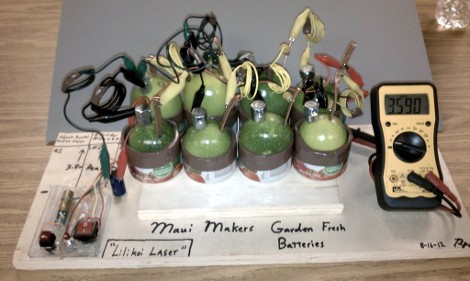
[POTUS31] figured that he could gradually anodize different areas of the ring by using laser-cut tape masks, allowing him to selectively oxidize different portions of his creations as he went along. Using the phosphoric acid prevalent in Coke as his oxidizing agent along with a constantly growing daisy-chain of 9-volt batteries, he had a firm grasp on the technique in no time. As you can see in the picture above, the anodizing works quite well, producing vivid colors on the titanium bands without the need for any sort of dye.

[POTUS31’s] favorite color thus far? A rich green that comes from oxidizing the metal at you guessed it – 99 volts.

[via Make]

Make Your Own Integrated Circuits At Home

The Nyan Cat you see above is only 600 micrometers from head to tail. To put that into perspective, that’s about 10 times the diameter of a human hair. Also, that Nyan is etched into 200 nanometer thick copper foil and is the work of the HomeCMOS team, who is developing a hobbyist-friendly process to make integrated circuits and MEMS devices at home.

The project is far from complete; HomeCMOS has yet to produce a working IC but a few experiments – getting wet etching down pat and even building an almost working quantum qbit – are remarkable given the small amount of equipment and tools involved.

The HomeCMOS team has yet to actually make an integrated circuit or MEMS device, [Jeri Ellsworth] has shown this is possible by making transistors and integrated circuits at home. While there won’t be chips with millions of transistors coming out of the HomeCMOS lab anytime soon, it’s more than possible to see a few small-scale integration-level tech such as a few logic gates or a regulator.

More DIY Solder Flux

[GuShH] wrote a guide for making your own rosin-based solder flux. According to [Stephen] — who sent in the tip and tried this method himself — is works well, it’s cheap, but you will need to clean up a bit after using it on a PCB.

Only two ingredients are necessary to make your own liquid or paste flux: rosin and a solvent. The rosin being weighed in the image above, can be found from several sources. We looked in on the same method quite recently where flux was sourced from a music store. But [GuShH] suggests that if you can find some from a hardware store it is better because the music store variety tends to be ‘molten’ and doesn’t work quite as well.

Proportions are listed on his guide for light, medium, and heavy concoctions. He recommends isopropyl alcohol as the solvent, and has stored the flux in a clear dropper bottle. We’re fans of needle bottles and asked about sourcing them in a previous post (linked in the paragraph above) so check that comments section if you don’t know where to get one.

Homemade Silicon Carbide LED

Here’s an LED indicator which was made at home out of a Silicon Carbide (SiC) crystal (Internet Archive Mirror). The concept is simple, but a bit of trial and error goes into getting that tiny amber spot to light up.

The guesswork comes in finding the right piece of crystal. First [KOS] broke it into tiny pieces, then he started poking the chunks with electrified probes to see if he could get some light out of them. Once an active area was found he needed a base for the crystal. The image above shows the two nails which he used. This provides a large mounting area that also acts as a heat sink to make sure the LED won’t burn itself out. There’s a solder blob which he kept molten with his iron until the crystal could be pushed into place. That holds it securely as the pin which serves as the cathode is positioned.

The whole setup is soldered to some protoboard and is ready to use. This is the second time we remember seeing this technique used to fabricate LEDS. The first time was an accident.