A 3D-printed 8-Shaft Table Loom

Simple 3D-Printed Table Loom For Complex Weavings

The loom has been a transformative invention throughout history, shaping the textile industry from simple hand looms to complex, fully automated machines. Now, thanks to advancements in 3D printing, this age-old craft is being revitalized by modern makers. One such creator, [Fraens], has recently designed a unique 3D-printed table loom with eight shafts, offering a simpler yet innovative approach to weaving. This project is a fresh take on traditional looms, blending centuries of design knowledge with contemporary technology.

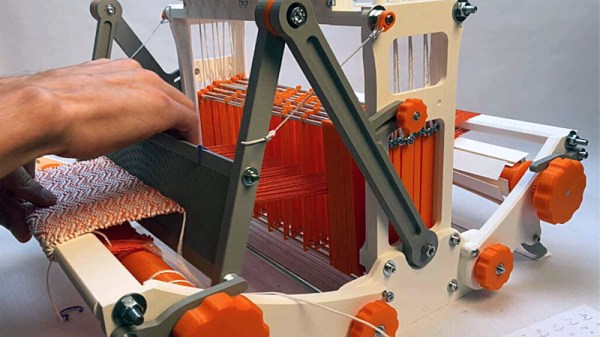
[Fraens], a longtime enthusiast of looms, has spent considerable time studying the countless designs that have evolved over more than 200 years. Drawing inspiration from these, he has crafted a more accessible version—a table loom that can be operated using levers to control the warp threads. Unlike larger, more complex looms, this 3D-printed model allows users to experiment with various weaving patterns easily, using different colors and sequences to create beautiful, intricate designs. [Fraens] provides guidance on how to adapt patterns meant for larger looms to this compact, lever-operated version on his website and in a detailed video tutorial.

This project is perfect for anyone interested in weaving or DIY technology. [Fraens]’ 3D-printed loom offers a new way to explore textile creation, making it both approachable and rewarding. To see this innovative loom in action and learn how to build your own, check out the video below.

Continue reading “Simple 3D-Printed Table Loom For Complex Weavings”

Homebrew Relay Computer Features Motorized Clock

Before today, we probably would have said that scratch-built relay computers were the sole domain of only the most wizardly of graybeards. But this impressive build sent in by [Will Dana] shows that not only are there young hardware hackers out there that are still bold enough to leave the transistor behind, but that they can help communicate how core computing concepts can be implemented with a bundle of wires and switches.

Created for his YouTube channel WillsBuilds, every component of this computer was built by [Will] himself. Each of the nine relay-packed protoboards inside the machine took hours to solder, and when that was done, he went out to the garage to start cutting the wood that would become the cabinet they all get mounted in.

Continue reading “Homebrew Relay Computer Features Motorized Clock”

A Simple Liquid Level Indicator With A Single IC

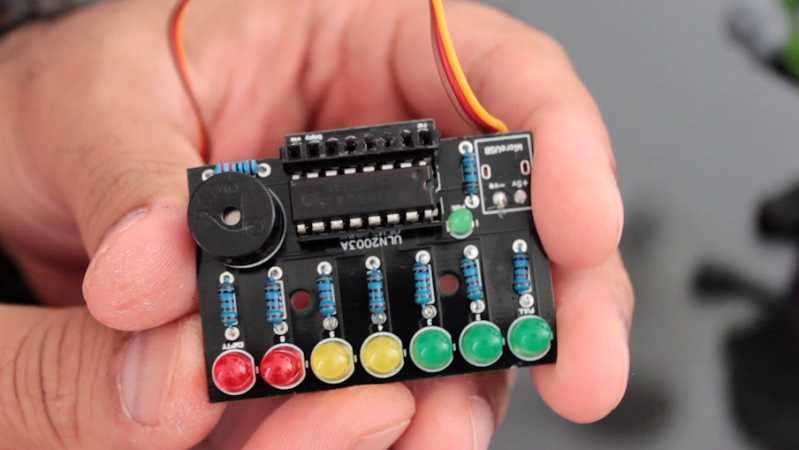
Often, the only liquid level indicator you need is your eyes, such as when looking at your cold beverage on a summer’s day. Other times, though, it’s useful to have some kind of indicator light that can tell you the same. [Hulk] shows us how to build one for a water tank using a single IC and some cheap supporting components.

If you’re unfamiliar with the ULN2003, it’s a simple Darlington transistor array with seven transistors inside. It can thus be used to switch seven LEDs without a lot of trouble. In this case, green, yellow, and red LEDs were hooked up to the outputs of the transistors in the ULN2003. Meanwhile, the base of each transistor is connected to an electrode placed at a different height in the water tank. A further positive electrode is placed in the tank connected to 12 volts. As the water raises to the height of each electrode, current flow from the base to the positive electrode switches the corresponding transistor on, and the LED in turn. Thus, you have a useful liquid level indicator with seven distinct output levels.

It’s a neat build that might prove useful if you need to check levels in a big opaque tank at a glance. Just note that it might need some maintenance over time, as the electrodes are unlikely to remain completely corrosion free if left in water. We’ve seen some other great uses of the ULN2003 before, too. Video after the break.

Continue reading “A Simple Liquid Level Indicator With A Single IC”

Need A Tube? Reach For Plywood!

To be clear, when we are talking about tubes, we mean ordinary cylinders, not vacuum-amplifying elements. With that out of the way, when we need a tube like that, we usually think of PVC or some other kind of pipe product. Or maybe we’ll 3D print what we need. But not [GregO29]. He made his tubes from plywood.

You can make tubes as small as 12 inches in diameter, and [GregO29] made some that were 16 inches. The first step was to make a mold or form. In this case, he elected to make a form that the tube-to-be wraps around. The plywood is thin 2-ply white birch. This makes it easy to shape.

The basic idea is to wrap the wood around the form and glue it. You hold it together with a strap until it dries. Then, you can add more layers until it is the thickness you need.

The real problem turned out to be removing the form once it was done. Why make a tube like this? In [Greg]’s case, he’s building a telescope, which is as good a reason as any to have a tube, we suppose.

We build a lot of things, but we always forget about plywood. It even mixes well with electricity.

Making A Solid State 6AK8 Tube

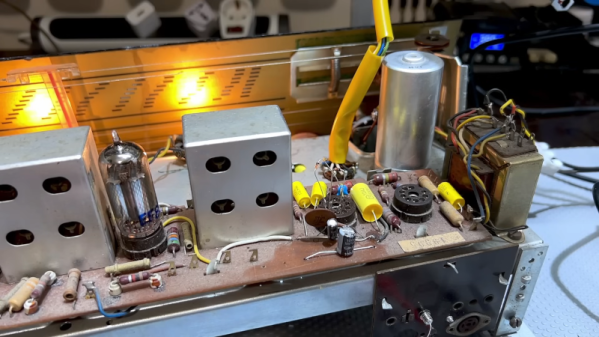
[M Caldeira] had a project in mind: replacing a common vacuum tube with a solid-state equivalent. The tube in question was an EABC80 or 6AK8 triple diode triode. The key was identifying a high-voltage FET and building it, along with some other components, into a tube base to make a plug-in replacement for the tube. You can see a video about the project below.

These tubes are often used as a detector and preamplifier. Removing the detector tube from a working radio, of course, kills the audio. Replacing the tube with a single diode restores the operation of the radio, although at a disadvantage.

From there, he adds more diodes directly into the socket. Of course, diodes don’t amplify, so he had to break out a LND150 MOSFET with a limit of 500 volts across the device. It takes some additional components, and the whole thing fits in a tube base ready for the socket.

Usually, we see people go the other way using tubes instead of transistors in, say, a computer. If you want real hacking, why not make your own tubes?

Continue reading “Making A Solid State 6AK8 Tube”

Ask Hackaday: Should We Teach BASIC?

Suppose you decide you want to become a novelist. You enroll in the Hackaday Famous Novelists School where your instructor announces that since all truly great novels are written in Russian, our first task will be to learn Russian. You’d probably get up and leave. The truth is, what makes a great (or bad) novel transcends any particular language, and you could make the same argument for programming languages.

Despite the pundits, understanding the basics of how computers work is more important than knowing C, Java, or the language of the week. A recent post by [lackofimagination] proposes that we should teach programming using BASIC. And not a modern whizz-pow BASIC, but old-fashioned regular BASIC as we might have used it in the 1980s.

Certainly, a whole generation of programmers cut their teeth on BASIC. On the other hand, the programming world has changed a lot since then. While you can sort of apply functional and object-oriented techniques to any programming language, it isn’t simple and the details often get in the way of the core ideas.

Still, some things don’t change. The idea of variables, program flow, loops, and arrays all have some parallel in just about anything, so we can see some advantages to starting out simply. After all, you don’t learn to drive by trying it out in the Indy 500, right?

What do you think? If you were teaching programming today, would you start with BASIC? Or with something else? You can modernize a little bit with QB64. Or try EndBasic which just recently had a new release.

How Ten Turn Pots Are Made

It is easy to think of a potentiometer as a simple device, but there are many nuances. For example, some pots are linear — a change of a few degrees at the low end will change the resistance the same amount as the same few degrees at the high end. Others are logarithmic. Changes at one end of the scale are more dramatic than at the other end of the scale. But for very precise use, you often turn to the infamous ten-turn pot. Here, one rotation of the knob is only a tenth of the entire range. [Thomas] shows us what’s inside a typical one in the video below.

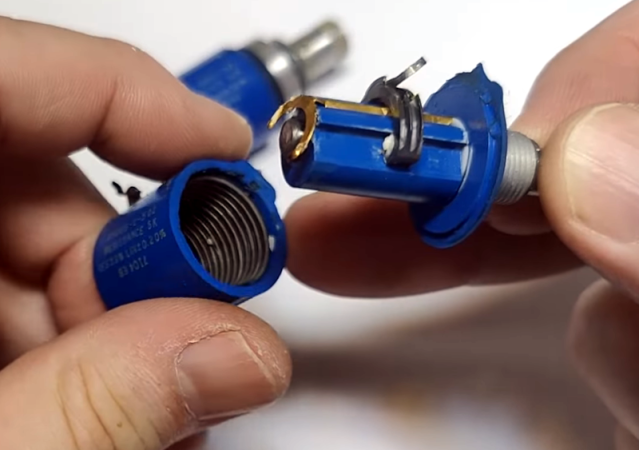
When you need a precise measurement, such as in a bridge instrument, these pots are indispensable. [Thomas] had a broken one and took that opportunity to peer inside. The resistor part is a coil of wire wound around the inside of the round body. Unsurprisingly, there are ten turns of wire that make up the coil.

The business end, of course, is in the rotating part attached to the knob. A small shuttle moves up and down the shaft, making contact with the resistance wire and a contact for the wiper. The solution is completely mechanical and dead simple.

As [Thomas] notes, these are usually expensive, but you can  — of course — build your own. These are nice for doing fine adjustments with precision power supplies, too.

Continue reading “How Ten Turn Pots Are Made”