The Pi CNC Controller

pi

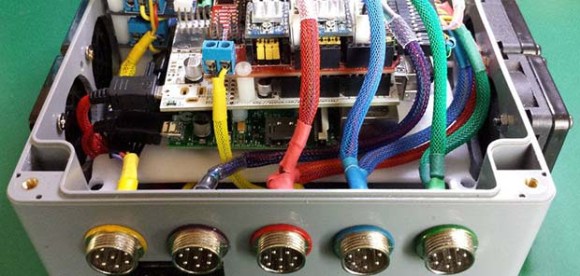
Back in the olden days, the latest and greatest CNC machines had minicomputers bolted onto their frames, replete with paper tape readers and seven segment displays. For the home CNC machinist of today, these hulking electronic brains are replaced with something a little more modern – desktop computers with parallel ports. Having a box filled with computers and motor drivers is just too cool though, and this tiny Raspberry Pi CNC controller fits the bill quite nicely.

The controller uses a Raspberry Pi as the brains of the device, but there aren’t too many options out there for stepper motor control in Pi land. There are, however, dozens of CNC shields or the Arduino. The Pi AlaMode board is able to provide voltage level conversion between the CNC shield and the pi, and also has the nice bonus of a battery-backed real time clock.

With some proper connectors, lighted buttons, and a beautiful cable sleeving job, this Pi CNC controller would be well suited for any of the desktop CNC  or engraving builds we see from time to time.


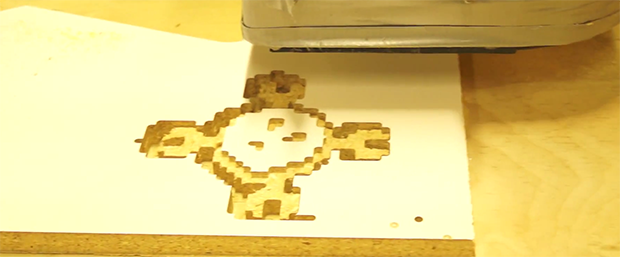
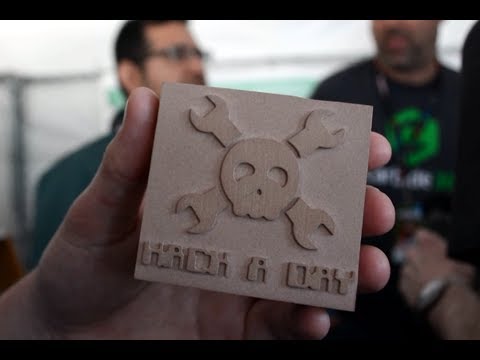
Hackaday logo carved in MDF

Live Look At Taktia Augmented Power Tool And Carbide 3D Mill

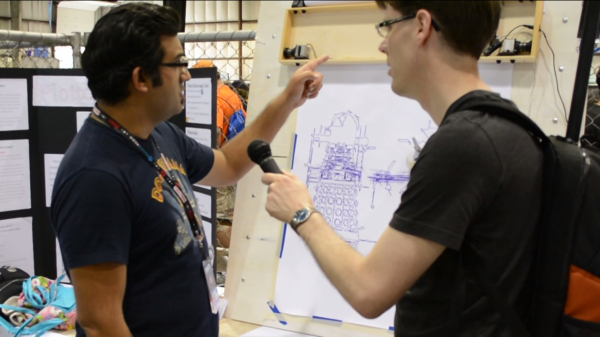
There were so many things to see at Maker Faire that the booths spilled out of the buildings and into various tents on the grounds. One of the most interesting tents was packed with tables showing off CNC machines and that’s where we ran into two that are familiar, and still amazing.

First up is the handheld CNC router which we saw all the way back in 2012. It’s a spectacular piece of tech that adds a base to a handheld router. The base gives the tool a touchscreen system, the ability to precisely track it’s location, and adjustment motors to move the cutting bit in order to correct for imperfections in operator movements. It’s really amazing and we are happy to see they have formed a company called Taktia around the concept and are heading for crowd funding soon.

The second half of the video shows off the Nomad CNC mill which we covered at the end of April. Carbide 3D had a hugely successful (more than 10x the goal) Kickstarter that they tried to blame on the support of Hackaday readers. It’s a no-brainer that this machine is the one to watch, as even our hacked camera work doesn’t lose the fact that it can produce rock-solid results.

Isoscel-Ease Drawing Robot Is Mesmerizing

Isoscel Ease Drawing Robot

Drawing is difficult for a lot of people… So, why not build a robot to do it for you? [Darcy] had an idea for a rather unique drawing robot — he calls it the Isoscel-Ease.

Instead of using a boring XY gantry, a deltabot, or using a scissor linkage (actually that one is pretty cool!), [Darcy] decided to try harnessing of the power of triangle geometry! As you can probably guess, the linkage forms an isosceles triangle, hence the name. A pair of stepper motors increases and decreases the odd side of the triangle, allowing for a full range of continuous inky movement (there’s no pen actuator) over the page.

It’s a very cool little drawing robot, and it was completely designed in SketchUp — He has lots of photos of the build process and example drawings on his site — But don’t forget to stick around after the break to see a video of it in action!

Continue reading “Isoscel-Ease Drawing Robot Is Mesmerizing”

Metal Inlays Using A Bit Of Solder

metal inlay

Looking for a unique way to add a nice metal inlay to finish off your project? [Ben Krasnow] shows us how using a CNC router, a bit of solder, and a lot of sand paper!

It’s actually a pretty simple job — Of course, that’s only if you have a CNC machine. [Ben] started by engraving his inlay using his handy CNC mill, and then sanding off any rough spots. He then filled the engraving with acid flux paste, got out his MAPP gas torch and started dripping solder into the piece. Once everything was covered, he started sanding it, from 60 grit all the way to 600 grit for a nice polished finish. The results speak for themselves.

An easier method of this could also be achieved using plastic and epoxy, instead of brass and solder. One of the biggest problems with the solder is bubbling, which can cause voids which will appear when you are sanding — so you might have to do a second pass with the solder.

[Ben Krasnow] is an interesting character. He’s sought out the perfect cookie, made his own CT scanner at home, explained the various heat treatments of steel — and even installed LEDs into his contact lenses just for kicks!

[Thanks Fabien!]

Injection Molding With Hot Glue

Injection molding is simply forcing a melted thermoplastic into a mold of some sort, letting it cool, and then prying the mold apart to get to the finished piece. Hot glue guns are basically handheld thermoplastic extruders, so when [scorch] dug up some old injection molds he had sitting around, it didn’t take long to put two and two together.

Injection molds aren’t something any normal person has sitting around, but a few years ago [scorch] found two books published by Gingery, the same people who have published instructions on how to build a metalshop from scrap. [scorch] created his molds on a small CNC mill – a Sieg X3 – and his initial experiments with injection molded plastic were fairly successful, even if the molds were made from self-cast billets.

After molding a few hot glue LEGO parts with his equipment, [scorch] had a look around the Internet and noticed this was nothing new. One company even sells a hot glue gun-based injection molding kit using polyethylene glue sticks. Their demo video (seen below) seems much more complicated than [scorch]’s efforts, so  we’ll say he came out ahead on this one.

Continue reading “Injection Molding With Hot Glue”

CNC’d And Anodized Ti Engagement Rings

Ti

[Patrick] met someone, and then some stuff happened. Good for him. Because of this, [Patrick] found himself in need of a pair of engagement rings. With a friend, some titanium bar stock, and an awesome lathe, he turned out a few awesome rings and also managed to selectively anodize them with a subtle rainbow of colors.

RingsMaking a ring on a lathe is a relatively simple ordeal, but the two larger rings [Patrick] made (one was for a friend) featured some interesting patterns that aren’t easy to make without a good CNC setup. Luckily, this friend has an awesome CNC with a rotary fourth axis.

With the machining out of the way, [Patrick] then turned to anodization. This was done by constructing a simple power supply with a variac, four diodes, and a big honkin’ cap. He managed to get a good result with a sodium carbonate solution. He doesn’t have any good pictures of it, but by varying the voltage from 20 to 100 Volts, the color of the anodization will change from green, purple, to yellow, to blue.

Finally, A Desktop CNC Machine With A Real Spindle

While cheap hobby CNC mills and routers are great machines that allow you to build things a 3D printer just can’t handle, they do have their limitations. They’re usually powered by a Dremel or other rotary tool, so speed control of the spindle via Gcode is nigh impossible. They’re also usually built with a piece of plywood as the bed – cheap, but not high on repeatability. The Nomad CNC mill fixes these problems, and manages to look good and be pretty cheap, to boot.

Instead of using a Dremel or other rotary tool to cut materials, the Nomad team is using a brushless DC motor connected to a real spindle. With a few certain motors, this allows for closed loop control of the spindle;  Sending S4000 Gcode to the mill will spin the spindle at 4000 RPM, and S6000 runs the spindle at 6000 RPM, whether it’s going through foam or aluminum. This is something you just can’t do with the Dremel or DeWalt rotary tools found in most desktop mills and routers.

Along with a proper spindle, the Nomad also features homing switches, a tool length probe, and a few included fixtures that make two-sided machining – the kind you need it you’re going to machine a two-layer PCB – possible, and pretty simple, too. The softwares controlling the mill are Carbide Motion and MeshCAM, a pretty popular and well put together CNC controller. Of course the mill itself speaks Gcode, so it will work with open source CNC software.

It’s all a very slick and well put together package. Below you can find a video of the Nomad milling out a Hackaday logo.

Continue reading “Finally, A Desktop CNC Machine With A Real Spindle”