Hands-On: New AND!XOR Unofficial DEF CON Badge

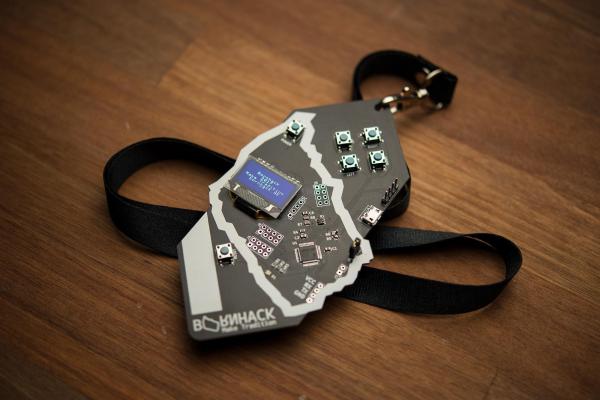
In just two weeks, we’ll be flooding into the casinos of Las Vegas for DEF CON. By far our favorite part is the unofficial hardware badges which make their way to the con each year. The AND!XOR team has put together an incredible offering this year with what I’m calling the “Bender on a Bender” badge. They sent us two of them, so let’s jump right in and see what this badge is all about.

Continue reading “Hands-On: New AND!XOR Unofficial DEF CON Badge”

DEF CON BadgeLife: Blinky Bling

This is the biggest year yet for unofficial electronic conference badges. We’re calling it the year of Badgelife, and for the next few weeks, we’re going to be taking a look at the unofficial conference badges being deployed at this year’s DEF CON.

[Mr Blinky Bling] a.k.a. [Benn Hibben] has created his own badge for this year’s con. On board is a bunch of LEDs, WiFi, and capacitive buttons. It’s a WiFi badge for all your AP scanning and deauth needs. The electronics for this badge are a bit more complicated than simply throwing an ESP8266 on a board and calling the design done. The capacitive touch functionality is being handled by an ATTiny88, the OLED display is handled by an ATMega32U4, wireless functions are done with an ESP8266, and there are a few bits and bobs for a LiPo battery.

This WiFi Badge is the focus of an astonishingly successful Kickstarter (ending in just a few hours), and [Mr Blinky Badge] already has enough backers to move 200 badges. This is really a spectacular amount of work; it’s one thing to build a single prototype for an electronic conference badge, but it’s another matter entirely to put a badge into production, source all the parts, handle the assembly, and finally ship all these badges to Kickstarter backers and conference attendees.

If the challenge of building and deploying hundreds of electronic conference badges sounds like fun, you’re in luck. This Friday, we’ll be hosting a Hack Chat with some of the creators of this year’s unofficial DEF CON badge creators. There’s a lot you can learn from these folks, and a lot of very cool badges that will make an appearance at this year’s Def Con.

Hackaday Superconference: Tickets And Proposals

We’re thrilled to announce Supercon tickets are now available. The 2017 Hackaday Superconference is November 11th and 12th in Pasadena, California.

This is the ultimate hardware conference. Hackers, designers, and engineers from all over the world converge — from the greenest beginners to those who have made history with their designs. This is the Hackaday community, and the Supercon is your chance to experience all things involved in hardware creation for one great weekend. There will be unparalleled talks and workshops, but the experience of Supercon transcends the organized event. We call it a conference but it’s truly a hacker village.

Call for Proposals

Want to present a talk (or a workshop) at this year’s Supercon? Great, please submit your proposal using this form.

The number one question we get about CFP is “I’m excited about X, should I submit a proposal?” The answer is yes. Don’t self-eliminate — if you have an idea for a talk we want to hear from you. Supercon is a flat conference, your proposal will be judged on the idea and how you plan to present it, not on how many other amazing speaking slots you’ve secured.

To help get your mind moving about topics, we suggest that you consider this list of themes your talk might fit into: Engineering Heroics, Prototyping, Research, Product Development, Full-Stack Fabrication, and of course Wildcard.

Tickets! Get Your Tickets Here!

Are you a true believer? We’ve just opened up the Call for Proposal today, so we can’t tell you who’s speaking or what workshops will take place. However, we suspect there are many of you ready to take the plunge right now. Those first 96 true believers get an incredibly low ticket price of $128. This covers admission for both days of the con, admission to the Hackaday Prize party on Saturday night and food on both days.

This is the third year we’ve hosted the Hackaday Superconference. You can check out all of the talk videos from last year, there’s a slew of articles on the event, and of course it was really fun seeing the geeky and unique shirts on exhibit throughout.

Get your ticket and book your travel. We look forward to hanging out with a huge chunk of the Hackaday community at Supercon!

DEF CON Badgelife: The Puffy That Runs Linux

DEF CON is canceled again this year, and this time that statement is at least partially true. There will be no special official badges this year. There is no challenge or mystery embedded in the official DC badge. This is the year that unofficial badges from villages and random attendees finally supersedes the official offering. This is badgelife, and for the next few weeks, we’re going to be taking a look at some of the unofficial badges of DEF CON.

The idea for [dorkengine]’s Puffy badge began last year with the so-called Bender badges from AND!XOR.  Chalk this up to a story that ends with, ‘but you had to have been there’, but the Bender badges were wildly popular, sold like hotcakes, and were an astonishing success of independent badge craft at DC. [dorkengine] decided to get in on the action and build his own badge for DC 25.

The design of the Puffy badges is based on a highly stylized rendering of the OpenBSD logo and mascot. Why a pufferfish with Kardashian lips? [dorkengine] has a bunch of boxes in a closet running OpenBSD, and that’s a good enough reason for us.

An electronic badge must do something, and the feature list [dorkengine] came up with included some sort of wireless connectivity, hackability, a serial console, blinkenlights, and some sort of *nix-ish OS. OpenBSD didn’t make the cut, but [dorkengine] eventually stumbled upon the VoCore2, a tiny System on Module that runs Linux, has WiFi and a few GPIOs, and is barely an inch on a side.

After getting a good deal on a large order of VoCores, [dorkengine] started on the PCB. The circuit was simple enough with just a VoCore attached to a USB port, power adapter, and a few LEDs. The Puffy rendering translated beautifully into soldermask and silkscreen, and after a prototype from ITEAD Studio, [dorkengine] had 40 PCBs that worked perfectly.

So, what is [dorkengine] going to do with a box full of Puffy badges? He’ll be selling them for $40 around the con. That’s surprisingly inexpensive for a large PCB soldered to a $17 SoC. If you want to get your grubby mitts on one, you could email him or ping him on Twitter. Of course, if you want to make your own, [dorkengine] has the KiCad files and software available, but at this point, you’re looking at a very fast turnaround for a board house.

SHA 2017 Talk Schedule Revealed

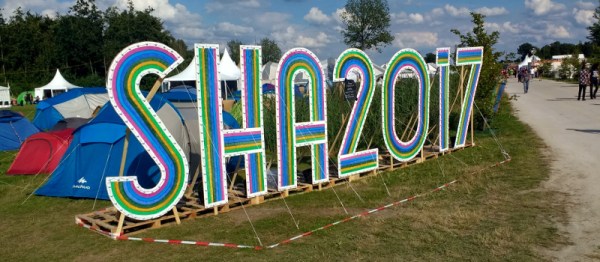
It’s always an exciting moment when an event schedule is released, and since events in our community don’t come much larger than this August’s SHA Camp in the Netherlands, you can imagine that the announcement of their schedule of lectures of talks is something of an event in itself. The event runs over five days, and you can browse the schedule itself to make your picks.

The SHA team have made their own picks, but with so many stages and speakers they are only a tiny selection. Running a Hackaday eye over the schedule, here are the ones that caught our eye.

[Kliment] has a workshop, Surface Mount Electronics Assembly for Terrified Beginners, in which you assemble a 20€ surface-mount power supply kit. [Editor’s Note: We’ve seen this one live — you can do it!]

[dennisdebel]’s lecture, from glass fiber to fiber glass noodles caught our eye. Using mung bean vermicelli, or ‘glass noodles’, for data transmission, is not something you hear about every day.

If you are a regular at European hardware hacker camps, you may have encountered the chiptune extravaganza performances of [Gasman], otherwise known as [Matt Westcott]. Hie lecture, Zero to chiptune in one hour, will create, from scratch, a chiptune cover version of a pop song chosen by the audience, all on a Sinclair ZX Spectrum.

The Hackeboy handheld game console is a project from a small Hamburg-based indie game label.[Axel Theilmann] describes the process of building the handheld console they always dreamed of.

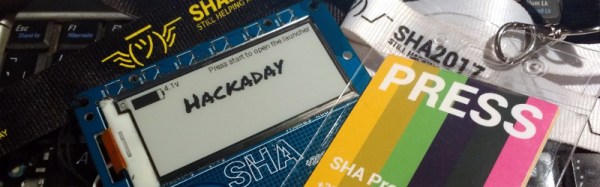
One of the final lectures of the event comes from [Niek Blankers], and will describe in detail the SHA2017 badge. How it was designed, and showcasing what some of the attendees will by then have managed to do with it.

Finally, if you want to see a Hackaday scribe talking about fun and games with little plastic bags of parts, you could do worse than seeking out From Project To Kit, all you will need to know about turning your personal electronic projects into a kit business.

Watch this space for more from SHA Camp as we get it. Meanwhile you can take a look at our coverage of the SHA2017 badge launch.

Hackaday’s BAMF Meetup Spills Into The Streets Of San Mateo

Saturday night marked the fourth annual Hackaday BAMF meetup. The night when weary exhibitors close up their booths at Bay Area Maker Faire and head over to O’Neil’s Irish Pub where the real fun starts. There are many drawbacks to having a booth; you’re on your feet all day repeating the same small snippet to everyone passing by, and usually you don’t get much of a chance to mingle with friends old and new.

Walking into the meetup, it was striking to watch aching bodies slow with weariness perk up to the energy and excitement of the Hackaday Community incarnate. Join me after the break for a peek into the fun of the evening.

Continue reading “Hackaday’s BAMF Meetup Spills Into The Streets Of San Mateo”

Zombie Badges Take Over Security Con

We can’t get enough of hacker-con badges. BSides Cape Town, held Last December, featured an IR-equipped badge that immersed attendees in a game while they chatted.

A group led by [AndrewMohawk] and [ElasticNinja] designed the badge around an ESP8266 and 128×64 OLED display, with eight buttons, an IR receiver and transmitter, five “level” LEDs, an RGB LED, and a 600 mAh LiPo that charged over USB.

The hardware was designed specifically to play an organic game so that the organizers could watch the interaction between the badges in real time. Each badge was randomly sorted into a faction, either red, blue, or green—identifiable by an RGB LED glowing on the badge. There was also a series of five LEDs signifying your level in the game. When two or more badges got close to each other, enough for the IR to link, the badge with the lowest level was converted to the faction of the winner.

Of course, the badge displayed attendees’ handles and contained a list of convention programming. It also presented attendees with a series of challenges, which could be unlocked to play Pong or Rock/Paper/Scissors/Lizard/Spock, scan for wireless networks, and run animations.

Continue reading “Zombie Badges Take Over Security Con”