Mike Harrison Knows Everything About LEDs

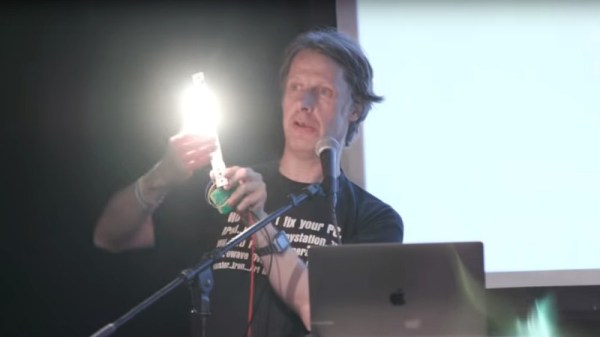
Driving an LED and making it flash is probably the first project that most people will have attempted when learning about microprocessor control of hardware. The Arduino and similar boards have an LED fitted, and turning it on and off is a simple introduction to code. So it’s fair to say that many of us will think we have a pretty good handle on driving an LED; connect it to a I/O pin via a resistor and that’s it. If this describes you, then Mike Harrison’s talk at the recent Hackaday Superconference (embedded below) will be an education.

Mike has appeared on these pages multiple times as he pushes LEDs and PCB techniques to their limits, even designing our 2017 Superconference badge, and his many years of work in the upper echelons of professional LED installations have given him an unrivaled expertise. He has built gigantic art projects for airports, museums, and cities. A talk billed as covering everything he’s learned about LEDs them promises to be a special one.

If there’s a surprise in the talk, it’s that he’s talking very little about LEDs themselves. Instead we’re treated to a fundamental primer in how to drive a lot of LEDs, how to do so efficiently, with good brightness and colour resolution, and without falling into design traps. It’s obvious that some of his advice such at that of relying on DIP switches rather than software for configuration of multi-part installations has been learned the hard way.
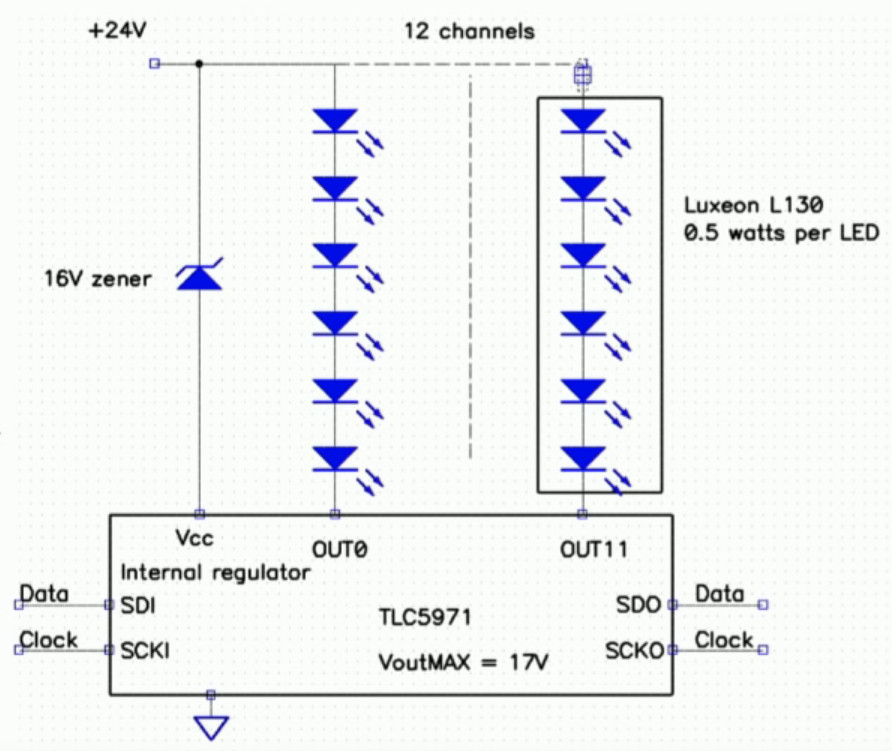
Multiple LEDs at once from your driver chip, using a higher voltage.

We are taken through a bit of the background to perceived intensity and gamma correction for the human eyesight. This segues neatly into the question of resolution, for brightness transitions to appear smooth it is necessary to have at least 12 bits, and to deliver that he reaches into his store of microcontroller and driver tips for how to generate PWM at the right bitrate. His favoured driver chip is the Texas TLC5971, so we’re treated to a primer on its operation. A useful tip is to use multiple smaller LEDs rather than a single big one in the quest for brightness, and he shows us how he drives series chains of LEDs from a higher voltage using just the TI chip.

Given the content of the talk this shouldn’t come as a shock, but at the end he reminds us that he doesn’t use all-in-one addressable LEDs such as the WS2932 or APA102. These are  the staple of so many projects, but as he points out they are designed for toy type applications and lack the required reliability for a multi-thousand LED install.

Conference talks come in many forms and are always fascinating to hear, but it’s rare to see one that covers such a wide topic from a position of experience. He should write it into a book, we’d buy it!

Continue reading “Mike Harrison Knows Everything About LEDs”
Thea Flowers – Creating A Sega-Inspired Hardware Synthesizer From The Ground Up

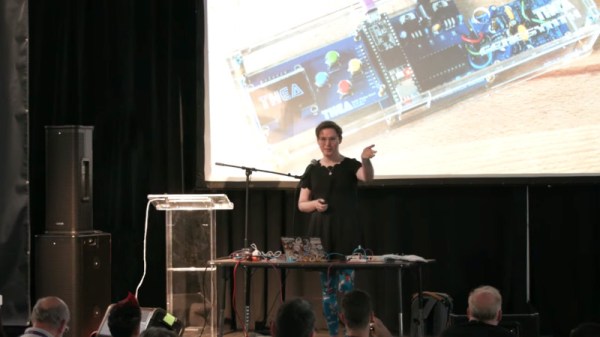
For those who grew up with video games, the legendary sounds of consoles past are an instant nostalgia hit. [Thea Flowers] first got her hands on a gamepad playing Sonic the Hedgehog, so the sounds of the Sega Genesis hold a special place in her heart. Decades later, this inspired the creation of Genesynth, a hardware synth inspired by the classic console. The journey of developing this hardware formed the basis of [Thea]’s enlightening Supercon talk.

[Thea’s] first begins by exploring why the Genesis sound is so unique. The Sega console slotted neatly into a time period where the company sought to do something more than simple subtractive synthesis, but before it was possible to use full-waveform audio at an affordable price point. In collaboration with Yamaha, the YM2612 FM synthesis chip was built, a cost-reduced sound engine similar to that in the famous DX7 synthesizer of the 1980s. This gave the Genesis abilities far beyond the basic bleeps and bloops of other consoles at the time, and [Thea] decided it simply had to be built into a dedicated hardware synth.

Continue reading “Thea Flowers – Creating A Sega-Inspired Hardware Synthesizer From The Ground Up”

East Coast RepRap Festival Comes Alive In Second Year

By pretty much any metric you care to use, the inaugural East Coast RepRap Festival (ERRF) in 2018 was an incredible success. There was plenty to see, the venue was accommodating, and the ticket prices were exceptionally reasonable. But being a first-time event, there was an understandable amount of trepidation from both exhibitors and the attendees. Convincing people to travel hundreds of miles to an event with no track record can be a difficult thing, and if there was a phrase that would best describe the feel of that first ERRF, it would probably have been “cautious optimism”.

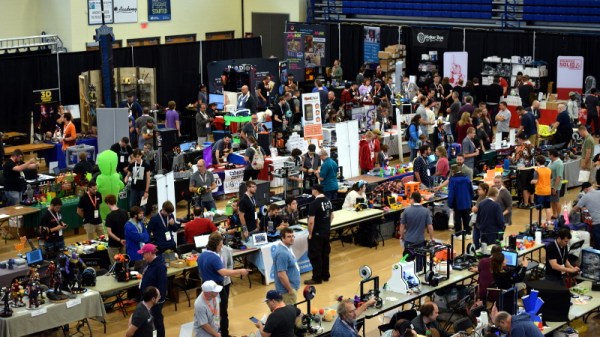
But this year, now that they had some idea of what to expect, the 3D printing community descended on Bel Air, Maryland with a vengeance. In 2019, everything at ERRF was bigger and better. There were more people, more printers, and of course, more incredible prints. Activities like the 3D Printed Derby returned, and were joined by new attractions including full-body 3D scanning and a shooting gallery where attendees could try out the latest in printable NERF weaponry.

The official tally shows that attendance nearly doubled over last year, and with growth like that, we wouldn’t be surprised if the ERRF organizers consider relocating to a larger venue for 2020 or 2021. As far as problems go, growth so explosive that it requires you to rethink where you hold the event isn’t a bad one to have. The Midwest RepRap Festival, which served as the inspiration for ERRF, found they too needed to move into more spacious digs after a few years. Something to keep in mind the next time somebody tells you the bubble has burst on desktop 3D printing.

Trying to distill an event as large and vibrant as ERRF 2019 into a few articles is always difficult. Even after spending hours walking around the show floor, you would still stumble upon something you hadn’t seen previously. As such, this article is merely a taste of what was on hand. The East Coast RepRap Festival 2020 should absolutely be marked on your calendar for next year, but until then let’s take a look at just some of what made this year’s event such a smash.

Continue reading “East Coast RepRap Festival Comes Alive In Second Year”

Hackaday Podcast 044: Supercon 2019 Special

Half of the Hackaday writing staff was at the 2019 Hackaday Supercon this weekend, and our own Kerry Scharfglass took the opportunity to interview everyone. Meanwhile, Elliot wandered around the soldering irons just about two hours before the Badge Hacking Ceremony, collecting stories of projects that worked, and those that didn’t.

Put the two together, and you’ve got an audio collage that gives you a peek into at least one facet of Supercon life, and gives you a chance to put voices to the words you read here every day!

We’ll be back to our normal programming next week.

Tell us what you think about this episode in the comments!

Take a look at the links below if you want to follow along, and as always, tell us what you think about this episode in the comments!

Direct download (60 MB or so.)

Continue reading “Hackaday Podcast 044: Supercon 2019 Special”

A Newbie Takes The SMD Challenge At Supercon

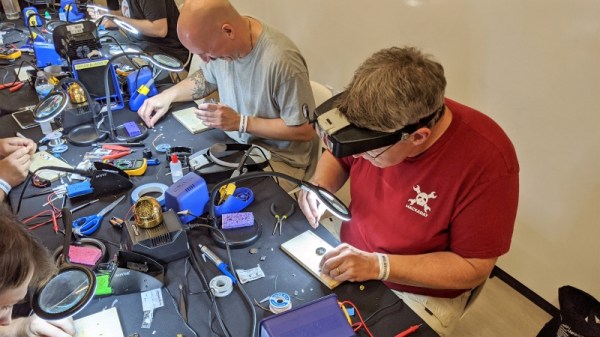
First-time visitors to Disneyworld often naively think they’re going to “do” the park in three days: one day for the Magic Kingdom, one day for Epcot, and one day for everything else. It’s easy to spot such people, collapsed on a bench or dragging exhausted kids around while trying to make their way to the next must-see attraction. Supercon is something like that — a Disney-esque theme park for hackers that will exhaust you if you don’t have a plan, and if you don’t set reasonable expectations. Which is why I was glad that I set only one real goal for my first Supercon: take the SMD Soldering Challenge.

Now, while I’m pretty handy with a soldering iron, I was under no illusion that I would be at all competitive. All my soldering experience has been with through-hole components, and while I also used to doing some production soldering on fine-pitch connectors, the whole surface-mount thing is new to me. I entered mainly because I wanted to see what was possible coming in raw. At best I’d learn what my limits are, and at worst I’d fail spectacularly and provide grist for a “Fail of the Supercon” post. It’s a win either way.

Continue reading “A Newbie Takes The SMD Challenge At Supercon”

Behind The Scenes Of The 2019 Superconference Badge

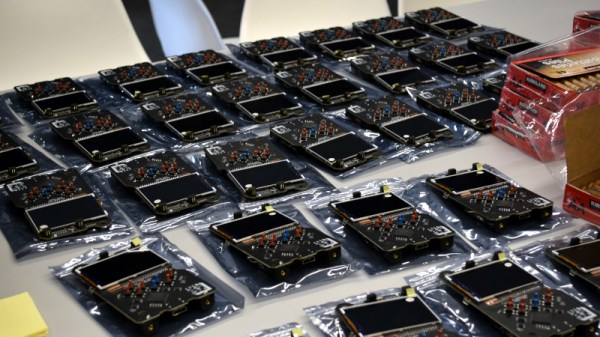
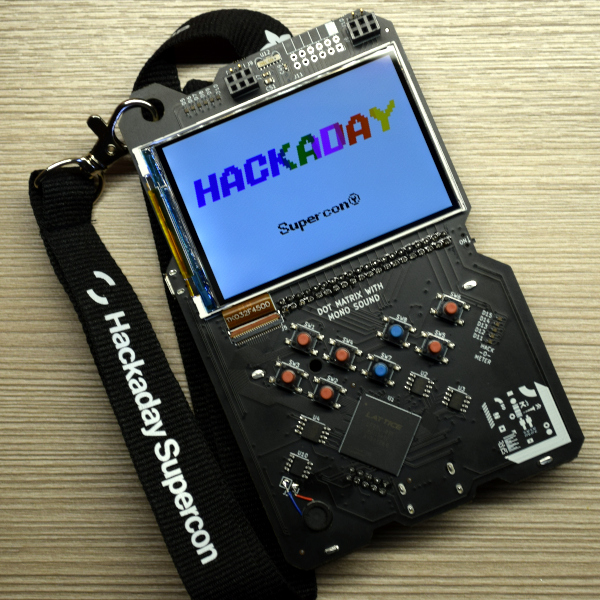
If you count yourself among the several hundred of our closest friends that have joined us at Supplyframe HQ for the 2019 Hackaday Superconference, then by now you’ll have your hands on one of this year’s incredible FPGA badges. It should come as no surprise that an incredible amount of time and effort went into developing and manufacturing this exceptionally unique piece of hardware; the slick gadget in your hands today took nearly an entire year to develop, and work continued on it until very literally the last possible moment.

Badge designer Jeroen Domburg (aka Sprite_TM), Hackaday staff, and a team of dedicated volunteers were still putting the final touches on these ambitious devices less than 24 hours before they were distributed to the first wave of Superconference attendees. Naturally, that’s not exactly how things were supposed to go. But when you’ve got a group of people that want to push the envelope and build something truly incredible, convincing them to actually stop working can be a challenge in itself.

In fact, development of the badge is still ongoing. Fixes and improvements are being made to the software even as you read this, and if you haven’t already, you should upgrade your badge to make sure you’ve got the latest and greatest from our international team of wizards. We all know that conference badges have an unfortunate habit of languishing on the shelf and collecting dust, but the 2019 Superconference badge was built to challenge you for longer than just one weekend. Consider yourself warned: for every Supercon badge that gets tossed in a drawer come Monday, Sprite_TM will shed a single tear.

After the break, come along as we turn back the clock and take a look at the last minute dash to get 500+ badges programmed and ready to go before the doors opened for the 2019 Hackaday Superconference.

Continue reading “Behind The Scenes Of The 2019 Superconference Badge”

2019 Superconference Is Streaming Live Right Now!

Perhaps Pasadena is a bit too far from home, or maybe you waited a few milliseconds longer than you should have and missed the tickets when they went on sale. Whatever the reason, the fact is that the vast majority of Hackaday readers won’t be able to join us at the 2019 Superconference. But thanks to the magic of the Internet, you’ll still be able to see the incredible talks we’ve got lined up.

Starting at 10 AM Pacific on both Saturday and Sunday, the live stream will allow you to virtually attend the ultimate hardware conference in glorious high definition. Many of the talks this year have a specific focus on FPGAs (and we’ve got an incredible badge to match), but you’ll also see presentations on subjects such as hacking quantum key distribution systems, the creation of free-form circuit sculptures, debugging PCBs with augmented reality, and using Peltier coolers for fermentation. Saturday evening we’ll reveal the winner of the Hackaday Prize live on stage, and come Sunday you can unwind with a look at the best and brightest badge hacks from the weekend.

We won’t lie to you, there’s more going on at Supercon than we can possibly fit into a live video stream. At an event where nearly every flat surface will be playing host to somebody fiddling with a piece of interesting hardware, there’s only so much you can do vicariously. If anyone knows how you can take part in the SMD Soldering Challenge over the Internet, we’re all ears. Whether you’ll be with us in corporeal form or otherwise, don’t forget to join the official 2019 Hackaday Superconference Chat and use the #supercon hashtag on your social media time sink of choice.