2022 Sci-Fi Contest: Motorized AT-AT Walker Gets Around With Servos

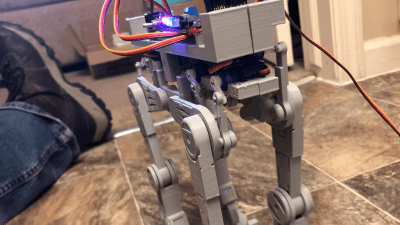
The AT-AT Walker was one of the more fearsome weapons of the Star Wars universe, even if it was incredibly slow and vulnerable to getting tangled up in Rebel tow cables. However, you can build your own small-scale example using servos for propulsion, as [Luke J. Barker] ably demonstrates.

Taking off the outer shell reveals the servo motors driving the leg linkages.

The build is a remix of the motorized AT-AT from [LtDan] on Thingiverse, originally powered by a 90 rpm DC gearmotor. [Luke] remixed the design, setting it up to be driven by eight servomotors instead. They’re controlled from a SparkFun RedBoard Edge, an Arduino-compatible microcontroller board that fits rather neatly inside the AT-AT shell.

Programmed with a simple sine-wave walk cycle, the AT-AT ambles along in a ponderous manner. It’s altogether very much like the real fictitious thing, albeit without the scorching sizzle of blaster fire ringing out across a frozen plain.

Quadruped vehicles never really caught on for military use, but that’s not to say nobody ever tried. Video after the break.

Continue reading “2022 Sci-Fi Contest: Motorized AT-AT Walker Gets Around With Servos”

The 2022 Hackaday Prize Hack Chat Kicks Things Off

The 2022 Hackaday Prize is on, and we’ve already seen some incredible submissions by folks who believe their idea just might have what it takes to make the world a better place. But as with all contests, it’s good to understand all the rules before you get too involved. We promise nothing’s hidden in the fine print, but we certainly don’t fault anyone who wants to make sure.

Which is why Majenta Strongheart, Head of Design and Partnerships at our parent company Supplyframe, stopped by this week’s Hack Chat to answer any and all questions the community had about this global hardware design challenge. A lot of ground was covered in an hour, with Majenta making sure everyone’s questions and concerns were addressed to their satisfaction. After all, with a residency at the Supplyframe DesignLab and a total of $125,000 in prize money up for grabs, we want to make sure everyone’s got the facts straight.

So what burning questions did the Hackaday community have about this year’s Prize? Several people wanted to know more about the themes of sustainability, circularity, and climate crisis resiliency. For example, what exactly does circularity mean in this context? While Challenge #2 “Reuse, Recycle, Revamp” most clearly exemplifies the idea, Majenta explained that this time around the judges will be giving particular consideration to ideas that limit the extraction of raw materials and the production of waste.

For a practical example, 2022 Hackaday Prize judge James Newton pointed to the direct granule extruder designed by Norbert Heinz. The project, which took 5th place last year, allows waste plastic to easily be repurposed in a desktop 3D printer. This includes objects which the printer itself produced, but for whatever reason, are no longer desired or needed. This “life-cycle” for printed objects, wherein the same plastic can be printed over and over again into new objects, is a perfect encapsulation of circularity within the context of this year’s prize.

Others were looking for clarification on the contest rules. Specifically, there was some confusion about entering existing projects into the competition. Did it have to be a completely new idea? What if you’d already been working on the project for years, but had never shown it publicly before? Not to worry — existing projects can absolutely be entered into the 2022 Hackaday Prize. In fact, even if the project had already been entered into the Hackaday Prize previously, it’s still fair game.

But there is an important caveat: to be eligible for this year’s Prize, the project MUST be documented on a new Hackaday.io page. Additionally, if it’s a project that has previously been entered into a Hackaday contest, you’ll have to show that it is “significantly different from when previously entered and show meaningful development during the course of the Contest“, as stated in the official rules. In layman’s terms, it means that anyone who tries to submit and old and outdated Hackaday.io page into the competition will find their entry disqualified.

Towards the end of the Chat, Erin Kennedy, a Hackaday Prize veteran that readers may know better as “Erin RobotGrrl” brought up the subject of mentors. In previous years, hardware luminaries like Andrew “Bunnie” Huang and Mitch Altman were made available to offer advice and guidance to the individuals and teams behind the Prize entries. While very proud of this effort, Majenta explained that at least for now, Mentor Sessions are on hold until that aspect of the program can be retooled. The main issue is figuring out the logistics involved; planing video calls between several groups of busy folks is just as tricky as it sounds. That said, bringing the Mentor Sessions back for 2022 isn’t completely out of the question if there’s enough interest from the competitors.

We appreciate Majenta taking the time to directly answer questions from the community, and hope that those who had their questions or concerns addressed during the Chat will ultimately decide to toss their hat into the ring. With a worthy goal and plenty of opportunities to win, we sincerely want to see as many people as possible get their entries in before the October 16th deadline. If you’re ready to take the next step, head over to the Contest page and show us what you’ve got.


The Hack Chat is a weekly online chat session hosted by leading experts from all corners of the hardware hacking universe. It’s a great way for hackers connect in a fun and informal way, but if you can’t make it live, these overview posts as well as the transcripts posted to Hackaday.io make sure you don’t miss out.


2022 Sci-Fi Contest: Nixie Calculator Is Resplendent In Walnut Enclosure

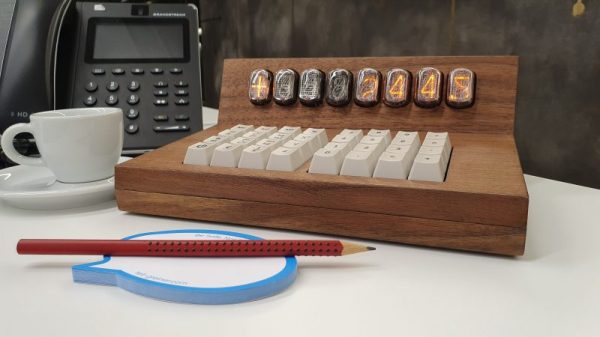
The Nixie tube is one of the most popular display technologies amongst the hacker and maker set. Glowing numerals can warm even the coldest heart, particularly when they’re energized with hundreds of volts. [ohad.harel] used these glorious displays to build the TORI Nixie Calculator, with beautiful results. 

The build uses seven IN-12 Nixie tubes for numerals, along with an IN-15A which displays mathematical symbols like +, %, and M. It’s equipped with a 32-key keyboard using mechanical key switches. Everything is wrapped up in a beautiful walnut enclosure that fits the tubes and keyboard perfectly, giving the final build a nice mid-century aesthetic.

Impressively, it goes beyond the basic usual calculator functions, also handling conversions between metric and imperial units. It’s a nice feature that would make it a wonderful tool to have on one’s desk beyond the simple aesthetic charm of the Nixie tubes.

Nixie projects never seem to die. Their beauty and warmth captivates builders to this day. Indeed, we’ve even seen some makers go to the trouble of creating new tubes from scratch!

Eyes On The Prize!

This year’s Hackaday Prize is off to a roaring start. And that’s fantastic, because this year’s challenge is a particularly important one: reducing mankind’s footprint on the earth through better energy collection, better resource use, and keeping what we’ve already got running a little bit longer. Not only is this going to be the central challenge for the next century, but it’s also a playground for hackers like us.

The first phase, Planet-Friendly Power, is in full swing, and we saw some entries on the first day! Were they cheating? Did they have inside information? Nope! Tons of hackers are working on energy efficient ways to drive their projects all along. If your Raspberry Pi data-logger can run on the fuel of the sun, it’s not only better for the world, but it’s a project that you don’t have to remember to change the batteries on.

We’ve got a challenge on recycling, one on reverse engineering stuff to keep it out of the landfill, and one on environmental monitoring and communications infrastructure. These are all great hacker topics, and showcase how folks like us can do our small parts to keep the world running without running it into the ground.

So all of you out there making mesh networks, optimizing solar projects, hacking open closed IoT networks to keep them from obsolescence, or building plastic-sorting robots, this is your chance to get some money and some recognition for your good work.

Thanks again to our Supplyframe overlords for consistently backing and believing in the purpose of the Hackaday Prize, and also to DigiKey who’s been a sponsor of the Prize many years running! Without them, we wouldn’t be able pull this off.

Hack the planet! (Non-ironically, and literally. And get money for doing it.) Hooray for the Hackaday Prize!

Enter The 2022 Hackaday Prize And Help Save The World

The biggest challenge facing humanity over the next century is how to do as much or more, with less environmental impact. Reducing our collective footprint on the planet is of course not any one person’s responsibility alone, and if it’s going to require a million clever solutions to create a sustainable future, then we know just the group of hackers to get to work.

This year’s 2022 Hackaday Prize challenges you to think of big or small ways to create greener energy sources, make recycling easier, hack old devices to save them from the landfill, or build out the networks that keep our local communities together and conscious of our group effort. If you’ve got a super solar harvester, a recycling robot, or even reverse engineering tools to help combat forced technological obsolescence, we want to see your hacks. Or if you’d like, you can simply save the world in the wildcard round.

As always, courtesy of our overlords at Supplyframe and the generous sponsorship of Digikey, we’ve got tons of prize money to give out to the best projects. The top ten projects in each of five challenge rounds will receive a $500 cash prize, and five winning projects will bag from $5,000 to $50,000 in the finals in November. But you shouldn’t wait — the first round, Planet-Friendly Power, starts right now!

Get your team together, start brainstorming an idea, post it up on Hackaday.io to enter in the Prize, and you’re on your way. Independent of the judging, we’ll be looking through the field and writing up awesome projects as we find them. This is your chance to be seen, to help create a better world, and maybe even to win big.

Challenge Date The Details
Planet-Friendly Power Mar 29 – May 1 Your solution should lower the cost of clean energy, through energy harvesting and/or storage efficiency improvements.
Reuse, Recycle, Revamp May 1 – June 12 Your project facilitates recycling of material that would otherwise end up in the waste stream.
Hack it Back June 12th – July 24 Your project adds new capabilities to older electrical gear to keep it useful.
Climate Resilient Communities July 24 – Sept 4 Design devices that help communities be more resilient to weather and climate disasters and/or collect data from their environments so that they may advocate for changes in local infrastructure.
Save the World Wildcard Sept 4 – Oct 16th This is where anything goes, your designs should stand apart from the other challenges but still create a more promising future for all.

Continue reading “Enter The 2022 Hackaday Prize And Help Save The World”

Announcing: The 2022 Hackaday.io Sci-Fi Contest

Ladies and Gentlemen, Sentient robots, Travellers from the distant future, or Aliens from the outer rim, it’s time to enter the 2022 Hackaday.io Sci-Fi Contest!

We last ran the Sci-Fi contest in the far, far past — before the Voigt-Kampff machine was detecting replicants on the gritty streets of 2019’s LA. Back then, we had some out-of-this-world entries. It’s time for the sequel.

Thanks to Digi-Key, the contest’s sponsor, your best blaster, your coolest costume, or your most righteous robot could win you one of three $150 shopping sprees in their parts warehouse. Create a Hackaday.io project, enter it in the contest, and you’re set. You might as well do that right now, but the contest closes on April 25th.

Sci-Fi is all about the looks, so if it’s purely decorative, be sure to blind us with science (fiction). If your project actually functions, so much the better! Of course we’d like to know how it works and how you made it, so documentation of the project is the other big scoring category. Whatever it is, it’s got to be sci-fi, and it’s got to have some electronics in it.

If you’re looking for inspiration, you could do a lot worse than to check out [Jerome Kelty]’s Animatronic Stargate Helmet, that not coincidentally took the grand prize last time around. It’s an artistic and engineering masterpiece all rolled into one, and the description of how it’s made is just as extensive. [Jochen Alt]’s “Paul” robot isn’t out of any particular sci-fi franchise that we know, but of rolling on one ball and reciting robot poetry, it absolutely should be.

Honorable Mentions

In addition to the overall prizes, we’ll be recognizing the best projects in the following honorable mention categories:

  • Star Star: Whether you’re “beam me up” or “use the force”, fans of either of the “Star” franchises are eligible for this honorable mention.
  • ExoSuit: This category recognizes sci-fi creations that you can wear. Costumes and armor fit in here.
  • Stolen off the Set: If your blaster looks exactly like Han Solo’s, you’re a winner here.  This is the category for your best prop replica.
  • Living in the Future: If your sci-fi device was purely fantasy when imagined, but now it’s realizable, you’re living in the future. A working tricorder or a functioning robot companion would fit in fine here.
  • The Most Important Device: Has no function, but it certainly looks like it does. Just blinking lights that blink back and forth, yet the government spent millions of dollars on it.

You don’t have to tell us where your project fits in. We’ve got you covered.

Engage!

Get started now by creating a project page on Hackaday.io. In the left sidebar of your project page, use the “Submit Project To” button to enter in the 2022 Sci-Fi Contest.

You have from now until April 25, 2022 to get it finished. Of course, if your time machine actually works, you can finish it whenever. Check out the Hackaday.io contest page for all the fine print.

8-bit counter made from 555s

555 Timer Contest Entry: A Digital Counter With Nothing But 555s

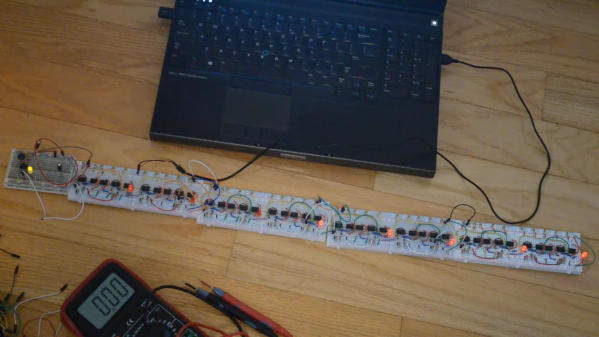
With a 555 on the BOM, you never know what you’re going to get. With 40 of the versatile timer chips in a build, you might just get something completely unexpected, like this 555-based eight-bit digital counter.

This one comes to us by way of [Astronomermike], who chose to make a digital circuit with nothing but 555s and a largish handful of passives as his entry in the current 555 Timer Contest. The ubiquitous timer chip is not exactly the first chip that comes to mind for digital applications, but it does contain an SR latch, which only requires a little persuasion to become a JK flip flop. His initial design for the flip flop that would form the core of the circuit had a pair of 555s surrounded with a bunch of OR gates and inverters — within the rules of the contest but hardly in its spirit. Luckily, the 555 makes a fine inverter too, and along with some diode-resistor OR gates, the basic counter module was born.

The video below shows the design and build, as well as the trip down the troubleshooting rabbit hole courtesy of a bad breadboard. Each half-nibble stage of the 8-bit counter occupies a full breadboard with ten 555s; the whole 40-chip string actually works and looks pretty cool doing it.

Truth be told, this is exactly the kind of thing we had in mind when dreaming up this year’s 555 contest, so good on [Astronomermike] for thinking outside the box for this one. To see what other uses people have found for the chip that keeps on giving, or to get your entry in before the deadline on January 10, head over to the contest page.

Continue reading “555 Timer Contest Entry: A Digital Counter With Nothing But 555s”