2022 Sci-Fi Contest: Glowing LED Cubes Make Captivating Artifacts

LED cubes were once an exercise in IO mastery, requiring multiplexing finesse in order to drive arrays of many LEDs. Going RGB only increased the challenge. This build from [DIY GUY Chris] shows how much easier it is these days, when every LED has a smart addressable controller on board, and serves as a great sci-fi prop to boot.

Yes, the build relies on the venerable WS2812B addressable LEDs, soldered up in 5×5 grids on each of the six faces of the cube. Running the show is the Raspberry Pi RP2040 microcontroller, sourced here as an individual part rather than in its development board form. An SPI memory chip is on board for the code, along with a USB-C connector for programming. Signals pass around the cube via soldered connections along the edges of the custom PCBs that make up the faces of the solid.

Sitting on its 3D printed stand, the cube glows brightly while drawing a full 2 amps of power. [Chris] coded up a variety of animations, from simple color breathing routines to frantic dazzle animations sure to captivate any cyberpunk thieves that come to steal your magic glowing artifact.

If rectangular prisms aren’t your fancy, though, you can always consider building yourself a glowing D20 instead. Video after the break.

Continue reading “2022 Sci-Fi Contest: Glowing LED Cubes Make Captivating Artifacts”

2022 Sci-Fi Contest: The Animatronic Baby Yoda You’ve Always Wanted

Simple robot parts make up the internals.

When it comes to sci-fi, it’s hard to go past Star Wars, and many submissions to our contest land in that exact universe. [Kevin Harrington]’s entry is one such example, with his animatronic Baby Yoda that’s exactly as cute as you’d hope it would be.  

The build is based on a Pololu Romi chassis, a simple two-wheeled differential-drive robot platform. It’s paired with a robot arm in the form of Hephaestus Arm 2, which provides the articulation for the precocious little creature. An ESP32 microcontroller serves as the brains of the operation, controlling all the servos and motors that make baby Yoda move. Control is via WiFi, using a website hosted on the ESP32 via RBE1001lib.

The animatronic baby Yoda would surely be a hit sitting on one’s shoulder at any sci-fi convention. Overall, it’s a simple robot that becomes more personable by skinning it with an adorable toy. It’s not the first baby Yoda (or Grogu) that we’ve seen, either – the popular character has inspired builds before, too! Video after the break.

Continue reading “2022 Sci-Fi Contest: The Animatronic Baby Yoda You’ve Always Wanted”

2022 Sci-Fi Contest: Schrödinger’s Trigger Is Trained On Electrons, Not Cats

While it’s true that Hackaday scribes and their families are sadly unable to compete in our contests, Hackaday alum are more than welcome to throw their hat in the ring. [Legionlabs] even made a game of it — they used only parts from the scrap heap, and even played beat the clock to build a real, science-fictiony, working thing in eight hours or less.

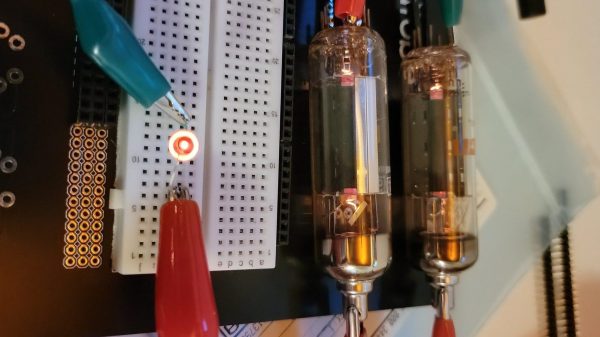
Okay, cool, but what does it do? Well, put simply, a rising edge on the input drives one of two outputs, lighting one of two drool-worthy flanged LEDs. Which output will [alight] is unknowable until observed, thus the Schrodinger’s aspect. In practice, the output is determined by sampling. In this case, the sampling is of the time difference between three electron-tunneling events.

Stage one of Schrodinger’s Trigger is a pair of inputs — one variable 10-15 VDC input and 5 VDC input. Then comes the electron-tunneling event generator. [Legionlabs] is reverse-biasing a semiconductor junction (a 2N551 transistor). What does that mean? If we consider the junction as a diode and apply voltage in the wrong direction, what happens? At best, nothing; at worst, the smoke monster appears to admonish us.

But with a semiconductor acting as a diode, some electrons are bound to jump across the junction. This is known as tunneling, and is a useful phenomenon as it is purely random.

Stage three consists of amplifying the signal from these rebel electrons via hex inverters. Why not op-amps? The CD4069s were cheaper and within reach. Finally, the amplified signals are sampled with an ATtiny12, and some assembly logic figures out which LED to light.

It’s nice to see an entry that leans more toward the science side of things while winning aesthetically. We dig the nice ABS enclosure, and are totally envious of [Legionlabs]’ access to flanged LEDs and those glass table top mounting point discs in the corners.

2022 Sci-Fi Contest: Motorized AT-AT Walker Gets Around With Servos

The AT-AT Walker was one of the more fearsome weapons of the Star Wars universe, even if it was incredibly slow and vulnerable to getting tangled up in Rebel tow cables. However, you can build your own small-scale example using servos for propulsion, as [Luke J. Barker] ably demonstrates.

Taking off the outer shell reveals the servo motors driving the leg linkages.

The build is a remix of the motorized AT-AT from [LtDan] on Thingiverse, originally powered by a 90 rpm DC gearmotor. [Luke] remixed the design, setting it up to be driven by eight servomotors instead. They’re controlled from a SparkFun RedBoard Edge, an Arduino-compatible microcontroller board that fits rather neatly inside the AT-AT shell.

Programmed with a simple sine-wave walk cycle, the AT-AT ambles along in a ponderous manner. It’s altogether very much like the real fictitious thing, albeit without the scorching sizzle of blaster fire ringing out across a frozen plain.

Quadruped vehicles never really caught on for military use, but that’s not to say nobody ever tried. Video after the break.

Continue reading “2022 Sci-Fi Contest: Motorized AT-AT Walker Gets Around With Servos”

The 2022 Hackaday Prize Hack Chat Kicks Things Off

The 2022 Hackaday Prize is on, and we’ve already seen some incredible submissions by folks who believe their idea just might have what it takes to make the world a better place. But as with all contests, it’s good to understand all the rules before you get too involved. We promise nothing’s hidden in the fine print, but we certainly don’t fault anyone who wants to make sure.

Which is why Majenta Strongheart, Head of Design and Partnerships at our parent company Supplyframe, stopped by this week’s Hack Chat to answer any and all questions the community had about this global hardware design challenge. A lot of ground was covered in an hour, with Majenta making sure everyone’s questions and concerns were addressed to their satisfaction. After all, with a residency at the Supplyframe DesignLab and a total of $125,000 in prize money up for grabs, we want to make sure everyone’s got the facts straight.

So what burning questions did the Hackaday community have about this year’s Prize? Several people wanted to know more about the themes of sustainability, circularity, and climate crisis resiliency. For example, what exactly does circularity mean in this context? While Challenge #2 “Reuse, Recycle, Revamp” most clearly exemplifies the idea, Majenta explained that this time around the judges will be giving particular consideration to ideas that limit the extraction of raw materials and the production of waste.

For a practical example, 2022 Hackaday Prize judge James Newton pointed to the direct granule extruder designed by Norbert Heinz. The project, which took 5th place last year, allows waste plastic to easily be repurposed in a desktop 3D printer. This includes objects which the printer itself produced, but for whatever reason, are no longer desired or needed. This “life-cycle” for printed objects, wherein the same plastic can be printed over and over again into new objects, is a perfect encapsulation of circularity within the context of this year’s prize.

Others were looking for clarification on the contest rules. Specifically, there was some confusion about entering existing projects into the competition. Did it have to be a completely new idea? What if you’d already been working on the project for years, but had never shown it publicly before? Not to worry — existing projects can absolutely be entered into the 2022 Hackaday Prize. In fact, even if the project had already been entered into the Hackaday Prize previously, it’s still fair game.

But there is an important caveat: to be eligible for this year’s Prize, the project MUST be documented on a new Hackaday.io page. Additionally, if it’s a project that has previously been entered into a Hackaday contest, you’ll have to show that it is “significantly different from when previously entered and show meaningful development during the course of the Contest“, as stated in the official rules. In layman’s terms, it means that anyone who tries to submit and old and outdated Hackaday.io page into the competition will find their entry disqualified.

Towards the end of the Chat, Erin Kennedy, a Hackaday Prize veteran that readers may know better as “Erin RobotGrrl” brought up the subject of mentors. In previous years, hardware luminaries like Andrew “Bunnie” Huang and Mitch Altman were made available to offer advice and guidance to the individuals and teams behind the Prize entries. While very proud of this effort, Majenta explained that at least for now, Mentor Sessions are on hold until that aspect of the program can be retooled. The main issue is figuring out the logistics involved; planing video calls between several groups of busy folks is just as tricky as it sounds. That said, bringing the Mentor Sessions back for 2022 isn’t completely out of the question if there’s enough interest from the competitors.

We appreciate Majenta taking the time to directly answer questions from the community, and hope that those who had their questions or concerns addressed during the Chat will ultimately decide to toss their hat into the ring. With a worthy goal and plenty of opportunities to win, we sincerely want to see as many people as possible get their entries in before the October 16th deadline. If you’re ready to take the next step, head over to the Contest page and show us what you’ve got.


The Hack Chat is a weekly online chat session hosted by leading experts from all corners of the hardware hacking universe. It’s a great way for hackers connect in a fun and informal way, but if you can’t make it live, these overview posts as well as the transcripts posted to Hackaday.io make sure you don’t miss out.

2022 Sci-Fi Contest: Nixie Calculator Is Resplendent In Walnut Enclosure

The Nixie tube is one of the most popular display technologies amongst the hacker and maker set. Glowing numerals can warm even the coldest heart, particularly when they’re energized with hundreds of volts. [ohad.harel] used these glorious displays to build the TORI Nixie Calculator, with beautiful results. 

The build uses seven IN-12 Nixie tubes for numerals, along with an IN-15A which displays mathematical symbols like +, %, and M. It’s equipped with a 32-key keyboard using mechanical key switches. Everything is wrapped up in a beautiful walnut enclosure that fits the tubes and keyboard perfectly, giving the final build a nice mid-century aesthetic.

Impressively, it goes beyond the basic usual calculator functions, also handling conversions between metric and imperial units. It’s a nice feature that would make it a wonderful tool to have on one’s desk beyond the simple aesthetic charm of the Nixie tubes.

Nixie projects never seem to die. Their beauty and warmth captivates builders to this day. Indeed, we’ve even seen some makers go to the trouble of creating new tubes from scratch!

Eyes On The Prize!

This year’s Hackaday Prize is off to a roaring start. And that’s fantastic, because this year’s challenge is a particularly important one: reducing mankind’s footprint on the earth through better energy collection, better resource use, and keeping what we’ve already got running a little bit longer. Not only is this going to be the central challenge for the next century, but it’s also a playground for hackers like us.

The first phase, Planet-Friendly Power, is in full swing, and we saw some entries on the first day! Were they cheating? Did they have inside information? Nope! Tons of hackers are working on energy efficient ways to drive their projects all along. If your Raspberry Pi data-logger can run on the fuel of the sun, it’s not only better for the world, but it’s a project that you don’t have to remember to change the batteries on.

We’ve got a challenge on recycling, one on reverse engineering stuff to keep it out of the landfill, and one on environmental monitoring and communications infrastructure. These are all great hacker topics, and showcase how folks like us can do our small parts to keep the world running without running it into the ground.

So all of you out there making mesh networks, optimizing solar projects, hacking open closed IoT networks to keep them from obsolescence, or building plastic-sorting robots, this is your chance to get some money and some recognition for your good work.

Thanks again to our Supplyframe overlords for consistently backing and believing in the purpose of the Hackaday Prize, and also to DigiKey who’s been a sponsor of the Prize many years running! Without them, we wouldn’t be able pull this off.

Hack the planet! (Non-ironically, and literally. And get money for doing it.) Hooray for the Hackaday Prize!