Competitive Soldering Is Now A Thing

At Hackaday, we’re constantly impressed by the skill and technique that goes into soldering up some homebrew creations. We’re not just talking about hand-soldering 80-pin QFNs without a stencil, either: there are people building charlieplexed LED arrays out of bare copper wire, and using Kynar wire for mechanical stability. There are some very, very talented people out there, and they all work in the medium of wire, heat, and flux.

At this year’s DEF CON, we opened the floodgates to competitive soldering. Along with [Bunny] from Hardware Hacking Village and the many volunteers from the HHV and Soldering Skills Village, dozens competed to solder up a tiny kit full of LEDs and microscopic resistors.

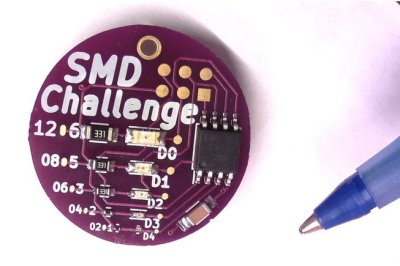
The kit in question was an SMD Challenge Kit put together my MakersBox, and consisted of a small PCB, an SOIC-8 ATtiny, and a LED and resistor for 1206, 0805, 0603, 0402, and 0201 sizes. The contest is done in rounds. Six challengers compete at a time, and everyone is given 35 minutes to complete the kit.

We’ve seen — and participated in — soldering challenges before, and each one has a slightly unique twist to make it that much more interesting. For example, at this summer’s Toorcamp, the soldering challenge was to simply drink a beer before moving to the next size of parts. You would solder the 1206 LED and resistor sober, drink a beer, solder the 0805, drink a beer, and keep plugging away until you get to the 01005 parts. Yes, people were able to do it.

Of course, being DEF CON and all, we were trying to be a bit more formal, and drinking before noon is uncouth. The rules for this Soldering Challenge award points on five categories: the total time taken, if the components are actually soldered down, a ‘functionality’ test, the orientation of the parts, and the quality of the solder joints.
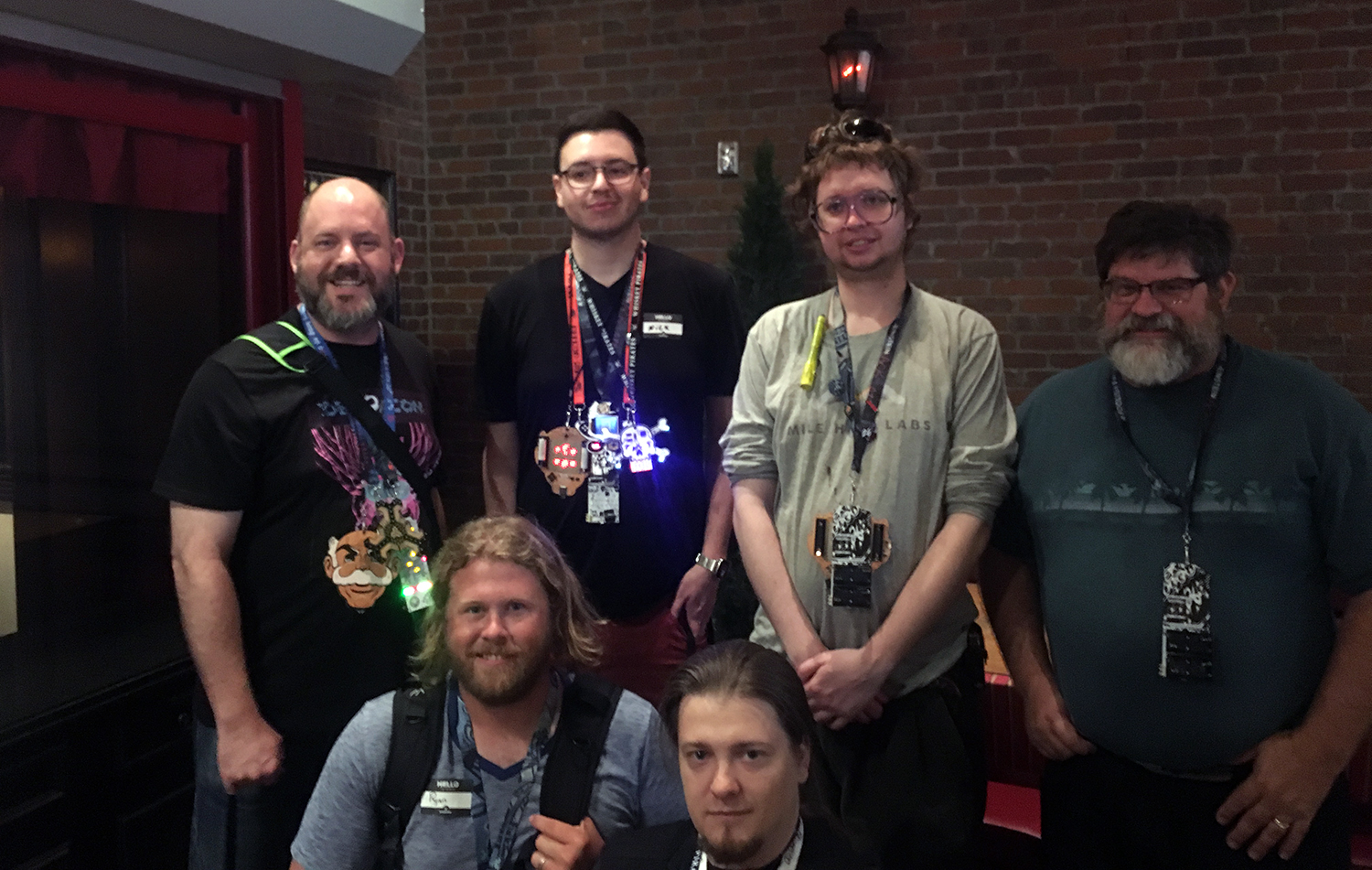
The winners of the soldering challenge, at the Hackaday Breakfast Meetup at DEF CON 26

So, with those rules in place, who won the Soldering Challenge at this year’s DEF CON? Out of a total 25 points, the top scorers are:

  • [True] – 23 pts
  • [Rushan] – 19 pts
  • [Ryan] – 18 pts
  • [Beardbyte] – 18 pts
  • [Casey] – 18 pts
  • [Bob] – 18 pts
  • [Nick] – 18 pts
  • [JEGEVA] – 18 pts

The Soldering Challenge had an incredible turnout, and the entire Soldering Skills Village was packed to the gills with folks eager to pick up an iron. The results were phenomenal!

We’d like to extend a note of thanks to [Bunny], the Hardware Hacking Village, the Soldering Skills Village, and MakersBox for making this happening. It was truly a magical experience, and now that competitive soldering is a thing, we’re going to be doing this a few more times. How do you think this could be improved? Leave a note in the comments.
Blink A Pi, Win A Prize

You can plug in a Raspberry Pi, and you can blink a LED. You can visualize data, and now there’s a contest on Hackaday.io to show off your skills. Right now, we’re opening up the Visualize It With Pi contest on Hackaday.io. The challenge? Visualize data with LED strips and panels. Is that ‘data’ actually just a video of Never Gonna Give You Up? We’ll find out soon enough.

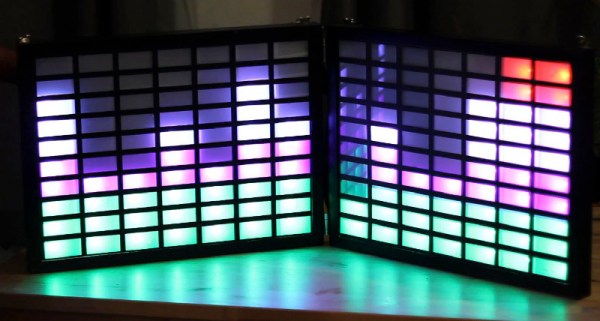
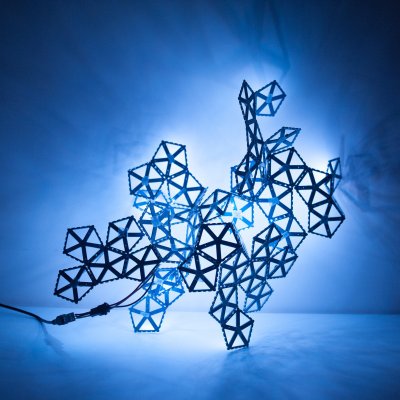
The goal of this contest is to combine a Raspberry Pi and its immense processing power and the blinky goodness of LED strips and panels to visualize and interpret data in novel and artistic ways. We’re looking for animation. clarity, and flamboyant flickering. Want some ideas? Check out the World of Light or the American Constitution Candle. We’re looking for the most blinky you can do with a Pi, and yes, there will be prizes.

Prizes

BlinkyTile Explorers Kit

Prizes for the best blinky include, of course, more blinky. The best visualizations from a directly connected sensor, data from an Internet Source, and data from an esoteric data source will each receive some Blinkytape. This is a strip of WS2812b LEDs with an ATMega32u4 embedded on the end. Plug a USB power supply into the Blinkytape, and you get a strip of LEDs in whatever color you want with the ability to push animation frames to the chip on the strip. The Grand Prize winner for this contest will also receive Blinkytile Explorers Kit, a Serpentine LED strip, a LED ring, and two meters of ultra thin LED strip.

Let’s Do This!

The requirements for the contest are simple: just use a Raspberry Pi to drive LED strips or panels, post it as a new project on Hackaday.io, and submit the project to the contest. We’re looking for a full description, source, schematics, and photos and videos of the finished version of the project — do everything you can to show off your work! The contest is open right now, and ends at 08:00 Pacific on October 1st. We know you like to blink those LEDs, so get crackin’.

DARPA Goes Underground For Next Challenge

We all love reading about creative problem-solving work done by competitors in past DARPA robotic challenges. Some of us even have ambition to join the fray and compete first-hand instead of just reading about them after the fact. If this describes you, step on up to the DARPA Subterranean Challenge.

Following up on past challenges to build autonomous vehicles and humanoid robots, DARPA now wants to focus collective brainpower solving problems encountered by robots working underground. There will be two competition tracks: the Systems Track is what we’ve come to expect, where teams build both the hardware and software of robots tackling the competition course. But there will also be a Virtual Track, opening up the challenge to those without resources to build big expensive physical robots. Competitors on the virtual track will run their competition course in the Gazebo robot simulation environment. This is similar to the NASA Space Robotics Challenge, where algorithms competed to run a virtual robot through tasks in a simulated Mars base. The virtual environment makes the competition accessible for people without machine shops or big budgets. The winner of NASA SRC was, in fact, a one-person team.

Back on the topic of the upcoming DARPA challenge: each track will involve three sub-domains. Each of these have civilian applications in exploration, infrastructure maintenance, and disaster relief as well as the obvious military applications.

  • Man-made tunnel systems
  • Urban underground
  • Natural cave networks

There will be a preliminary circuit competition for each, spaced roughly six months apart, to help teams get warmed up one environment at a time. But for the final event in Fall of 2021, the challenge course will integrate all three types.

More details will be released on Competitor’s Day, taking place September 27th 2018. Registration for the event just opened on August 15th. Best of luck to all the teams! And just like we did for past challenges, we will excitedly follow progress. (And have a good-natured laugh at fails.)

The Square-Inch Project Rides Again!

Want to play a game? Your challenge is to do something incredible with a printed circuit board that measures no more than one inch by one inch. It’s The Return of the One Square Inch Project and it’s going to be amazing!

We can’t believe that it’s been three years! The original One Square Inch Project was a contest dreamt up by Hackaday.io user [alpha_ninja] back in 2015, and we thought it was such a great idea that we ponied up some prizes. The entries were, frankly, the best we’ve ever seen. So we’re doing it again!

Last time around, the size constraint focused the minds and brought out the creativity in some of the best and brightest of Hackaday.io. What functionality or simply amusement can you pack into a square PCB that’s just a tad over 25 mm on a side? We’d like to see.

We’ll be featuring entries throughout the contest. We think geek ‘cred is the best reward but if you want something more to sweeten the pot here you go:

  • Grand Prize:

    • $500 Cash!
  • Four Top Entries Win Tindie Gift Certificates:

    • Best Project – $100
    • Best Artistic PCB Design – $100
    • Best Project Documentation – $100
    • Best Social Media Picture or Video – $100
  • Five Runner-Up Entries:

    • $100 OSH Park gift cards
Quadcopter in One Inch

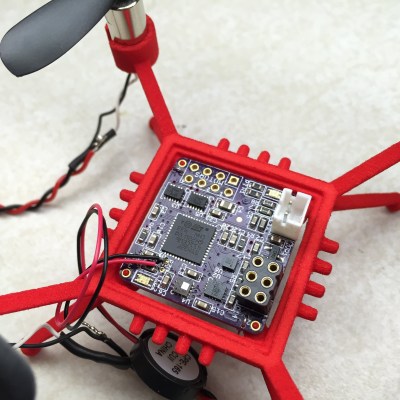
Want some inspiration? Last time the winner was a quadcopter in one square inch, but there were tons of useful and amusing projects crammed into tight quarters, and many of them transcend their constraints. There were not one but two hi-fi sound cards: one for your laptop’s USB port and one for your microcontroller projects that is now officially supported by the Teensy Audio Library. Need a MPPT power converter for a small solar project? How about a plug-load meter that fits on a US mains plug or an I2C to WS2818 converter to make blinking easier?

There were breakout boards for nearly every imaginable chip, a radio downconverter from our own [Jenny List], and a great magnetic rotary encoder design. Key Pass, an Arduino in the size of a DIP-8, and of course a bat detector, a bubble display volt meter, a smart watch, and a capacitive touch wheel.

It’s been three years, and parts have gotten cheaper, smaller, and more capable. What’s newly feasible in a square inch that wasn’t way back in 2015? Show us what you got.

SMD Soldering Challenge Lands At DEF CON

Strap on the jeweler’s loupe and lay off the caffeine for a few days. You’ll need to be at your peak for the SMD Soldering Challenge at this year’s DEF CON (number 26 for those counting).

It’s exciting to see that a Soldering Skills Village has been added to the conference this year. It will be in the same room as the Hardware Hacking Village. After all, who doesn’t want to solder at a conference? This soldering challenge is a great way to ring in the new village, and will take place in eight heats of six people for a total of 48 contestants. If you want to compete, make sure you get to the village right away and sign up for a slot!

A familiar board is being used for the contest. It’s the SMD Challenge board which MakersBox developed. You can check out the Hackaday.io project page and even order one from their Tindie store if you like. The contest will be scored based on time, completion, functionality, precise orientation, and quality of the joints.

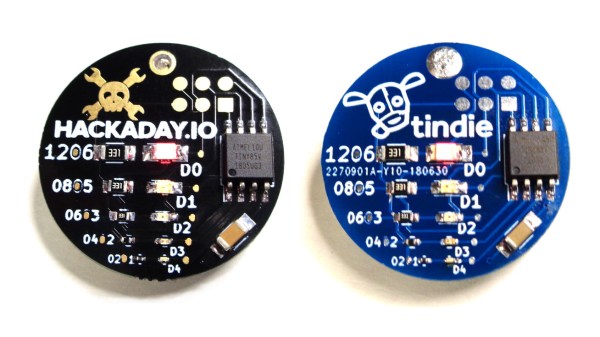
The SOIC ATtiny85 is a snap to place on the board, but things get harder with each step. To successfully complete it you need to solder both a resistor and an LED in 1206, 0805, 0603, 0402, and 0201 packages. Those oh-two-oh-ones are basically grains of sand… good luck with that! We’re really excited that MakersBox rolled some custom Hackaday and Tindie boards (pictured above) for this contest which we’re honored to sponsor. It sounds as if the winners will be announced during Hackaday and Tindie’s traditional Breakfast at DEF CON which is happening at 10:30am on Sunday in the HHV.

We plan to spectate during some of the heats and if you’re at the con you should too! For those participating, here’s our advice. Practice soldering the smallest of parts ahead of time (watch some videos on it at the very least). Bring a multimeter to test the diode polarity because you won’t be able to see the symbols on the smallest parts. You may even consider bringing some custom tools; this surface mount “clamp” comes to mind, you’ll just need a much smaller version.

If you have advice of your own, we’d love to hear it in the comments below!

Hot Camera Contest: Build A Battery Powered Thermal Camera

Here’s a challenge for all you hardware hackers out there. Peter Jansen has opened up the Hot Camera Contest on Hackaday.io to use a thermal imaging camera in a battery-powered project.

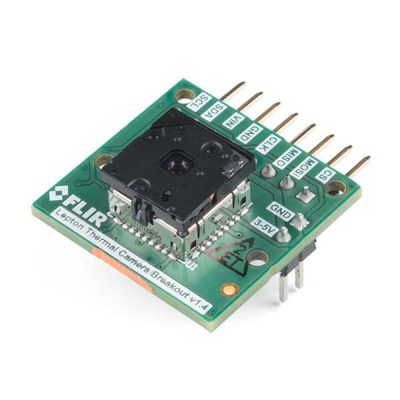
The challenge here is simple. Use a Flir Lepton thermal imaging camera module in a battery-powered configuration. There’s a catch, though: this is a project to use the Lepton in radiometric mode, where the camera spits out an actual temperature value for each pixel. Yes, this is a documented feature in the Flir Lepton module, but so far very few people are using it, and no one has done it with a small, battery-powered device.

The rules for this challenge are to use the Flir Lepton 2.5 in radiometric mode using either the Raspberry Pi Zero W or ESP32. Any software in this challenge must spit out absolute temperature values in a text format, and there must be a demonstration of putting the Flir Lepton into low-power mode. There are two challenges here, one for the Raspi and one for the ESP32; and winner will be named for each.

Getting More from a Fascinating Sensor

The Flir Lepton is a tiny little thermal camera that’s been available to the Maker community for some time now, first through GroupGets and now through Sparkfun. For a pair of Benjamins, the specs are very impressive: the Lepton has a resolution of 60×80 pixels and everything is can be read over an SPI port. The Lepton gives any project thermal imaging, and the PureThermal board turns the Lepton into a USB device.
Peter Jansen is the creator of the Open Source Science Tricorder (yes, it’s a tricorder) which took Fourth Prize in the 2014 Hackaday Prize. You can understand how he became interested in portable, and we’re sure whatever project he has in mind for this battery-powered Flir will be awesome.

This really is a great example of what the Hackaday.io community is capable of. The goal here is to create useful Open Source drivers for some very interesting hardware, and there’s some prizes to sweeten the pot. Peter has a $125 Sparkfun gift card on offer for each of the two winners. And the challenge of solving a tricky problem and making designs easier for others is a powerful motivator. Who doesn’t like a challenge?

Human-Computer Interface Challenge: Change How We Interact With Computers, Win Prizes

Pay no attention to the man behind the curtain. It’s a quote from the Wizard of Oz but also an interesting way to look at our interactions with electronics. The most natural interactions free us from thinking about the ones and zeros behind them. Your next challenge is to build an innovative interface for humans to talk to machines and machines to talk to humans. This is the Human-Computer Interface Challenge!

The Next Gen of HCI

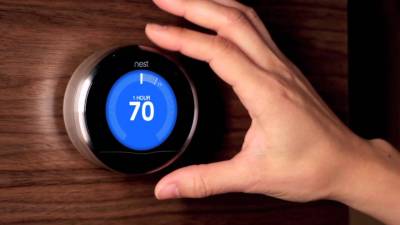
A Human-Computer Interface (or HCI) is what we use to control computers and what they use to control us get information to us. HCIs have been evolving since the beginning. The most recent breakthroughs include touchscreens and natural-language voice interaction. But HCI goes beyond the obvious. The Nest thermostat used a novel approach to learning your habits by observing times and days that people are near it, and when the temperature setting is changed. This sort of behavior feels more like the future than having to program specific times for temperature control adjustments. But of course we need to go much further.

You don’t need to start from scratch. There are all kinds of great technologies out there offering APIs that let you harness voice commands, recognize gestures, and build on existing data sets. There are chips that make touch sensing a breeze, and open source software suites that let you get up and running with computer vision. The important thing is the idea: find something that should feel more intuitive, more fun, and more natural.

The Best Interfaces Have Yet to Be Dreamed Up

No HCI is too simple; a subtle cue that makes sure you don’t miss garbage collection day can make your day. Of course no idea is too complex; who among you will work on a well-spoken personal assistant that puts Jarvis to shame? We just saw that computers sound just like people if you only tell them to make random pauses while speaking. There’s a ton of low-hanging fruit in this field waiting to be discovered.

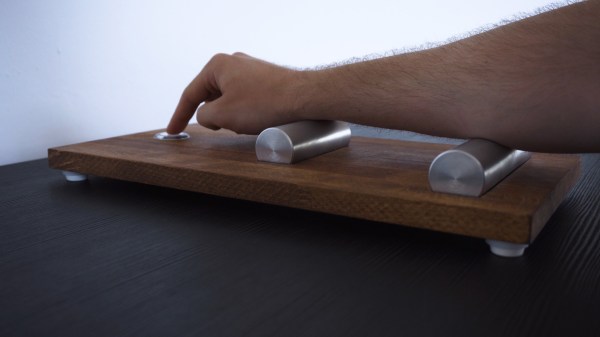
An HCI can be in an unexpected place, or leverage interactions not yet widely used like olfactory or galvanic responses.  A good example of this is the Medium Machine which is pictured above. It stimulates the muscles in your forearm, causing your finger to press the button. The application is up to you, and we really like it that Peter mentions that Medium Machine reaches for something that wouldn’t normally come to mind when you think about these interfaces; something that hasn’t been dreamed up yet. Get creative, get silly, have some fun, and show us how technology can be a copilot and not a dimwitted sidekick.

You have until August 27th to put your entry up on Hackaday.io. The top twenty entries will each get $1,000 and go on to the finals where cash prizes of $50,000, $20,000, $15,000, $10,000, and $5,000 await.