Hackaday has been around long enough to see incredible changes in what’s possible at the hobbyist level. The tools, techniques, and materials available today border on science-fiction compared to what the average individual had access to even just a decade ago. On a day to day basis, that’s manifested itself as increasingly elaborate electronic projects that in many cases bear little resemblance to the cobbled together gadgets which graced these pages in the early 2000s.
Kip Daugirdas
But these gains aren’t limited to our normal niche — hobbyists of all walks have been pushing their respective envelopes. Take for example the successful launch of MESOS, a homebuilt reusable multi-stage rocket, to the very edge of the Kármán line. It was designed and built by amateur rocket enthusiast Kip Daugirdas over the course of several years, and if all goes to plan, will take flight once again this summer with improved hardware that just might help it cross the internationally recognized 100 kilometer boundary that marks the edge of space.
We were fortunate enough to have Kip stop by the Hack Chat this week to talk all things rocketry, and the result was a predictably lively conversation. Many in our community have a fascination with spaceflight, and even though MESOS might not technically have made it that far yet (there’s some debate depending on who’s definition you want to use), it’s certainly close enough to get our imaginations running wild.
Humanity thus far has supplied most of its electricity needs by burning stuff, mostly very old stuff that burns great but is hard to replace. That stuff is getting increasingly expensive, and the pollution is a bother too, so renewable sources of energy are becoming more popular.
In the electronics world, even for the hobbyists, things have only gotten smaller over the years. We went from through-hole components to surface mount, and now we’re at the point where the experienced DIYers are coming around to the idea of using ball grid array (BGA) components in their designs. We’d wonder what things are going to look like in another couple decades, but frankly, it gives us the heebie-jeebies.
So while we’re pretty well versed these days in the hows and whys of tiny things, we see comparatively little large-scale engineering projects. Which is why we were excited to have Andy Oliver stop by this week for the Heavy Engineering Hack Chat. His day job sees him designing and inspecting the control systems for movable bridges — or what many would colloquially refer to as drawbridges.
Now you might think there’s not a lot of demand for this particular skill set, but we’re willing to bet there’s a lot more of these bridges out there than you realized. Andy kicked things off with the revelation that just between the states of Florida and Louisiana, there are about 200 movable bridges of various sizes. On a larger scale, he points out that BridgeHunter.com lists an incredible 3,166 movable bridges in their database, though admittedly many of those are historical and no longer standing. (There really is a site for everything!)
Andy Oliver
There’s also a huge incentive to keep the existing bridges functioning for as long as possible — building a new one these days could cost hundreds of millions of dollars. Instead, repairs and upgrades are the name of the game. Andy says that if it’s properly maintained, you should get about a century out of a good bridge.
It will probably come as little surprise to find that keeping things as simple as possible is key to making sure a movable bridge can withstand the test of time. While we might imagine that all sorts of high-tech automation systems are at work, and they probably would be if any of us were in charge, Andy says that most of the time it’s old school relay logic.
Even controlling the speed of motors is often down to using beefy relays to switch some additional resistance into the circuit. But when reliability and ease of repair are top priorities, who’s to argue against a classic? Andy recalled a time when a government client made it clear that the only tool you should need to maintain a particular bridge’s control system was a hammer.
Of course, when moving around a million pounds of steel, there’s more than just electrical considerations at play. You’ve also got to take into account things like wind forces on the bridge, specifically that your gears and motors can handle the extra load without tearing themselves apart. The bridge also needs an emergency stop system that can arrest movement at a moment’s notice, but not damage anything in the process.
A lot of fascinating details about these motorized behemoths were covered in the Chat, so we’d invite anyone who’s ever watched a bridge slowly reconfigure itself to peruse through the full transcript. Special thanks to Andy Oliver for stopping by and sharing some of the details about his unique career with the community, and remember that if you’ve got your own engineering stories to tell, we’d love to hear them.
The Hack Chat is a weekly online chat session hosted by leading experts from all corners of the hardware hacking universe. It’s a great way for hackers connect in a fun and informal way, but if you can’t make it live, these overview posts as well as the transcripts posted to Hackaday.io make sure you don’t miss out.
Since their relatively recent appearance on the commercial scene, rare-earth magnets have made quite a splash in the public imagination. The amount of magnetic energy packed into these tiny, shiny objects has led to technological leaps that weren’t possible before they came along, like the vibration motors in cell phones, or the tiny speakers in earbuds and hearing aids. And that’s not to mention the motors in electric vehicles and the generators in wind turbines, along with countless medical, military, and scientific uses.
These advances come at a cost, though, as the rare earth elements needed to make them are getting harder to come by. It’s not that rare earth elements like neodymium are all that rare geologically; rather, deposits are unevenly distributed, making it easy for the metals to become pawns in a neverending geopolitical chess game. What’s more, extracting them from their ores is a tricky business in an era of increased sensitivity to environmental considerations.
Luckily, there’s more than one way to make a magnet, and it may soon be possible to build permanent magnets as strong as neodymium magnets, but without any rare earth metals. In fact, the only thing needed to make them is iron and nitrogen, plus an understanding of crystal structure and some engineering ingenuity.
Remember old hard drives with their giant ribbon cables? They went serial and now the power cables are way thicker than the data cables. We’ve seen the same thing in embedded devices. Talking between chips these days tends to use I2C or SPI or some variation of these to send and receive data over a handful of pins. But now there is I3C, a relatively new industry standard that is getting a bit of traction.
I2C and SPI are mature but they do have problems. I2C can be relatively slow and SPI usually requires extra pins for each device. Besides that, there is poor support for adding and removing devices dynamically or discovering devices automatically.
I3C, created by the MIPI Alliance, aims to fix these problems. It does use the usual two wires, SCL for the clock and SDA for data. One device acts as a controller. Other devices can be targets or secondary controllers. It is also backward compatible with I2C target devices. Depending on how you implement it, speeds can be quite fast with a raw speed of 12.5 Mbps and using line coding techniques can go to around 33 Mbps.
A few years ago, I managed to get myself on a mailing list from a fellow who fancied himself an expert on energy. Actually, it seemed that no area was beyond his expertise, and the fact that EVERY EMAIL FROM HIM CAME WITH A SUBJECT LINE IN CAPS WITH A LOT OF EXCLAMATION POINTS!!!! really sealed the deal on his bona fides. One of the facts he liked to tout was that natural gas was the perfect fuel. Not only is it clean-burning and relatively cheap, it’s also delivered directly to consumers using a completely self-powered grid. Even under “zombie apocalypse” conditions, he claimed that natural gas would continue to flow.
At the time, it seemed a bit overstated, but I figured that there was at least a nugget of truth to it — enough so that I converted from an electric range and water heater to gas-powered appliances a couple of years ago, and added gas fireplaces for supplemental heat. I just sort of took it for granted that the gas would flow, at least until the recent kerfuffle over the Nordstream pipeline. That’s when I got a look at pictures of the immense turbine compressors needed to run that pipeline, the size and complexity of which seem to put the lie to claims about the self-powered nature of natural gas grids.
Surely a system dependent on such equipment could not be entirely self-powered, right? This question and others swirled doubt in my mind, and so I did what I always do in these cases: I decided to write an article so I could look into the details. Here’s what I found out about how natural gas distribution works, at least in North America.
Ask the average person about steam power and they’ll probably imagine a bygone era, a time when the sky was thick with smoke belched out by coal-burning locomotives and paddle-wheel ships. Steam is ancient technology they’ll say, and has as much to do with modern living as the penny-farthing.
Naturally, the real story is a bit more complex than that. Sure the reciprocating steam engine has fallen out of favor as a means of propulsion, but the concept of running machinery with steam is alive and well. In fact, unless you’re running on wind or solar power, there’s an excellent chance that a steam turbine is responsible for keeping the lights on in your house.
In honor of all things steam, we invited Quinn Dunki to host this week’s Hack Chat. Those who follow her exploits on YouTube will know that over the last several years she’s built a number of steam engines, from miniature scratch-built models to commercial kits that can do useful work. Who better to answer your burning steaming questions?
The first questions in the Chat were logical enough, with several users wanting to know just how hard it is to build a functional steam engine if you don’t have access to a mill or other means of high precision machining. According to Quinn, while better equipment will certainly allow you to build a more powerful and efficient engine, the basic premise is so simple that it doesn’t take much to get one going. If you’ve got a mini lathe and some bar stock, you’re half way there. In fact, they are so forgiving that she opines you’d struggle to build a steam engine that didn’t at least turn over — though that doesn’t mean it will necessarily run well.
Naturally some comparisons were drawn between the complexity of building a steam engine and putting together a small internal combustion engine (ICE). But while they might seem conceptually similar, Quinn cautions that building a working ICE from scratch is far more difficult and dangerous. She explains that steam engines have a tendency to fail gracefully, that is, mistakes in the design or poor tolerances generally result in little worse than wasted steam and extra noise. Comparatively, a faulty ICE design could easily turn into a bomb on your workbench.
Of course, that’s not to say working with steam is without danger. You certainly don’t want to underestimate high pressure steam, which is why boilers that are over 6 in (15 cm) in diameter or that produce more than 100 PSI will often require the operator to be licensed. They may also need to be inspected, though Quinn notes that your local government official probably won’t be able to make heads or tails of your homebrew build — so if you need an official stamp of approval, your best bet is to find a local model engineering club or society that would have the appropriate connections. All that being said, most hobbyists make it a point to try and get their engine running at the lowest pressure possible, so unless you’ve got something really massive in mind, you’ll probably never need to build up more than 60 PSI or so.
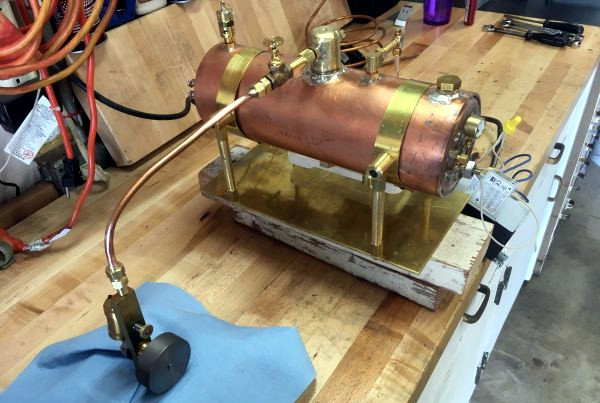
A DIY electric boiler and small steam engine.
Another topic of discussion was how to fuel the boiler itself. An electrically powered boiler is perhaps the easiest option, but is somewhat counterproductive if you hope to put your steam engine to useful work. Coal and wood fires are an option, and indeed were commonly used in the old days, but the soot and ash they produce can be a problem.
Quinn also notes that if you’re using such fuels, you need a way to quickly remove the firebox from the boiler in an emergency; something she likens to the starship Enterprise having to eject its warp core before it explodes. For her own projects, Quinn says she uses either an electric element or a camping gas burner.
While most of the questions during this Hack Chat had to do with the work Quinn has already featured on her blog and YouTube channel, naturally there were questions about where things go from here. After she completes the steam engine kit she’s working on currently, she says she’ll likely to back to another scratch-built engine. She also plans on coupling some of her engines to generators, as she’s gotten many requests about seeing these machines put to useful work. Looking further ahead Quinn says she’s interested in casting her own bronze and aluminum components, and specifically wants to work with “lost PLA” casting, which is a variant of lost wax casting that uses a mold based on a 3D printed part.
We’d like to thank Quinn Dunki for stopping by the Hack Chat and sharing some insights into this unique hobby. While a handcrafted boiler or a desktop steam reciprocating engine might not be on the average Hackaday reader’s list of future projects, it’s still fascinating to see how they work. We owe much of our modern life to steam power, so the least we can do is show it some respect.
The Hack Chat is a weekly online chat session hosted by leading experts from all corners of the hardware hacking universe. It’s a great way for hackers connect in a fun and informal way, but if you can’t make it live, these overview posts as well as the transcripts posted to Hackaday.io make sure you don’t miss out.