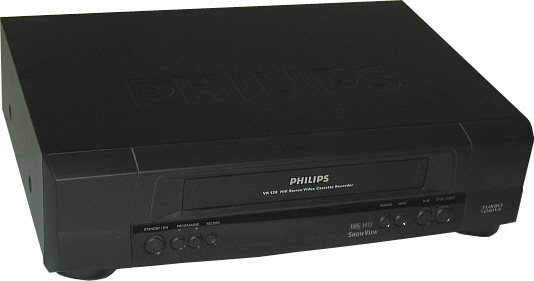
The news has been full of reports that the last company manufacturing consumer VCRs will cease making them this year. I think most of us are surprised that the event is only happening now. After all, these days, video recording is likely to be on a hard drive, a USB stick, or on a server somewhere. Even recording to DVDs seems a bit quaint these days.
Back before there were web sites, people had to get information from magazines like Popular Electronics, Radio Electronics, and a few others. In the late 1960s and early 1970s, it was common to see these magazines predict that this would be the year of the home video recording system. For example, in 1971, [Lou Garner] wrote: “…they [Sony] hope will put home videotape playing in the same living room as conventional high-fidelity sound systems.” You should know that the video cassette he was talking about was 8 inches wide by 5 inches deep (a big larger than a VHS tape) and contained 3/4 inch magnetic tape (VHS used 1/2 inch tape). The 32-pound player had a retail price of about $350 (about $2,000 in today’s dollars; remember gas was $0.36 a gallon and eggs were $0.53 a dozen). It would be several years before VHS and Betamax would duke it out for home supremacy.
When the story of an invention is repeated as Received Opinion for the younger generation it is so often presented as a single one-off event, with a named inventor. Before the event there was no invention, then as if by magic it was there. That apple falling on Isaac Newton’s head, or Archimedes overflowing his bath, you’ve heard the stories. The inventor’s name will sometimes differ depending on which country you are in when you hear the story, which provides an insight into the flaws in the simple invention tales. The truth is in so many cases an invention does not have a single Eureka moment, instead the named inventor builds on the work of so many others who have gone before and is the lucky engineer or scientist whose ideas result in the magic breakthrough before anyone else’s.
The history of computing is no exception, with many steps along the path that has given us the devices we rely on for so much today. Blaise Pascal’s 17th century French mechanical calculator, Charles Babbage and Ada, Countess Lovelace’s work in 19th century Britain, Herman Hollerith’s American tabulators at the end of that century, or Konrad Zuse’s work in prewar Germany represent just a few of them.
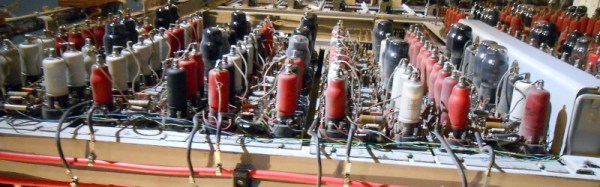
So if we are to search for an inventor in this field we have to be a little more specific than “Who invented the first computer?”, because there are so many candidates. If we restrict the question to “Who invented the first programmable electronic digital computer?” we have a much simpler answer, because we have ample evidence of the machine in question. The Received Opinion answer is therefore “The first programmable electronic digital computer was Colossus, invented at Bletchley Park in World War Two by Alan Turing to break the Nazi Enigma codes, and it was kept secret until the 1970s”.
It’s such a temptingly perfect soundbite laden with pluck and derring-do that could so easily be taken from a 1950s Eagle comic, isn’t it. Unfortunately it contains such significant untruths as to be rendered useless. Colossus is the computer you are looking for, it was developed in World War Two and kept secret for many years afterwards, but the rest of the Received Opinion answer is false. It wasn’t invented at Bletchley, its job was not the Enigma work, and most surprisingly Alan Turing’s direct involvement was only peripheral. The real story is much more interesting.
The recent movie “The Imitation Game” gave [Alan Turing] some well-deserved fame among non-computer types (although the historical accuracy of that movie is poor, at best; there have been several comparisons between the movie and reality). However, for people in the computer industry, Turing was famous for more than just helping to crack Enigma. His theoretical work on computing led to the Turing machine, which is still an important concept for reasoning about computers in a mathematical way. He also laid the foundation for the stored program computer that we take for granted today.
What’s a Turing Machine?
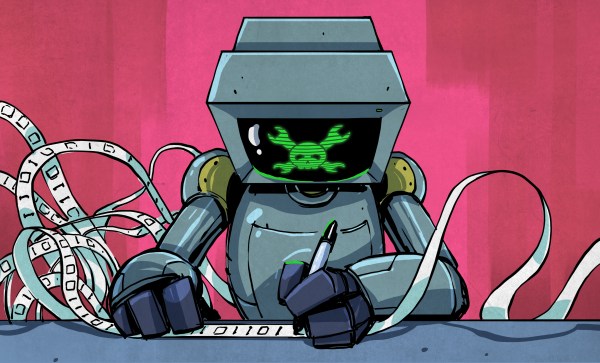
A Turing machine is deceptively simple and, like many mathematical models, highly impractical. Leading off the inpracticalities, the machine includes an infinite paper tape. There is a head that can read and write any symbol to the tape at some position, and the tape can move to the left or the right. Keep in mind that the head can write a symbol over another symbol, so that’s another practical difficulty, although not an insurmountable one. The other issue is that the symbol can be anything: a letter, a number, a jolly wrencher, or a bunch of dots. Again, not impossible, but difficult to do with practical hardware implementations.
The history of the diode is a fun one as it’s rife with accidental discoveries, sometimes having to wait decades for a use for what was found. Two examples of that are our first two topics: thermionic emission and semiconductor diodes. So let’s dive in.
Vacuum Tubes/Thermionic Diodes
Our first accidental discovery was of thermionic emission, which many years later lead to the vacuum tube. Thermionic emission is basically heating a metal, or a coated metal, causing the emission of electrons from its surface.
Electroscope
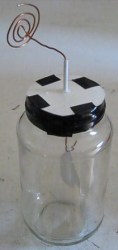
In 1873 Frederick Guthrie had charged his electroscope positively and then brought a piece of white-hot metal near the electroscope’s terminal. The white-hot metal emitted electrons to the terminal, which of course neutralized the electroscope’s positive charge, causing the leafs to come together. A negatively charged electroscope can’t be discharged this way though, since the hot metal emits electrons only, i.e. negative charge. Thus the direction of electron flow was one-way and the earliest diode was born.
Thomas Edison independently discovered this effect in 1880 when trying to work out why the carbon-filaments in his light bulbs were often burning out at their positive-connected ends. In exploring the problem, he created a special evacuated bulb wherein he had a piece of metal connected to the positive end of the circuit and held near the filament. He found that an invisible current flowed from the filament to the metal. For this reason, thermionic emission is sometimes referred to as the Edison effect.
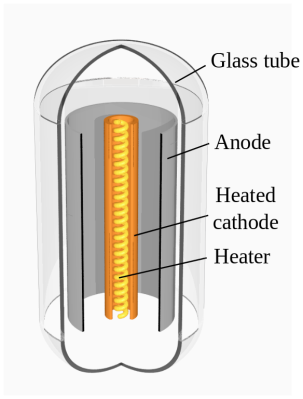
Thermionic diode. By Svjo [CC BY-SA 3.0], via Wikimedia CommonsBut it took until 1904 for the first practical use of the effect to appear. John Ambrose Fleming had actually consulted for the Edison Electric Light Company from 1881-1891 but was now working for the Marconi Wireless Telegraph Company. In 1901 the company demonstrated the first radio transmission across the Atlantic, the letter “S” in the form or three dots in Morse code. But there was so much difficulty in telling the received signal apart from the background noise, that the result was disputed (and still is). This made Fleming realize that a more sensitive detector than the coherer they’d been using was needed. And so in 1904 he tried an Edison effect bulb. It worked well, rectifying the high frequency oscillations and passing the signals on to a galvanometer. He filed for a patent and the Fleming valve, the two element vacuum tube or thermionic diode, came into being, heralding decades of technological developments in many subsequent types of vacuum tubes.
Vacuum tubes began to be replaced in power supplies in the 1940s by selenium diodes and in the 1960s by semiconductor diodes but are still used today in high power applications. There’s also been a resurgence in their use by audiophiles and recording studios. But that’s only the start of our history.
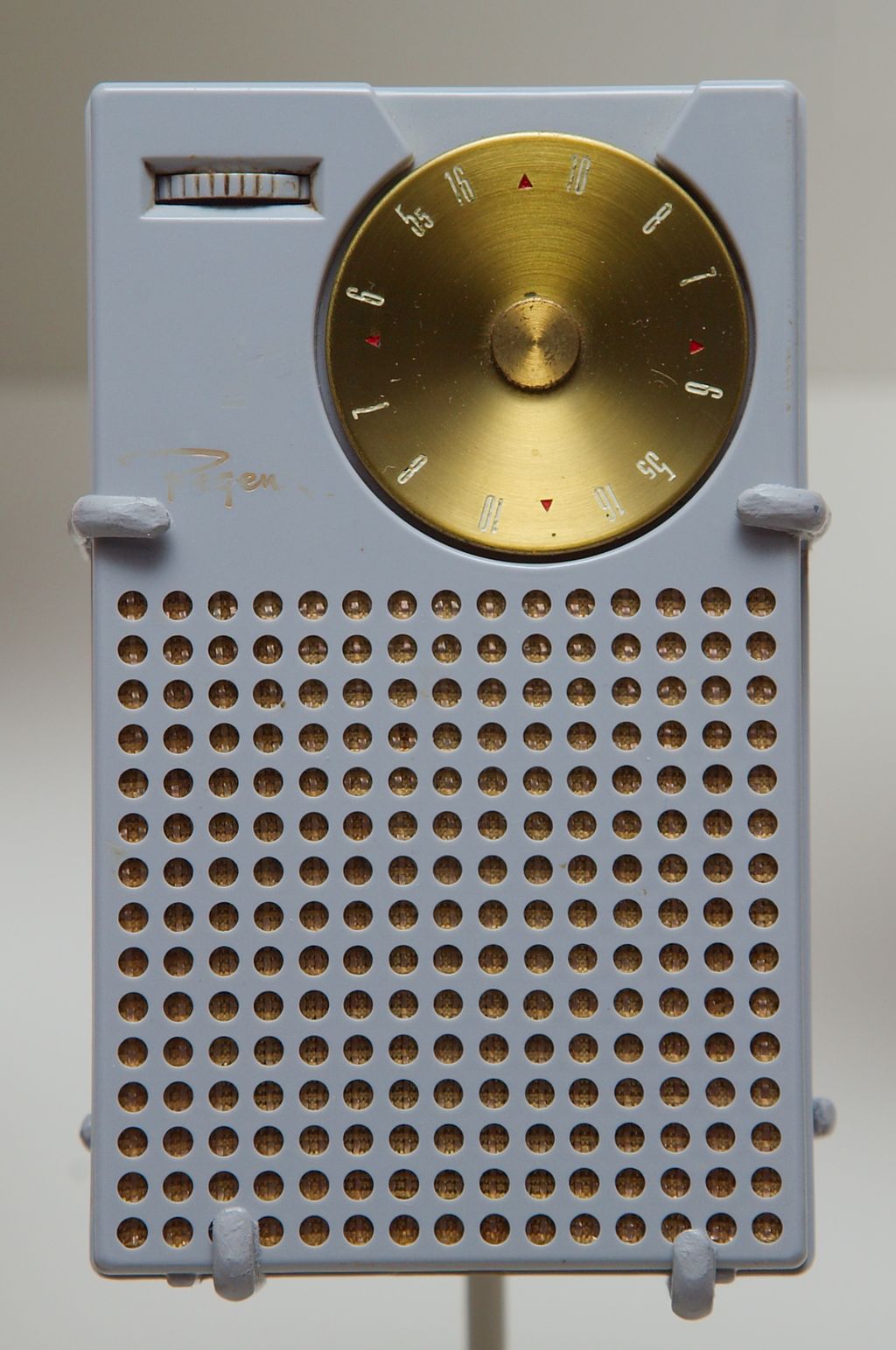
Transistors have come a long way. Like everything else electronic, they’ve become both better and cheaper. According to a recent IEEE article, a transistor cost about $8 in today’s money back in the 1960’s. Consider the Regency TR-1, the first transistor radio from TI and IDEA. In late 1954, the four-transistor device went on sale for $49.95. That doesn’t sound like much until you realize that in 1954, this was equivalent to about $441 (a new car cost about $1,700 and a copy of life magazine cost 20 cents). Even at that price, they sold about 150,000 radios.
Part of the reason the transistors cost so much was that production costs were high. But another reason is that yields were poor. In some cases, 4 out of 5 of the devices were not usable. The transistors were not that good even when they did work. The first transistors were germanium which has high leakage and worse thermal properties than silicon.
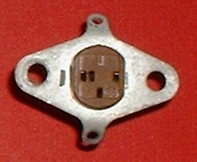
Early transistors were subject to damage from soldering, so it was common to use an alligator clip or a specific heat sink clip to prevent heat from reaching the transistor during construction. Some gear even used sockets which also allowed the quick substitution of devices, just like the tubes they replaced.
When the economics of transistors changed, it made a lot of things practical. For example, a common piece of gear used to be a transistor tester, like the Heathkit IT-121 in the video below. If you pulled an $8 part out of a socket, you’d want to test it before you spent more money on a replacement. Of course, if you had a curve tracer, that was even better because you could measure the device parameters which were probably more subject to change than a modern device.
Of course, germanium to silicon is only one improvement made over the years. The FET is a fundamentally different kind of transistor that has many desirable properties and, of course, integrating hundreds or even thousands of transistors on one integrated circuit revolutionized electronics of all types. Transistors got better. Parameters become less variable and yields increased. Maximum frequency rises and power handling capacity increases. Devices just keep getting better. And cheaper.
A Brief History of Transistors
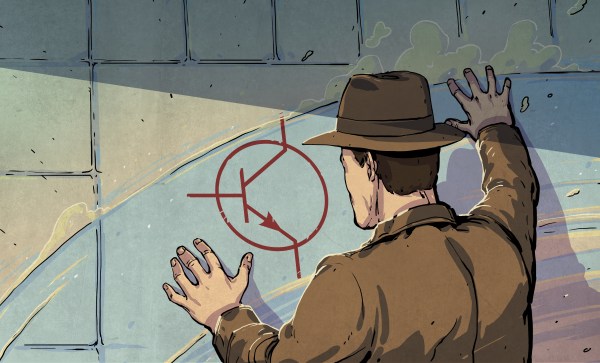
The path from vacuum tube to the Regency TR-1 was a twisted one. Everyone knew the disadvantages of tubes: fragile, power hungry, and physically large, although smaller and lower-power tubes would start to appear towards the end of their reign. In 1925 a Canadian physicist patented a FET but failed to publicize it. Beyond that, mass production of semiconductor material was unknown at the time. A German inventor patented a similar device in 1934 that didn’t take off, either.
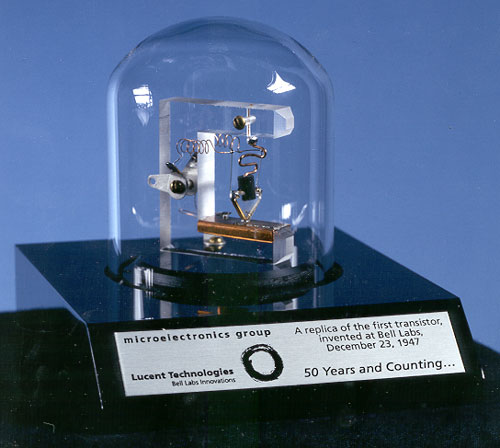
Replica of the First Transistor
Bell labs researchers worked with germanium and actually understood how to make “point contact” transistors and FETs in 1947. However, Bell’s lawyers found the earlier patents and elected to pursue the conventional transistor patent that would lead to the inventors (John Bardeen, Walter Brattain, and William Shockley) winning the Nobel prize in 1956.
Two Germans working for a Westinghouse subsidiary in Paris independently developed a point contact transistor in 1948. It would be 1954 before silicon transistors became practical. The MOSFET didn’t appear until 1959.
Of course, even these major milestones are subject to incremental improvements. The V channel for MOSFETs, for example, opened the door for FETs to be true power devices, able to switch currents required for motors and other high current devices.
The pioneering years in the history of capacitors was a time when capacitors were used primarily for gaining an early understanding of electricity, predating the discovery even of the electron. It was also a time for doing parlor demonstrations, such as having a line of people holding hands and discharging a capacitor through them. The modern era of capacitors begins in the late 1800s with the dawning of the age of the practical application of electricity, requiring reliable capacitors with specific properties.
Leyden Jars
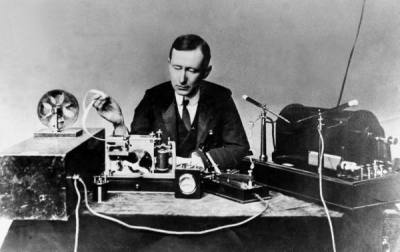
Marconi with transmitting apparatus, Published on LIFE [Public domain], via Wikimedia CommonsOne such practical use was in Marconi’s wireless spark-gap transmitters starting just before 1900 and into the first and second decade. The transmitters built up a high voltage for discharging across a spark gap and so used porcelain capacitors to withstand that voltage. High frequency was also required. These were basically Leyden jars and to get the required capacitances took a lot of space.
Mica
In 1909, William Dubilier invented smaller mica capacitors which were then used on the receiving side for the resonant circuits in wireless hardware.
Early mica capacitors were basically layers of mica and copper foils clamped together as what were called “clamped mica capacitors”. These capacitors weren’t very reliable though. Being just mica sheets pressed against metal foils, there were air gaps between the mica and foils. Those gap allowed for oxidation and corrosion, and meant that the distance between plates was subject to change, altering the capacitance.
In the 1920s silver mica capacitors were developed, ones where the mica is coated on both sides with the metal, eliminating the air gaps. With a thin metal coating instead of thicker foils, the capacitors could also be made smaller. These were very reliable. Of course we didn’t stop there. The modern era of capacitors has been marked by one breakthrough after another for a fascinating story. Let’s take a look.
It seems hard to imagine, but in the early part of the 20th century, there weren’t a lot of great options for creating copies of documents. The most common method was to use carbon paper to create multiple copies at once from a typewriter or a line printer. All that changed with a company called Haloid. Never heard of them? They later became the Xerox company.
The underlying technology dates back to 1938 (invented by a physicist who was also a lawyer). In 1944, they produced a practical copier and shortly thereafter sold the rights to Haloid. The Haloid company originally made photographic copy machines that used wet chemistry.
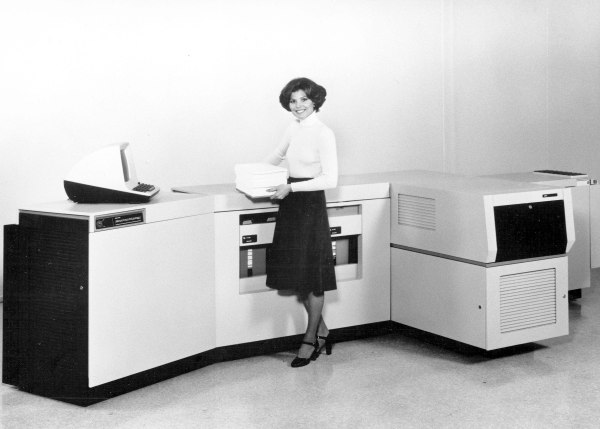
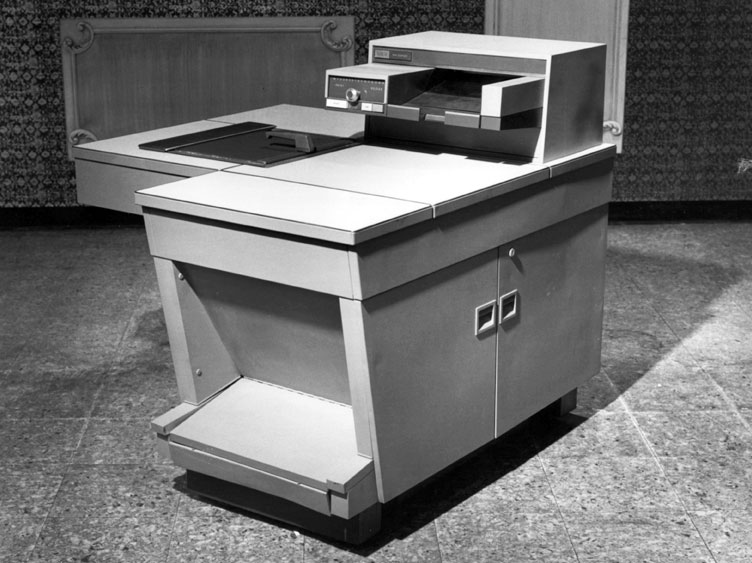
In 1959, the Xerox 914 (so called because it could copy a 9″ x 14″ document) came on the scene (that’s it, below). The 650 pound copier could make seven copies per minute and came with a fire extinguisher because it had a tendency to burst into flames. If you didn’t want to spend the $27,500 price tag, you could rent for only $25/month (keep in mind that in 1959, $25 would buy about 25 pounds of T-bone steaks). You can see a commercial for the 914 in the video below.
In the commercial, you’ll see them make a big deal out of the fact that the print was dry. That’s because a lot of previous machines used actual photographic processes with wet chemistry. Obviously, that also took special paper.
Even Further Back
If the copier didn’t exist until recently, how did people make copies before? Turns out there were lots of ways to make copies of varying degrees of bad quality or extreme trouble. In some sense, the best copies were made by scribes just writing down a second copy of things. There were a variety of machines that would capture what you wrote and make a copy by mechanical or other means. A polygraph (not the lie detecting kind) allowed Thomas Jefferson to write letters and make a copy. The machine moved a pen to match the movements of the author’s pen, thus making a near perfect copy. With a few adjustments, this became the pantograph which not only does the same job, but also can shrink or enlarge the copy. Carbon paper was widely used to make multiple copies of handwritten and typewritten documents.


 Back before there were web sites, people had to get information from magazines like Popular Electronics, Radio Electronics, and a few others. In the late 1960s and early 1970s, it was common to see these magazines predict that this would be the year of the home video recording system. For example, in 1971, [Lou Garner] wrote: “…they [Sony] hope will put home videotape playing in the same living room as conventional high-fidelity sound systems.” You should know that the video cassette he was talking about was 8 inches wide by 5 inches deep (a big larger than a VHS tape) and contained 3/4 inch magnetic tape (VHS used 1/2 inch tape). The 32-pound player had a retail price of about $350 (about $2,000 in today’s dollars; remember gas was $0.36 a gallon and eggs were $0.53 a dozen). It would be several years before VHS and Betamax would duke it out for home supremacy.