As buzzwords go, the “Internet of Things” is pretty clever, and at the same time pretty loathsome, and both for the same reason. “IoT” can mean basically anything, so it’s a big-tent, inclusive trend. Every company, from Mattel to Fiat Chrysler, needs an IoT business strategy these days. But at the same time, “IoT” is vacuous — a name that applies to everything fails to clarify anything.
That’s a problem because “IoT Security” is everywhere in the news these days. Above and beyond the buzz, there are some truly good-hearted security professionals who are making valiant attempts to prevent what they see as a repeat of 1990s PC security fiascos. And I applaud them.
But I’m going to claim that a one-size-fits-all “IoT Security” policy is doomed to failure. OK, that’s a straw-man argument; any one-size-fits-all security policy is bound for the scrap heap. More seriously, I think that the term “IoT” is doing more harm than good by lumping entirely different devices and different connection modes together, and creating an implicit suggestion that they can all be treated similarly. “Internet of Things Security” is a thing, but the problem is that it’s everything, and that means that it’s useful for nothing.
What’s wrong with the phrase “Internet of Things” from a security perspective? Only two words: “Internet” and “Things”.
One of the biggest challenges for a company that holds invaluable data is protecting it. At first, this task would seem fairly straightforward. Keep the data on an encrypted server that’s only accessible via the internal network. The physical security of the server can be done with locks and other various degrees of physical security. One has to be thoughtful in how the security is structured, however. You need to allow authorized humans access to the data in order for the company to function, and there’s the rub. The skilled hacker is keenly aware of these people, and will use techniques under the envelope of Social Engineering along with her technical skills to gain access to your data.
Want to know how secure your house is? Lock yourself out. One of the best ways to test security is to try and break in. Large companies routinely hire hackers, known as penetration testers, to do just this. In this article, we’re going to dissect how a hired penetration tester was able to access data so valuable that it could have destroyed the company it belonged to.
The start of any hack involves information gathering. This is usually pretty easy for larger companies. Their website along with a few phone calls can reveal quite a bit of useful information. However, you can be assured that any company who has hired a pen tester has taken the necessary precautions to limit such information.
And such was the case for our hacker trying to gain access to the ACME Corp. servers. Her first target was the dumpsters – dumpster dives have been proven to unearth a trove of valuable information in the past. But the dumpsters were inside the complex, which was guarded by a contracted security firm. Through a bit of website snooping and a few phone calls, she was able to find out the department that was in charge of trash removal for the company. She then placed a phone call to this department. Using a social engineering (SE) technique known as pretexting, she pretended to be with a trash removal company and wanted to submit a quote to service their business. Using another SE technique called elicitation, she was able to find out:
that trash collection took place on Wednesdays and Thursdays
the total number of dumpsters
that there was a special dumpster for paper and technology trash
the name of the current waste removal company – Waster’s Management
the name of the employee in charge of the waste removal – [Christie Smith]
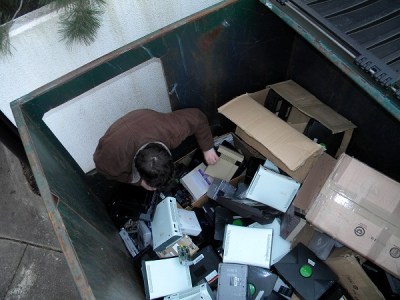
Dumpster Dive
Armed with this information, she went to the Waster’s Management website and grabbed their JPEG logo. Within a few days, she had a shirt and hat with the logo in her hands. She called the security department and said she was with Waster’s Management, and that [Christie Smith] had told her one of the dumpsters was damaged, and she needed to take a look at it before the next trash removal.
The next day, wearing the shirt and hat she had ordered online, she was given a badge from security and allowed access to the dumpsters. Now, any hacker worth her weight in PIC16F84’s already knows what dumpster she dove into. It didn’t take her long to walk away with several hard drives, a few USB drives and some useful documents. She was able to gain knowledge of an upcoming IT contract work, the name of the CFO, and the name of a server with some level of importance – prod23.
Hacking the Server
With some more SE, she was able to find out when the IT work was scheduled. It was after hours. She showed up a bit late and was able to walk right through the front door by claiming she worked for the IT contract company. She then shifted roles and pretended to be an employee. She approached one the real IT contract guys, and said she worked for the CFO, [Mr. Shiraz], and asked if he knew to be careful with the prod23 server. With more SE, she was able to find out the prod23 server was off-limits, encrypted, and only accessible by specific admins.
She was able to access an admin office, and it was there she would don her black hat. She booted the computer with BackTrack via USB and installed a key logger. She made an SSH tunnel to her personal server where she could dump the contents of the key logger, along with some other shells. Now, this is where things get interesting. She opened Virtual Box and used the computer’s hard drive as the boot medium. The VM booted the OS, and she hid all of the screen decorations to make it look like the target OS was running. The admin would log in without a clue, and our hacker would get their username and password through the key logger.
Once the login information came in, she was able to access the admin’s computer, and from there the prod23 server. You can imagine the look on the faces of the top executives for ACME Corp when our hacker handed them a copy of the keys to their kingdom.
Social engineering is human hacking, and a dark art in itself. Our hacker in this story would have never been able to even get close to the server if she did not have SE skills. No matter how secure you make something, so long as you allow humans access to it, it’s vulnerable to attack. And then it’s down to how well-trained your people are in repelling these kinds of intrusions.Just ask Target.
You can find the full story in the source below.
Sources
Social Engineering, The Art of Human Hacking, Chapter 8, by Christopher Hadnagy, ISBN-13: 860-1300286532
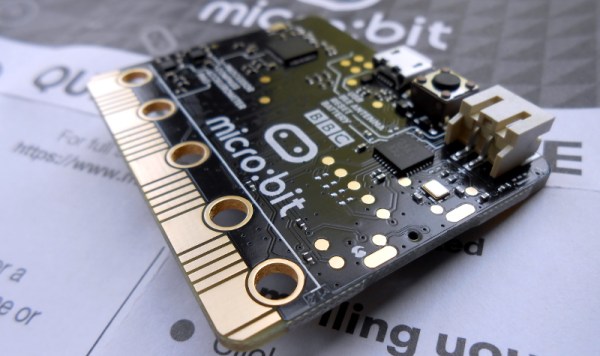
It’s been a long wait, but our latest single board computer for review is finally here! The BBC micro:bit, given free to every seventh-grade British child, has landed at Hackaday courtesy of a friend in the world of education. It’s been a year of false starts and delays for the project, but schools started receiving shipments just before the Easter holidays, pupils should begin lessons with them any time now, and you might even be able to buy one for yourself by the time this article goes to press.
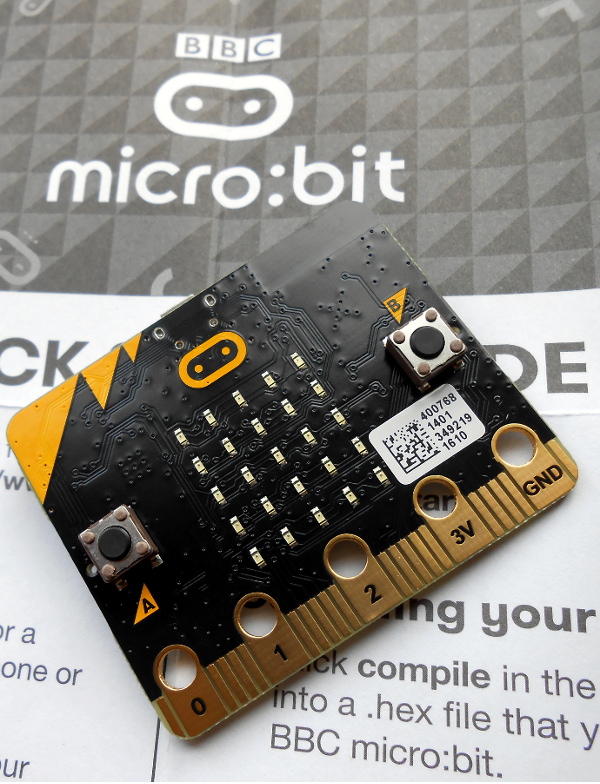
The micro:bit top view
It’s a rather odd proposition, to give an ARM based single board computer to coder-newbie children in the hope that they might learn something about how computers work, after all if you are used to other similar boards you might expect the learning curve involved to be rather steep. But the aim has been to position it as more of a toy than the kind of development board we might be used to, so it bears some investigation to see how much of a success that has been.
Opening the package, the micro:bit kit is rather minimalist. The board itself, a short USB lead, a battery box and a pair of AAA cells, an instruction leaflet, and the board itself. Everything is child-sized, the micro:bit is a curved-corner PCB about 50mm by 40mm. The top of the board has a 5 by 5 square LED matrix and a pair of tactile switches, while the bottom has the surface-mount processor and other components, the micro-USB and power connectors, and a reset button. Along the bottom edge of the board is a multi-way card-edge connector for the I/O lines with an ENIG finish. On the card edge connector several contacts are brought out to wide pads for crocodile clips with through-plated holes to take 4mm banana plugs, these are the ground and 3V power lines, and 3 of the I/O lines.
One of the things you find yourself doing as a young engineer is equipping yourself with the tools of your trade. These will be the foundations upon which your career is built in a way that a diploma or degree certificate will never be, for the best degree in the world is less useful if the quality of your tools renders you unable to capitalise upon it. You may be lucky enough to make some of them yourself, but others you’ll lust after as unaffordable, then eventually put the boat out a little to buy at the limit of your meager income.
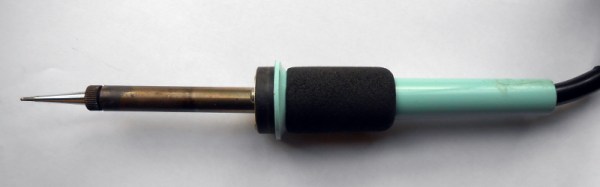
Your bench may have a few of these lifetime tools. They could be something as simple as screwdrivers or you may have one of those indestructible multimeters, but in my case my lifetime tool is my soldering iron. At some time in 1992 I spent about £60($173 back then), a lot of money for a student, on a mains-powered Weller Magnastat. The World Wide Web was still fairly fresh from Tim Berners-Lee’s NeXT in those days, so this meant a trip to my university’s RS trade counter and a moment poring over a telephone-book-sized catalogue before filling in an order slip.
The Magnastat is a simple but very effective fixed-temperature-controlled iron. The tip has a magnet on its rear end which holds closed a power switch for the heating element. When the tip has heated to the Curie temperature of the magnet, it loses its magnetism and the switch opens. The temperature falls to below the Curie temperature and the magnetism returns, the switch closes, the tip warms up again, and the cycle repeats itself. The temperature of the tip is thus dictated by the magnet’s Curie temperature, and Weller provides a range of tips fitted with magnets for different temperatures.
The result is an iron with enough power to solder heat-sucking jobs that would leave lesser irons gasping for juice, while also having the delicacy to solder tiny surface-mount components without destroying them or lifting tracks. It’s not a particularly small or lightweight iron if you are used to the featherlight pencil irons from today’s soldering stations, but neither is it too large or heavy to be unwieldy. In the nearly quarter century I have owned my Magnastat it has had a hand in almost everything I have made, from hi-fi and tube amplifiers through radio transmitters, stripline filters, kits, and too many repairs to mention. It has even been pressed into service plastic-welding a damaged motorcycle fairing. It has truly been a lifetime tool.
From the Forbin Project, to HAL 9000, to War Games, movies are replete with smart computers that decide to put humans in their place. If you study literature, you’ll find that science fiction isn’t usually about the future, it is about the present disguised as the future, and smart computers usually represent something like robots taking your job, or nuclear weapons destroying your town.
Lately, I’ve been seeing something disturbing, though. [Elon Musk], [Bill Gates], [Steve Wozniak], and [Stephen Hawking] have all gone on record warning us that artificial intelligence is dangerous. I’ll grant you, all of those people must be smarter than I am. I’ll even stipulate that my knowledge of AI techniques is a little behind the times. But, what? Unless I’ve been asleep at the keyboard for too long, we are nowhere near having the kind of AI that any reasonable person would worry about being actually dangerous in the ways they are imagining.
Smart Guys Posturing
Keep in mind, I’m interpreting their comments as saying (essentially): “Soon machines will think and then they will out-think us and be impossible to control.” It is easy to imagine something like a complex AI making a bad decision while driving a car or an airplane, sure. But the computer that parallel parks your car isn’t going to suddenly take over your neighborhood and put brain implants in your dogs and cats. Anyone who thinks that is simply not thinking about how these things work. The current state of computer programming makes that as likely as saying, “Perhaps my car will start flying and we can go to Paris.” Ain’t happening.
Laser cutters are CNC power tools, which means an operator uploads a job digitally and then pushes START to let the machine do all the work while they lie back in a hammock sipping a margarita, occasionally leaping out in a panic because the sound coming from the machine changed slightly.
Like other power tools, laser cutters are built around doing one thing very well, but they require an operator’s full attention and support. The operator needs to handle all the other things that go on before, during, and after the job. It’s not too hard to get adequate results, but to get truly professional and repeatable ones takes work and experience and an attention to detail.
People often focus on success stories, but learning from failures is much more educational. In the spirit of exploring that idea, here are my favorite ways to fail at laser cutting and engraving. Not all of these are my own personal experience, but they are all someone’s personal experience.
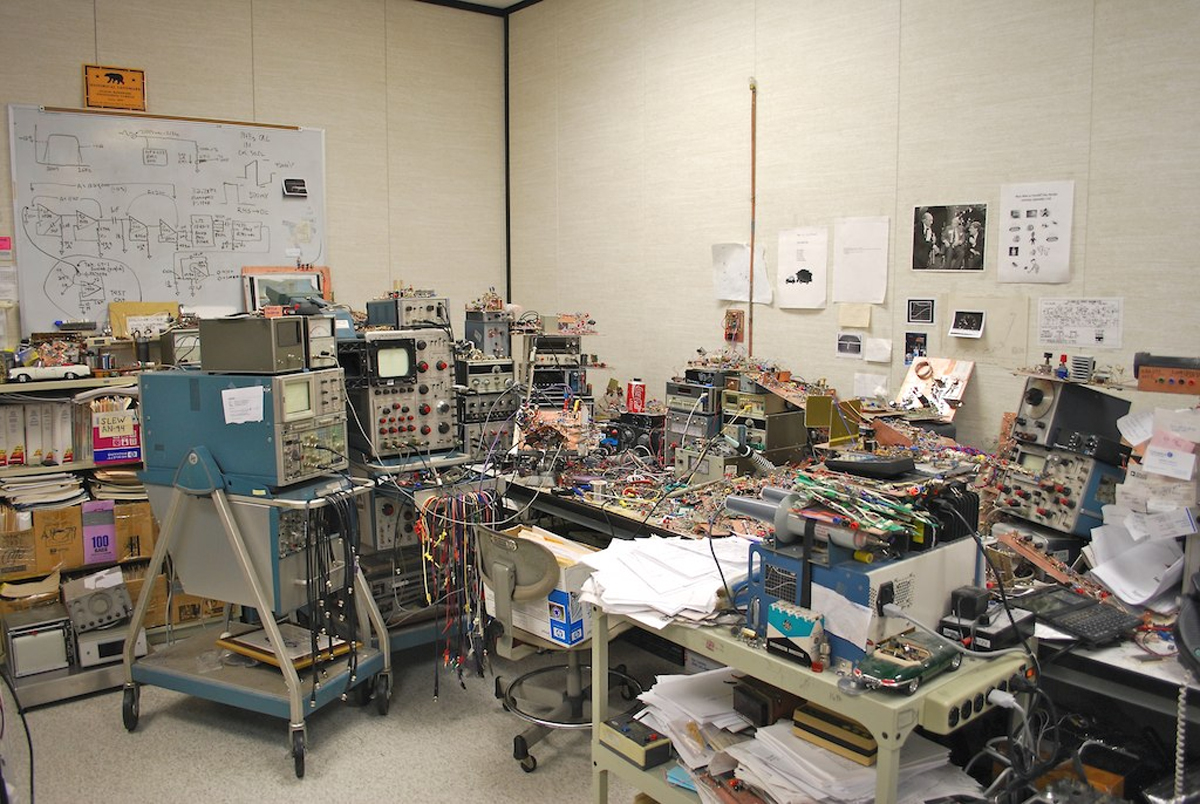
Some hackers build sharp, mildly toxic nests of parts, components, and thrifty finds around themselves. These nests, while not comfortable, are certainly comforting. They allow the hacker’s psyche to inhabit a locale as chaotic as their minds. Within these walls of stuff and clutter, stunning hacks pour out amid a small cloud of cursing. This article is not for them.
Very few of us can actually function in a workplace such like that of the venerable Jim Williams (photo from linked article). Thanks to the commenters for mentioning him in the previous article.
For the rest of us, clutter is a Zen destroying, seemingly unconquerable, monster that taunts our poor discipline and organizational skill from the dark corner of our minds. However, there is an easy solution that is oft overlooked. Somewhat obviously, most organization problems can be solved by simply not having things to organize.
It’s taken me a very long time to realize the source of my clutter woes. My first tactic was to blame myself for my inability to keep up with the mess. A more superior human would certainly be able to use their effortless discipline to keep a space organized. However, the clutter was a symptom of a problem completely separate from my actual ability to keep a space clean.




 Within a few days, she had a shirt and hat with the logo in her hands. She called the security department and said she was with Waster’s Management, and that [Christie Smith] had told her one of the dumpsters was damaged, and she needed to take a look at it before the next trash removal.