As a rule, I try hard not to get sucked into religious wars. You know, Coke vs Pepsi. C++ vs Java. Chrome vs Firefox. There are two I can’t help but jump into: PC vs Mac (although, now that Mac has turned into Unix, that’s almost more habit than anything else) and–the big one–Emacs vs vi.
If you use Linux, Unix, or anything similar, you are probably at least aware of the violence surrounding this argument. Windows users aren’t immune, although fewer of them know the details. If you aren’t familiar with these two programs, they are–in a way–text editors. However, that’s like calling a shopping mall “a store.” Technically, that’s correct, but the connotation is all wrong.
Like most religious wars, this one is partly based on history that might not be as relevant as it used to be. Full disclosure: I’m firmly in the Emacs camp. Many of my friends are fans of vi–I try not to hold it against them. I’ll try to be balanced and fair in my discussion, unless I’m talking about my preference. I don’t have to be fair when it comes to my opinions. Just to be clear: I know how to use vi. My preference isn’t based out of not wanting to learn something new.
If you’ve watched the tech news these last few months, you probably have noticed the rumors that Apple is expected to dump the headphone jack on the upcoming iPhone 7. They’re not alone either. On the Android side, Motorola has announced the Moto Z will not have a jack. Chinese manufacturer LeEco has introduced several new phones sans phone jack. So what does this mean for all of us?
This isn’t the first time a cell phone company has tried to design out the headphone jack. Anyone remember HTC’s extUSB, which was used on the Android G1? Nokia tried it with their POP Port. Sony Ericsson’s attempt was the FastPort. Samsung tried a dizzying array of multi-pin connectors. HP/Palm used a magnetic adapter on their Veer. Apple themselves tried to reinvent the headphone jack by recessing it in the original iPhone, breaking compatibility with most of the offerings on the market. All of these manufacturers eventually went with the tried and true ⅛” headphone jack. Many of these connectors were switched over during an odd time in history where Bluetooth was overtaking wired “hands-free kits”, and phones were gaining the ability to play mp3 files.
When you learn to solder, you are warned about the pitfalls of creating a solder joint. Too much solder, too little solder, cold joints, dry joints, failing to “wet” the joint properly, a plethora of terms are explained if you read one of the many online guides to soldering.
Unsurprisingly it can all seem rather daunting to a novice, especially if they are not used to the dexterity required to manipulate a tool on a very small-scale at a distance. And since the soldering iron likely to be in the hands of a beginner will not be one of the more accomplished models with fine temperature control and a good tip, it’s likely that they will experience most of those pitfalls early on in their soldering career.
As your soldering skills increase, you get the knack of making a good joint. Applying just the right amount of heat and supplying just enough solder becomes second nature, and though you still mess up from time to time you learn to spot your errors and how to rework and fix them. Your progression through the art becomes a series of plateaux, as you achieve each new task whose tiny size or complexity you previously thought rendered it impossible. Did you too recoil in horror before your first 0.1″ DIP IC, only to find it had been surprisingly easy once you’d completed it?
A few weeks ago we posted a Hackaday Fail of the Week, revolving around a soldering iron failure and confirmation bias leading to a lengthy reworking session when the real culprit was a missing set of jumpers. Mildly embarrassing and something over which a veil is best drawn, but its comments raised some interesting questions about bad solder joints. In the FoTW case I was worried I’d overheated the joints causing them to go bad, evaporating the flux and oxidising the solder. This was disputed by some commenters, but left me with some curiosity over bad solder joints. We all know roughly how solder joints go wrong, but how much of what we know is heresay? Perhaps it is time for a thorough investigation of what makes a good solder joint, and the best way to understand that would surely be to look at what makes a bad one.
Makerspace North is unique out of the 5 makerspaces in the Ottawa, Canada area in that it started life as an empty 10,000 square foot warehouse with adjoining office spaces and large open rooms, and has let the community fill it, resulting in it having become a major hub for makers to mix in all sorts of ways, some unexpected.
Many makerspaces are run by an organization that provides tools that groups or individuals use, along with qualification courses for select tools. Makerspace North, on the other hand, provides the space and lets the community provide the maker component. The result is a variety of large scale events from indoor drone flying and various types of maker faire style days, to craft shows, garage sales, and even concerts. Smaller meet-ups, most often open to anyone, are held by such groups as the Ottawa Robotics Club and the Ottawa Electronics Club as well as some more general ones. Courses offered by the community are also as varied.
This also means that the owners of Makerspace North don’t provide tools for people to use, but instead provide dedicated rental space. That doesn’t mean there aren’t tools — it means that Makerspace North encompasses a microcosm of various renters who fill out the task of things like tool rental. This is just one example of how the community has embraced the unique approach. Let’s take a closer look at that and a few other novelties of this system.
Killer robots are a mainstay of science fiction. But unlike teleportation and flying cars, they are something that we are likely to see within our lifetime. The only thing that’s stopping countries like the USA, South Korea, the UK, or France from deploying autonomous killing machine in the very near term is that they’re likely to be illegal under current international humanitarian law (IHL) — the rules of war.
But if you just sighed in relief that the fate of humanity is safe, think again. The reason that autonomous killing machines are illegal is essentially a technicality, and worse, it’s a technicality that’s based on the current state of technology. The short version of the story, as it stands right now, is that the only thing making autonomous robotic killing weapons illegal is that it’s difficult for a robot to tell a friend from an enemy. When technology catches up with human judgement, all bets are off.
Think I’m insane? The United Nations Office at Geneva (UNOG), the folks who bring you the rules of warfare, started up a working group on killer robots three years ago, and the report from their 2016 meeting just came out. Now’s as good a time as any to start taking killer robots seriously.
It’s no surprise that things change as we age, and that tasks that were once trivial become difficult. Case in point: my son asked for help with the cord on his gaming headset the other night. The cable had broken and we could see frayed conductors exposed. When I got it apart, I found that I could barely see the ultra-fine wires to resolder them after cutting out the bad section. I managed to do it, but just barely.
This experience got me thinking about how to deal with the inevitable. How do you stay active as a hacker once your body starts to fight you more than it helps you? I’m interested mostly in dealing with changes in vision, but also in loss of dexterity and fine motor skills, and dealing with cognitive changes. This isn’t a comprehensive list of the ravages of time, but they’re probably the big ones that impact any hacker-related hobby. I enlisted a couple of my more seasoned Hackaday colleagues, [Bil] and [Rud], for their tips and tricks to deal with these issues.
Einstein referred to her as the most important woman in the history of mathematics. Her theorem has been recognized as “one of the most important mathematical theorems ever proved in guiding the development of modern physics.” Yet many people haven’t the slightest clue of who this woman was, or what she did that was so significant to our understanding of how our world works. If you count yourself as one of those who have never heard of Emmy Noether and wish to enlighten yourself, please read on. I can only hope I do her memory justice. Not just by telling you who she was, but by also giving you an understanding of how her insight led to the coming together of symmetry and quantum theory, pointing academia’s arrow toward quantum electrodynamics.
Being a female in Germany in the late 1800s was not easy. She wasn’t allowed to register for math classes. Fortunately, her father happened to be a math professor, which allowed her to sit in on many of his classes. She took one of his final exams in 1904 and did so well that she was granted a bachelors degree. This allowed her to “officially” register in a math graduate program. Three years later, she earned one of the first PhD’s given to a woman in Germany. She was just 25 years old.
1907 was a very exciting time in theoretical physics, as scientists were hot on the heels of figuring out how light and atoms interact with each other. Emmy wanted in on the fun, but being a woman made this difficult. She wasn’t allowed to hold a teaching position, so she worked as an unpaid assistant, surviving on a small inheritance and under-the-table money that she earned sitting in for male professors when they were unable to teach. She was still able to do what professors are supposed to do, however – write papers. In 1916, she would pen the theorem that would have her rubbing shoulders with the other physics and mathematical giants of the era.
Noether’s Theorem – The Basics
Emmy Noether’s Theorem seems simple on the onset, but holds a fundamental truth that explains the fabric of our reality. It goes something like this:
For every symmetry, there is a corresponding conservation law.
We all have heard of laws such as Newton’s first law of motion, which is about the conservation of momentum. And the first law of thermodynamics, which is about the conservation of energy. Noether’s theorem tells us that there must be some type of symmetry that is related to these conservation laws. Before we get into the meaning, we must first understand a little known subject called The Principle of Least Action.
The Universe is Lazy
I would wager a few Raspberry Pi Zeros that many of you already have an intuitive grasp of this principle, even if you’ve never heard of it before now. The principle of least action basically says that the universe has figured out the easiest way possible to get something done. Mathematically, it’s the sum over time of kinetic energy minus potential energy as the action occurs. Let us imagine that you’re trying to program an STM32 Discovery eval board in GCC. After about the 6,000th try, you toss the POS across the room and grab your trusty Uno. The graph depicts the STM32 moving through time and space.
The green points represent particular points of how how high the STM32 is at a given point in time. Note that there are no values for height and time – this example is meant to explain a principle. We can say that at these points (and all points along the curve), the SMT32 has both kinetic and potential energies. Let us call the kinetic energy (kt) and the potential energy (pt). The ‘t‘ subscript is for time, as both the energies are functions of time. The action for each point will be called s, and can be calculated as:
However, action is the total sum of the difference of energies at each point between t1 and t2. If you’ve read my integral post, you will know that we need to integrate in order to calculate the total action.
Now before you get your jumper wires in a bunch, all that is saying is that we’re taking the difference in potential (p) and kinetic (k) energies at each point along the curve between t1 and t2, and we’re adding them together. The elongated S symbol means a sum, and the (dt) means as it changes over time. The path that the STM32 will take will be the path where the action S is at its minimum value. Check out the video in the source section below if you’re confused. It’s only 10 minutes and goes into this concept in easy to follow details.
Noether’s Theorem – The Details
Noether’s theorem is based upon a mathematical proof. It’s not a theory. Her proof can be applied to physics to develop theories, however. Now that we know what the principle of least action is, we can do just this.
Any law of nature can be traced back to a symmetry and the least action principle. Let’s consider two very simple examples – Newton’s first law of motion and the first law of thermodynamics.
Conservation of Momentum
Space has what is known as translational symmetry. That’s just fancy-pants talk for saying that what you do in one point in space is the same as what you do in another point in space. It doesn’t matter what hacker space you throw your STM32, it will act the same at all hacker spaces on earth. Space itself provides the symmetry. And because the principle of least action applies, you have a natural law – the first law of motion.
Conservation of Energy
Time has the same translational symmetry as space does. If I toss the STM32 now, and toss it tomorrow, it will act the same. It doesn’t matter what point in time I toss it, the results will always be the same. Thus energy is conserved between different points in time. Time is our symmetry, and the 1st law of thermodynamics is the result.
Now, I realize these examples might seem a bit useless. But when you dig a bit deeper, things get interesting. Electrical charge is also conserved. Noether says there must then be some type of symmetry involved. What do you suppose that symmetry might be? Keep following that rabbit hole, and you’ll end up face to face with QED. We’ll get there in a future article, so for now just keep Noether’s Theorem in mind.
Sources
Physics Helps, The principle of least action, video link.
Ransom Stephens, Ph.D., Emmy Noether and The Fabric of Reality, video link








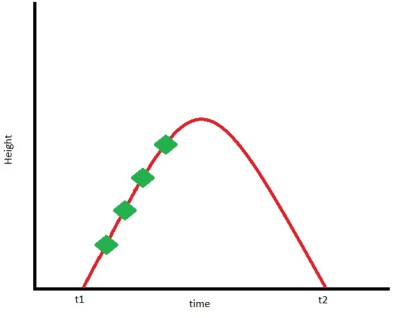 I would wager a few Raspberry Pi Zeros that many of you already have an intuitive grasp of this principle, even if you’ve never heard of it before now. The principle of least action basically says that the universe has figured out the easiest way possible to get something done. Mathematically, it’s the sum over time of kinetic energy minus potential energy as the action occurs. Let us imagine that you’re trying to program an STM32 Discovery eval board in GCC. After about the 6,000th try, you toss the POS across the room and grab your trusty Uno. The graph depicts the STM32 moving through time and space.
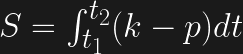
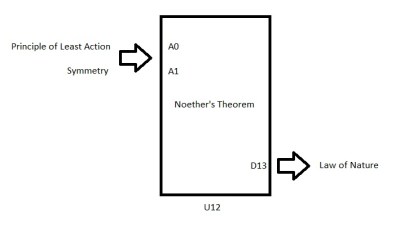 Noether’s theorem is based upon a mathematical proof. It’s not a theory. Her proof can be applied to physics to develop theories, however. Now that we know what the principle of least action is, we can do just this.








