Don’t Be Salty: How To Make Desalination Work In Tomorrow’s World

Although water is often scarce for human consumption and agriculture, this planet is three-quarters covered by the stuff. The problem is getting the salt out, and this is normally done by the Earth’s water cycle, which produces rain and similar phenomena that replenish the amount of fresh water. Roughly 3% of the water on Earth is fresh water, of which a fraction is potable water.

Over the past decades, the use of desalination has increased year over year, particularly in nations like Saudi Arabia, Israel and the United Arab Emirates, but parched United States states such as California are increasingly looking into desalination technologies. The obvious obstacles that desalination faces – regardless of the exact technology used – involve the energy required to run these systems, and the final cost of the produced potable water relative to importing it from elsewhere.

Other issues that crop up with desalination include the environmental impact, especially from the brine waste and conceivably marine life sucked into the intake pipes. As the need for desalination increases, what are the available options to reduce the power needs and environmental impact?

Continue reading “Don’t Be Salty: How To Make Desalination Work In Tomorrow’s World”

Agrivoltaics Is A Land Usage Hack For Maximum Productivity

Land tends to be a valuable thing. Outside of some weird projects in Dubai, by and large, they aren’t making any more of it. That means as we try to feed and power the ever-growing population of humanity, we need to think carefully about how we use the land we have.

The field of agrivoltaics concerns itself with the dual-use of land for both food production and power generation. It’s all about getting the most out of the the available land and available sunlight we have.

Continue reading “Agrivoltaics Is A Land Usage Hack For Maximum Productivity”

Iron Nitrides: Powerful Magnets Without The Rare Earth Elements

Since their relatively recent appearance on the commercial scene, rare-earth magnets have made quite a splash in the public imagination. The amount of magnetic energy packed into these tiny, shiny objects has led to technological leaps that weren’t possible before they came along, like the vibration motors in cell phones, or the tiny speakers in earbuds and hearing aids. And that’s not to mention the motors in electric vehicles and the generators in wind turbines, along with countless medical, military, and scientific uses.

These advances come at a cost, though, as the rare earth elements needed to make them are getting harder to come by. It’s not that rare earth elements like neodymium are all that rare geologically; rather, deposits are unevenly distributed, making it easy for the metals to become pawns in a neverending geopolitical chess game. What’s more, extracting them from their ores is a tricky business in an era of increased sensitivity to environmental considerations.

Luckily, there’s more than one way to make a magnet, and it may soon be possible to build permanent magnets as strong as neodymium magnets, but without any rare earth metals. In fact, the only thing needed to make them is iron and nitrogen, plus an understanding of crystal structure and some engineering ingenuity.

Continue reading “Iron Nitrides: Powerful Magnets Without The Rare Earth Elements”

We Can’t Switch To Electric Cars Until We Get More Copper

Reducing emissions from human activity requires a great deal of effort in many different sectors. When it comes to land transport, the idea is generally to eliminate vehicles powered by combustion engines and replace them with electric vehicles instead. At a glance, the job is simple enough. We know how to build EVs, and the technology is getting to the point where they’re capable of replacing traditional vehicles in many applications.

Of course, the reality is not so simple. To understand the problem of converting transportation to electric drive en masse, you have to take a look at the big numbers. Focus in on the metrics of copper, and you’ll find the story is a concerning one. 

Continue reading “We Can’t Switch To Electric Cars Until We Get More Copper”

Building A Glowing Demon Core Lamp

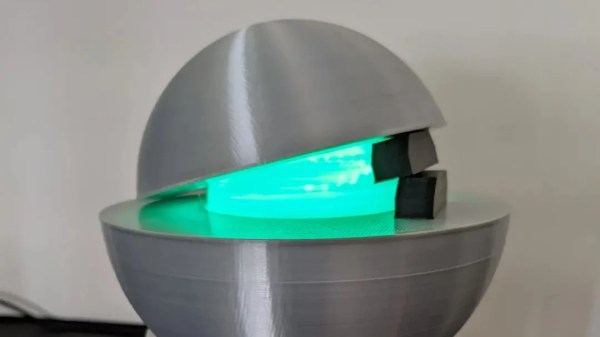
The so-called Demon Core was a cursed object, a 6.2 kilogram mass of plutonium intended to be installed in a nuclear weapon. Instead, slapdash experimental techniques saw it feature in several tragic nuclear accidents and cause multiple fatalities. Now, you can build yourself a lamp themed after this evil dense sphere.

A later recreation of the infamous “Slotin Accident” that occurred with the Demon Core. Credit: Public Domain, Los Alamos National Laboratory

Creator [skelly] has designed the lamp to replicate the Slotin incident, where the spherical Demon Core was placed inside two half-spheres of beryllium which acted as neutron reflectors to allow it to approach criticality. Thus, the core is printed as a small sphere which is thin enough to let light escape, mimicking the release of radiation that doomed Louis Slotin. The outer spheres are then printed in silvery PLA to replicate the beryllium half-spheres. It’s all assembled atop a stand mimicking those used in the Los Alamos National Laboratory in the 1940s.

To mimic the Core’s deadly blue glow, the build uses cheap LED modules sourced from Dollar Tree lights. With the addition of a current limiting resistor, they can easily be run off USB power in a safe manner.

The Demon Core has become a meme in recent times, perhaps as a new generation believes themselves smart enough not to tinker with 6.2 kilograms of plutonium and a screwdriver. That’s not to say there aren’t still dangerous nuclear experiments going on, even the DIY kind. Be careful out there!

Militaries Are Rushing To Get Anti-Drone Lasers Operational

Flying drones have been a part of modern warfare for a good few decades now. Initially, most of these drones were built by traditional military contractors and were primarily used by the world’s best-funded militaries. However, in recent conflicts in Syria, Ukraine, and elsewhere have changed all that. Small commercial drones and compact militarized models have become key tools on the battlefield, for offense, defence, and reconnaissance.

With so many of these tiny craft buzzing around, militaries are scrambling for practical ways to shoot them down. Lasers might be just the ticket to do exactly that. Continue reading “Militaries Are Rushing To Get Anti-Drone Lasers Operational”

Visual Mandela Effect: You Don’t Know Iconic Images As Well As You Think

Pop quiz, hotshot: does the guy on the Monopoly box (standard edition) wear a monocle? Next question: does the Fruit of the Loom logo involve a cornucopia? And finally, does Pikachu have a black-tipped tail? If you answered yes to any of these, I am sad to say that you are wrong, wrong, wrong.

So, what’s the deal? These are all examples of the visual version of the Mandela effect (VME), which is named after the common misconception/mass false memory that anti-Apartheid activist Nelson Mandela died decades ago in prison, despite leading South Africa in the latter half of the ’90s and living until 2013. Many people even claim having seen TV coverage of his funeral, or say they learned about his death in school during Black History Month. The whole thing has VICE wondering whether CERN is causing these mass delusions somehow with the LHC.

The more attention VME gets, the more important it seems to be to study it and try to come to some conclusion. To that end, University of Chicago researchers Deepasri Prasad and Wilma A. Bainbridge submitted an interesting and quite readable study earlier this year purporting that the VME is ‘evidence for shared and specific false memories across people’. In the study, they conducted four experiments using crowd-sourced task completion services.

Continue reading “Visual Mandela Effect: You Don’t Know Iconic Images As Well As You Think”