Visual Mandela Effect: You Don’t Know Iconic Images As Well As You Think

Pop quiz, hotshot: does the guy on the Monopoly box (standard edition) wear a monocle? Next question: does the Fruit of the Loom logo involve a cornucopia? And finally, does Pikachu have a black-tipped tail? If you answered yes to any of these, I am sad to say that you are wrong, wrong, wrong.

So, what’s the deal? These are all examples of the visual version of the Mandela effect (VME), which is named after the common misconception/mass false memory that anti-Apartheid activist Nelson Mandela died decades ago in prison, despite leading South Africa in the latter half of the ’90s and living until 2013. Many people even claim having seen TV coverage of his funeral, or say they learned about his death in school during Black History Month. The whole thing has VICE wondering whether CERN is causing these mass delusions somehow with the LHC.

The more attention VME gets, the more important it seems to be to study it and try to come to some conclusion. To that end, University of Chicago researchers Deepasri Prasad and Wilma A. Bainbridge submitted an interesting and quite readable study earlier this year purporting that the VME is ‘evidence for shared and specific false memories across people’. In the study, they conducted four experiments using crowd-sourced task completion services.

Continue reading “Visual Mandela Effect: You Don’t Know Iconic Images As Well As You Think”

Buy The Right To Build A Nakagin Tower Anywhere

We’re guessing that among Hackaday’s readership are plenty of futurists, and while the past might be the wrong direction in which to look when considering futurism, we wouldn’t blame any of them for hankering for the days when futurism was mainstream.

Perhaps one of the most globally iconic buildings of that era could have been found in Tokyo, in the form of the Nakagin Capsule Tower, Kisho Kurokawa’s 1972 Metabolist apartment block. This pioneering structure, in which individual apartments were conceived as plug-in units that could be moved or changed at will, never achieved its potential and was dismantled, looking more post-apocalyptic than futuristic in early 2022, but it could live on in both digital form and reconstructed elsewhere as the rights to its design are being auctioned.

Unfortunately there appears to be some NFT mumbo-jumbo associated with the sale, but what’s up for auction is a complete CAD model along with the rights to build either real or virtual copies of the building. It’s unlikely that any Hackaday readers will pony up for their own Metabolist skyscraper, but the interest lies not only in the love of a future that never quite happened, but in the engineering behind the structure. Where this is being written as in many other places there is simultaneously a chronic housing shortage and a housing system wedded to the outdated building techniques of a previous century, so the thought of updated equivalents of the Nakagin Tower offering the chance of modular interchangeable housing in an era perhaps more suited to it than the 1970s is an intriguing one. Now that we’re living in the future, perhaps it’s time to give futurism another chance.

Regular readers will have spotted this isn’t the first time we’ve brought you a taste of futuristic living.

Header: Svetlov Artem, CC0.

I3C — No Typo — Wants To Be Your Serial Bus

Remember old hard drives with their giant ribbon cables? They went serial and now the power cables are way thicker than the data cables. We’ve seen the same thing in embedded devices. Talking between chips these days tends to use I2C or SPI or some variation of these to send and receive data over a handful of pins. But now there is I3C, a relatively new industry standard that is getting a bit of traction.

I2C and SPI are mature but they do have problems. I2C can be relatively slow and SPI usually requires extra pins for each device. Besides that, there is poor support for adding and removing devices dynamically or discovering devices automatically.

I3C, created by the MIPI Alliance, aims to fix these problems. It does use the usual two wires, SCL for the clock and SDA for data.  One device acts as a controller. Other devices can be targets or secondary controllers. It is also backward compatible with I2C target devices. Depending on how you implement it, speeds can be quite fast with a raw speed of 12.5 Mbps and using line coding techniques can go to around 33 Mbps.

Continue reading “I3C — No Typo — Wants To Be Your Serial Bus”

Space-Based Solar Power: Folly Or Stroke Of Genius?

The Sun always shines in space, unless a pesky planet gets in the way. That’s more or less the essential thought behind space-based solar power (SBSP) as newly pitched by ESA’s director general, Josef Aschbacher on Twitter. Rather than putting photovoltatic solar panels on the Earth’s surface which has this annoying property of constantly rotating said panels away from the Sun during what is commonly referred to as ‘night’, the panels would be put stationary in space, unaffected by the Earth’s rotation and weather.

Although a simple idea, it necessitates the solving of a number of problems. The obvious first question is how to get these panels up in space, hundreds of kilometers from the Earth’s surface, to create a structure many times larger than the International Space Station. The next question is how to get the power back to Earth, followed by questions about safety, maintenance, transfer losses and the inevitable economics.

With organizations ranging from NASA to China’s Academy for Space Technology (CAST), to US institutions and others involved in SBSP projects, it would seem that these problems are at the very least deemed to be solvable. This raises the question of how ESA’s most recent proposal fits into this picture. Will Europe soon be powered from orbital solar panel arrays?

Continue reading “Space-Based Solar Power: Folly Or Stroke Of Genius?”

How Resilient Is The Natural Gas Grid?

A few years ago, I managed to get myself on a mailing list from a fellow who fancied himself an expert on energy. Actually, it seemed that no area was beyond his expertise, and the fact that EVERY EMAIL FROM HIM CAME WITH A SUBJECT LINE IN CAPS WITH A LOT OF EXCLAMATION POINTS!!!! really sealed the deal on his bona fides. One of the facts he liked to tout was that natural gas was the perfect fuel. Not only is it clean-burning and relatively cheap, it’s also delivered directly to consumers using a completely self-powered grid. Even under “zombie apocalypse” conditions, he claimed that natural gas would continue to flow.

At the time, it seemed a bit overstated, but I figured that there was at least a nugget of truth to it — enough so that I converted from an electric range and water heater to gas-powered appliances a couple of years ago, and added gas fireplaces for supplemental heat. I just sort of took it for granted that the gas would flow, at least until the recent kerfuffle over the Nordstream pipeline. That’s when I got a look at pictures of the immense turbine compressors needed to run that pipeline, the size and complexity of which seem to put the lie to claims about the self-powered nature of natural gas grids.

Surely a system dependent on such equipment could not be entirely self-powered, right? This question and others swirled doubt in my mind, and so I did what I always do in these cases: I decided to write an article so I could look into the details. Here’s what I found out about how natural gas distribution works, at least in North America.

Continue reading “How Resilient Is The Natural Gas Grid?”

Integrated Circuit Manufacturing At Bell Labs In 1983

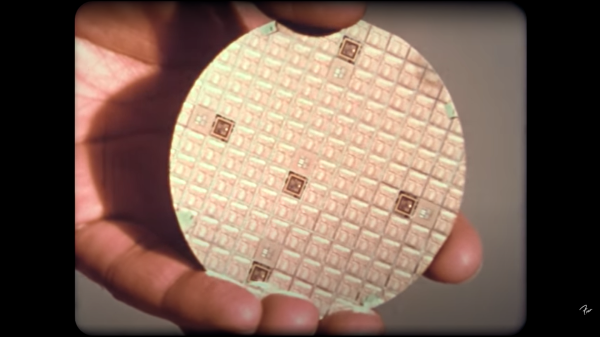
With the never ending march of technological progress, arguably the most complex technologies become so close to magic as to be impenetrable to those outside the industry in which they operate. We’ve seen walkthrough video snapshots of just a small part of the operation of modern semiconductor fabs, but let’s face it, everything you see is pretty guarded, hidden away inside large sealed boxes for environmental control reasons, among others, and it’s hard to really see what’s going on inside.

Let’s step back in time a few decades to 1983, with an interesting tour of the IC manufacturing facility at Bell Labs at Murray Hill (video, embedded below) and you can get a bit more of an idea of how the process works, albeit at a time when chips hosted mere tens of thousands of active devices, compared with the countless billions of today. This fab operates on three inch wafers, producing about 100 die each, with every one handled and processed by hand whereas modern wafers are much bigger, die often much smaller with the total die per wafer in the thousands and are never handled by a filthy human.

Particle counts of 100 per cubic foot might seem laughable by modern standards, but device geometries back then were comparatively large and the defect rate due to it was not so serious. We did chuckle somewhat seeing the operator staff all climb into their protective over suits, but open-faced with beards-a-plenty poking out into the breeze. Quite simply, full-on bunny suits were simply not necessary. Anyway, whilst the over suits were mostly for the environment, we did spot the occasional shot of an operator wearing some proper protective face shielding when performing some of the higher risk tasks, such as wafer cleaning, after all as the narrator says “these acids are strong enough to eat through the skin” and that would certainly ruin your afternoon.

No story about integrated circuit processing would be complete without mentioning the progress of [Sam Zeloof] and his DIY approach to making chips, and whilst he’s only managing device counts in the hundreds, this can only improve given time.

Continue reading “Integrated Circuit Manufacturing At Bell Labs In 1983”

Optimizing The Mining Of Uranium From Coal Ash And Seawater

Of all the elements that make up the Earth’s crust, uranium is reasonably abundant, coming in at 49th place, ahead of elements such as tin, tungsten and silver. Ever since humankind began to exploit uranium for its fissile properties in energy production, this abundance has also translated into widespread availability for mining. As of 2019, Kazakhstan, Canada and Australia formed the world’s main producers, accounting for about 68% of output.

Considering the enormous energy density of uranium when used as fuel in a nuclear fission reactor, the demand for uranium is relatively low, especially combined with the long (two years on average) refueling cycles of commercial reactors. The effect is that even with the very inefficient once-through fuel cycle – which only uses a fraction of the uranium fuel’s potential energy – uranium market prices have remained relatively low and stable even amidst geopolitical crises.

Despite this, the gradual rise in uranium market prices ($10/lb in 2003, $49/lb in 2022), as well as the rapid construction of new reactors is driving new exploration. Here recent innovations may make uranium fuel even more accessible to all nations, by unlocking the billions of tons of uranium found in plain seawater as well as the many tons of fly ash produced by coal plants every single day.

Continue reading “Optimizing The Mining Of Uranium From Coal Ash And Seawater”