GimBall Bounces Off Trees And Comes Back For More

gimball

We’ve seen a lot of flying robots over the years, and for many of them, intimate contact with a stationary object would be a very, very bad thing. [The Laboratory of Intelligent Systems], at EPFL in Switzerland designed GimBall to not only take impacts in stride, but to actually use them as navigational aids. This is similar to an insect bouncing off an obstacle in nature.

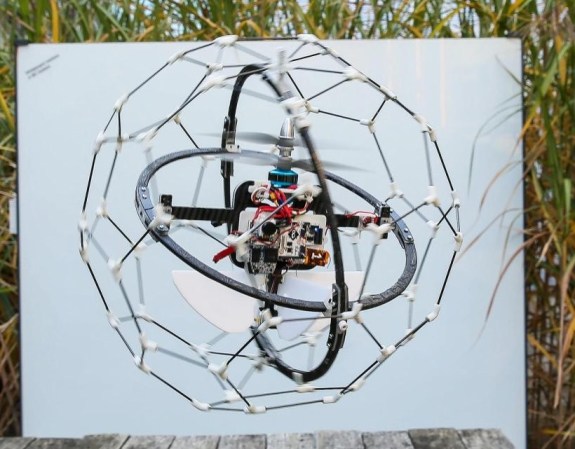
GimBall’s design is a bit of a departure from the norm as well. Contra-rotating airplane propellers provide thrust while countering torque. It appears that the propellers are driven by two separate brushless outrunner motors, which would allow for yaw control via mismatched torque. Directional control is provided by a 4 articulated vanes on the bottom of the craft. Standard RC servos move the vanes. While not as common as quadcopters today, this “tail sitting” design has been around for decades. The Convair XFY “Pogo” is a good example of an early tail sitter design.

What makes GimBall so novel is its exoskeleton. A carbon fiber gimbal encircles the entire craft. Around the gimbal is a geodesic sphere made up of carbon fiber rods and plastic joints. The sphere acts like a shock absorber, allowing GimBall to harmlessly bounce off objects. The gimbal ensures that impacts won’t upset the craft’s attitude. Check out the video after the break to see how these two systems form an impressive shell which completely separates GimBall’s chassis from the outside world. GimBall can actually use its shell to “rotate” around obstacles.

Continue reading “GimBall Bounces Off Trees And Comes Back For More”

PropVario, A Talking Variometer/Altimeter For RC Sailplanes

propvario

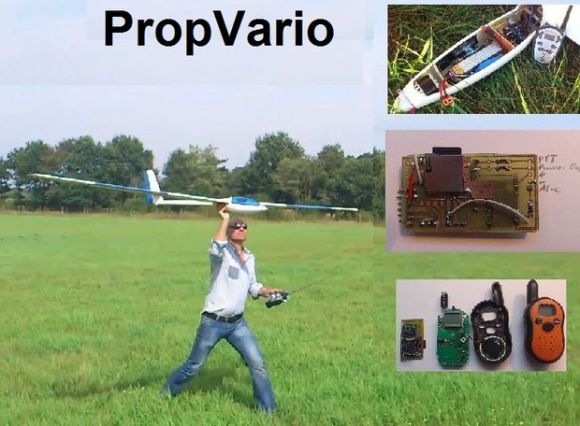
Lift. For a sailplane pilot it means the difference between a nice relaxing flight, or searching for an open area to land. Finding lift isn’t always easy though. This is especially true when the sailplane is hundreds of meters above a pilot whose feet are planted firmly on the ground. That’s why [Tharkun] created PropVario. PropVario is a combination variometer and altimeter for Radio Controlled sailplanes. We’ve seen a few variometers in the past, most often for full-scale sailplane or hang glider pilots. Almost every full-scale plane has a variometer as part of its suite of gauges – usually called a rate of climb or vertical speed indicator.

R/C pilots don’t have the luxury of looking at a gauge while flying though. At altitude even large 2 meter gliders can appear to the naked eye as no more than a dot. It would be somewhat embarrassing to lose sight of your glider because you were checking gauges. The solution is actually simple. A varying audio tone indicates the rate of climb of the plane. Higher pitched tones mean the plane is going up. Lower pitched tones mean the plane is descending. This system, coupled with a simple radio transmitter, has been in use by R/C sailplane pilots for years.

Continue reading “PropVario, A Talking Variometer/Altimeter For RC Sailplanes”

DIY Mini Quadcopter Frame Is Light And Strong

quadcopter-frame

[Oscar] has been busy lately building DIY mini quadcopters. We saw his controller design earlier in the month. Back then he was using it with his walking robot designs. Now [Oscar] has posted up some information on his quadcopter work. Even though [Oscar] is new to mini quads, he began by designing his own frame. He started his frame design by using a cut down version of the well-known 949 frame. [Oscar] chose polystyrene for his motor mounts, which turned out to be the downfall of the frame. Polystyrene proved to be much too flimsy to handle the vibrations of the motors and props. The vibrations were transmitted to the accelerometers, which resulted in a model that was very hard to control. You can see this in the first video after the break.

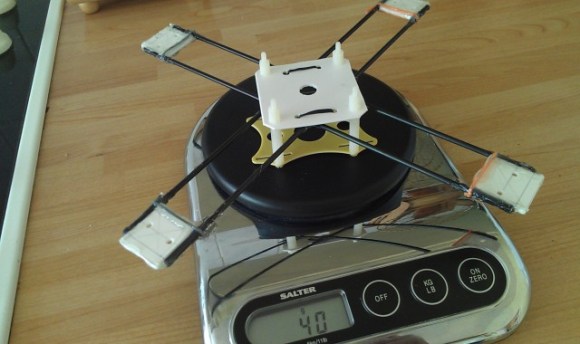
For his second attempt, [Oscar] started with a proven design from HobbyKing. HobbyKing’s fiberglass mini quadcopter frame is sturdy, but heavy, and expensive to replace (If the parts are even in stock). The frame did work though, so he used it as a starting point for his second DIY frame. The new frame is based upon fiberglass shafts. [Oscar] used hot glue to join the shafts to the motor mounts. Each joint was wrapped in string, which was then coated with hot glue. We’d suggest thin cyanoacrylate glue in the future for these types of joints. Only a few drops of CA soaks up into the string, creating an extremely light and strong joint. [Oscar’s] frame ended up at about half the weight of the HobbyKing frame, but was stiff enough for a successful flight test, as can be seen in the second video after the break.

Continue reading “DIY Mini Quadcopter Frame Is Light And Strong”

Pocket Sized Sattelites For Asteroid Detection

satellite

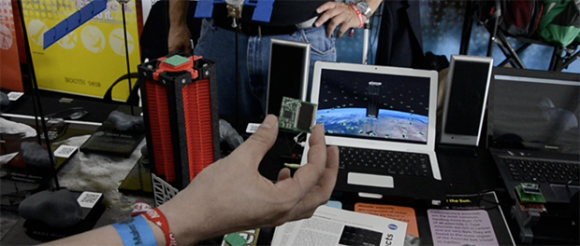
We’ve seen kicksats before, small pocketable single board satellites designed to orbit Earth. At this year’s Maker Faire, the team behind these kicksats has a new plan: using them to determine the orbits of earth-passing asteroids and hopefully not giving us any forewarning of our imminent extinction.

Instead of simply orbiting Earth, the new plan for these kicksats is to deploy them into the path of an oncoming asteroid such as Apophis so the radio transmissions from each satellite can pinpoint where exactly the asteroid is, something Earthbound optical and radio telescopes struggle with.

Despite the small size, the hardware on each kicksat is pretty impressive; each mini satellite has a solar cell on each side, a low-power MSP430 microcontroller with a radio module, and a few sensors. The system is designed so anyone can pick up the telemetry from these satellites with a small Yagi antenna and an RTL SDR TV tuner dongle.

An impressive bit of kit, but if holding a satellite or asteroid in your hand is more your thing, the same team behind the kicksat put up a whole bunch of 3D models of asteroids and space probes. They’re actually quite impressive when they’re printed out.

Tearing An Old Laptop Apart To Build A Ground Control Station

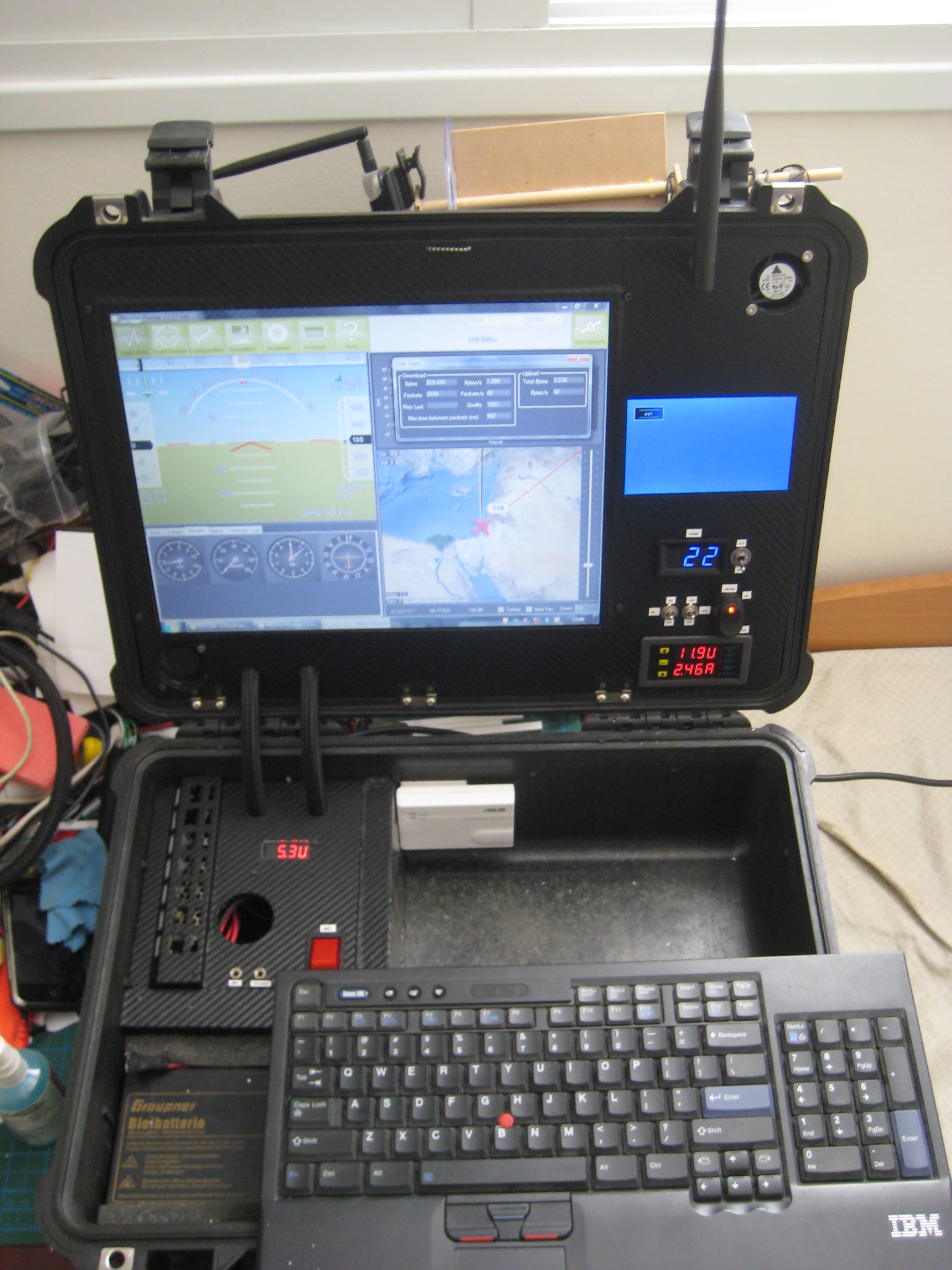
Being tired of assembling and disassembling parts/cables every time he went outside to fly his plane, [Elad] figured that he’d be better off building his own ground control station.

The core of the station is based on an old laptop with a broken screen he had laying around and (luckily) an older laptop screen he had found. As the latter only accepted LVDS, an adapter that could generate theses signals from the standard laptop’s VGA output was needed. [Elad] therefore disassembled his laptop and fit all the parts in a Pelican case he bought, as well as a lead-acid battery, a 12V to 19V stepup converter (to power the laptop), temperature/voltage/current sensors with their displays, 40mm fans, an AC/DC converter to charge the battery and finally a pico-UPS to allow uninterrupted use of the station when switching between power sources.

Because [Elad] didn’t have access to any machinery, PVC foam was used to maintain all the parts in place. Autonomy of his station is around 2.5hours on a single 12V 7Ah battery.

FPV Drones With An Oculus Rift

It was only a matter of time, and now someone’s finally done it. The Oculus Rift is now being used for first person view aerial photography. It’s the closest you’ll get to being in a pilot’s seat while still standing on the ground.

[Torkel] is the CEO of Intuitive Aerial, makers of the huge Black Armor Drone, a hexacopter designed for aerial photography. With the Rift FPV rig, the drone carries a huge payload into the air consisting of two cameras, a laptop and a whole host of batteries. The video from the pair of cameras is encoded on the laptop, sent to the base station via WiFi, and displayed on the Oculus Rift.

Latency times are on the order of about 120 ms, fairly long, but still very usable for FPV flight. [Torkel] and his team are working on a new iteration of the hardware, where they hope to reduce the payload mass, increase the range of transmission, and upgrade the cameras and lenses.

Continue reading “FPV Drones With An Oculus Rift”

Turning Anything Into A Drone

drone

For his graduate project, [Jasper] wanted to do something with a quadcopter drone. Not content with simply building any old drone, he decided to make a kit that turns anything into a drone. Everything from a bicycle wheel, to a computer keyboard, and even a phone is more than able to take flight with [Jasper]’s Drone It Yourself kit.

The DIY drone kit consists of a few 3D printed parts that include four clamps and mounts for the four engines. Also on board are ESCs, a battery, receiver, and an OpenPilot autopilot that will hopefully keep a drone in any shape imaginable hovering in the air. All this packaged in a sleek aluminum briefcase make it look like something out of an eccentric Bond film parody.

This project isn’t for sale – at least until the Brookstone catalog steals the idea – but you can get the bill of materials directly from [Jasper], just in case you’d like to make your own random flying object.

Continue reading “Turning Anything Into A Drone”