Red Bull Creation: Omnicorp: This Time, They’re Not Evil

While the bulk of the building for the Red Bull Creation happened at a recycling center/art space in Detroit, the judging was at Detroit’s Eastern Market, a huge farmer’s market that has just about everything. The Omnicorp hackerspace is just off Eastern Market, so this is their territory: they know what will work. For their entry for this year’s RBC, they’re going local: a wheeled information kiosk that’s also a great place to make smoothies and grill up a few veggies and dogs.

While the information kiosk the team is commendable, the idea of giving all the visitors to the Red Bull Creation event a halfway decent lunch is a great idea: all the ingredients are already there, so all that’s needed is an extension cord and a little bit of charcoal.

After the Red Bull Creation event is where this project would have really shined: hundreds of people going through at least six kegs, fireworks, a friggin’ dragon dump truck, and a DJ loud enough to be heard a half mile away. We’ll get to that in a post tomorrow. Let’s just say our head editor had fun.

Judge Spotlight: Joe Grand

judge-spotlight-joe-grand

We’ve been fascinated by [Joe Grand] for years. His early talks at DEFCON, and extensive work designing badges for it, helped to put the conference on our radar. We’ve seen many pieces of hardware come from his company Grand Idea Studio over the years, and of course there was the television show Prototype This! which must have been way too awesome for some TV exec to allow it to continue.

We asked [Joe], who is a judge for The Hackaday Prize, a few a questions. He sent back the video response embedded below. He talks about what he’s doing these days, the hacker community in Boston, shows off some hardware he uses when teaching about security, and much more.

Continue reading “Judge Spotlight: Joe Grand”

Red Bull Creation: Giant Cannons Shooting Salt

Hackaday took a trip to Detroit last weekend for the Red Bull Creation Contest. It was a blast, we had a lot of fun, and we were lucky enough to catch a glimpse at seven teams hacking, grinding, sawing, and soldering their way through the 72 hour buildoff.

Team Detroitus started their build with the idea of building a giant air cannon. The theme of the build was ‘reinventing the wheel’, but they apparently didn’t let that get in the way of building a giant double barrel air cannon, filling it with candy and stuffed animals, and shooting it, point blank, at children. I was wanged by a lemon Starburst, but that’s my favorite flavor anyway.

Continue reading “Red Bull Creation: Giant Cannons Shooting Salt”

Old Laptops, Modems, And The Hackaday Retro Edition

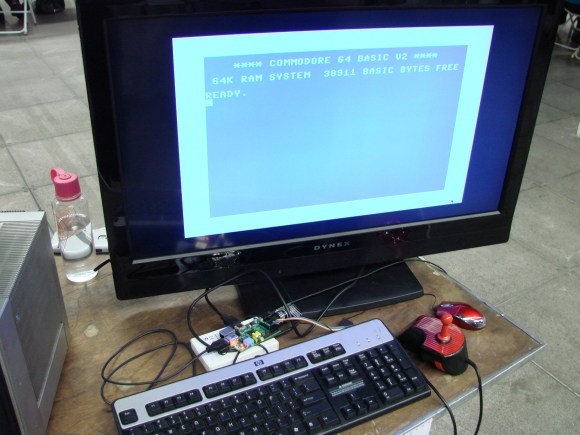
We haven’t been getting very many submissions of extremely old computers loading up the Hackaday Retro Edition in a while. For shame. Thankfully, [alnwlsn] is here to pick up the slack from the rest of you with his latest accomplishment, getting two old laptops on the Internet with some old telecom equipment.

The first is a Toshiba from about 1995, Pentium processor, 12 MB of RAM, and a 10 GB (!) hard drive. [aln] had a PCMICA modem sitting around, and with Windows 95 and IE 5.5, he was able to slowly connect.

Pentium class machines are okay, but the next one – a Zenith Data Systems laptop from about 1987 – is awesome. 80C88 CPU, two 720k floppy drives, and the exact amount of RAM in that quote falsely attributed to [Bill Gates]. [alnwlsn] is connecting with a 28.8k modem, but the serial port only supports up to 9600. It’s a computer so old, even the retro edition’s main page times out. The about page, though, loaded fine.

[alnwlsn] used a modem with both of these laptops, but he doesn’t have dial-up or even a landline. This forced him to make his own line simulator that requires plugging in the phone line at the right time, manually ringing a modem connected to another computer, and letting PPP take it from there. It’s a crude circuit, but it works. slow, but it works. Video below.

Continue reading “Old Laptops, Modems, And The Hackaday Retro Edition”

All Precincts Reporting — Next Round Of Voting Is Now


THP_Voting-Best_Concept-results

Check out the vote tally which [Alek] put together (click for a much larger version). We couldn’t be more delighted at how the first round of voting for Astronaut or Not went. With very nearly 50k votes it’s time to start another round.

This is an entirely new round. Your 30 votes have been restored and you must vote at least once in this new round to be eligible for the voter lottery. The theme has also changed; vote for projects whose ideas are most likely to be used in other projects. That is to say: is there a core piece of cleverness that, properly explained and modularized, would be extremely extensible? Then vote for that one!

Links to the 15 winners are listed after the break; everyone on this list is getting a T-shirt and some stickers. The same will be true for the next round but we’re changing up the Voter Lottery prize — it’ll be similarly valuable and desirable but we’ll save details for this for Thursday. Make sure you vote or risk losing Friday’s lottery!

Continue reading “All Precincts Reporting — Next Round Of Voting Is Now”

Judge Spotlight: Elecia White

If you’re a fan of the Embedded podcast you know her voice well. If not, you need to check out the show! Of course we’re talking about [Elecia White], who spent her recent holiday answering our questions.

She’s an accomplished embedded systems engineer — she literally wrote the book on it. We’re delighted that [Elecia] agreed to lend us her skill and experience as a judge for The Hackaday Prize!


judge-spotlight-q5We find that embedded engineers come from all manner of backgrounds. Can you tell us a little bit about how you got into the field?

judge-spotlight-a5I majored in a combination of applied computer science and theoretical systems engineering: my classes were all about programming, C, Fourier, and control loops. I had no idea I’d built a major that would be perfect for low level embedded development.

After school, I went to Hewlett-Packard. I was in the network server division, monitoring servers, writing drivers, and getting ever closer to the hardware. I moved over to HP Labs’ BioScience division to do real embedded work, though I didn’t understand that at the time (yay for a hiring manager who did!). Once I made a motor move, well, it was all over for me. I loved having my software touch the physical world. Happily, the environment was great and the electrical engineers were very patient.


judge-spotlight-q5Do whimsical embedded challenges ever come to mind? For instance, do you ever flip on the TV and think to yourself: “some day I’m going to reprogram the uC and write something that works!”?

Continue reading “Judge Spotlight: Elecia White”

Go Vintage! Learn To Repair And Restore Mechanical Pocket And Wrist Watches.

pw tear down 1

Until recently, watches have been entirely mechanical where each wheel, gear, and mechanism representing a milestone in our understanding of precision manufacturing and timekeeping.

One of the very first watches, created by a locksmith.

Today it is nearly impossible to find watchmakers to service or repair vintage mechanical pocket and wristwatches, so we have to do it ourselves. Learn to repair vintage mechanical watches. You can do this and we’ll show you how.

They tick, mechanical watches have a pulse. First created in the 16th century by locksmiths, these early watches could only resolve time down to the hour and for this reason displayed time with only one hour hand.

By the 18th century fusee technology enabled watches to achieve accuracies to within seconds.

Continue reading “Go Vintage! Learn To Repair And Restore Mechanical Pocket And Wrist Watches.”