If You Own A Camera You Need To Try Light Graffiti

Do you have a camera that’s capable of controlling how long of an exposure it takes?  With this and any small light source, you can make a really awesome illuminated image like the one featured above.  Combine this with the hacking skills that you’ve hopefully learned from reading Hackaday, and the visual possibilities are endless.

Let’s look at the background of this entertaining light hacking technique, and how you can make images like this yourself!

Continue reading “If You Own A Camera You Need To Try Light Graffiti”

Interview: Mill CPU For Humans Parts 3 And 4

Welcome back to the conclusion of our interview on Mill CPU architecture with [Ivan Godard]. If you missed yesterday’s offering you can watch the preview video or go back and read the original article. Above is the third part, with the final installment found after the break.

We’d like to address some concerns from the comments of yesterday’s post. Several readers noted that Mill is only in the simulation phase. [Ivan] is very up-front about that… there is no silicon. But that doesn’t mean we should disregard a company that looks to build on successes from the current generation of processors while avoiding their drawbacks. It is incredibly costly to design silicon from scratch. This is why we don’t see new architectures sprouting up on a monthly basis.

We simply think it’s exciting to see what kinds of changes may be coming and how designers plan to accomplish advances in processing power while reducing power consumption at the same time.

Continue reading “Interview: Mill CPU For Humans Parts 3 And 4”

Interview: New Mill CPU Architecture Explanation For Humans

Hackaday had an amazing opportunity to sit down with [Ivan Godard] who discussed the Mill CPU development which his company — Out of the Box Computing —  has been working on for about a decade. The driving force behind Mill development is that optimizations to existing architectures can only get you so far. At some point you need to come up with a new processor that builds on success and failure of its predecessors.

Ivan’s team has put out several lecture videos linked from their site that dig really deep into the inner workings that give Mill an advantage over currently available chips. We covered one of them recently which prompted [Ivan] to reach out to us. But what if you aren’t working on your advanced degree in semiconductor design? Our interview certainly isn’t for the laymen, but any engineering enthusiast should find this a refreshing and delightful conversation. After the jump you can see the first two installments of the four part interview.

Continue reading “Interview: New Mill CPU Architecture Explanation For Humans”

Trinket Contest Winners

trinket-contest-winners

Originally Adafruit offered us 20 boards to give away. But when we had so many interesting submissions they were kind enough to throw in some more. We took them up on it, eventually choosing 41 winners… and believe us when we say it was difficult to whittle it down to that number! Thank you to all who took the time and made the effort to send something in.

Organizationally it’s been a challenge keeping all of the submissions straight. That’s why the presentation of the top entries is listed as a set of galleries. More info on each is available on their associated update posts. Congratulations to all! We want to do more giveaways in this same spirit (with different prize hardware and submission themes each time). If you’re interested in that please let us leave your words of encouragement in the comments.

Continue reading “Trinket Contest Winners”

A New Old Lathe For Your Hackerspace Or Garage

3D printers, or even small CNC routers may seem like relatively easy machine tools to obtain for your hackerspace or garage. They are both very useful, but at some point you may want to start working with round parts (or convert square-ish items into round parts). For this, there is no better tool than a lathe. You can buy a small and relatively cheap lathe off of any number of distributors, but what if you were to get a good deal on a larger lathe? Where would you even start?

In my case, I was offered a lathe by a shop that no longer had a use for it. Weighing in at 800 pounds and using 3 phase power, this South Bend Lathe might have been obtained economically, but getting it running in my garage seemed like it would be a real challenge. It definitely was, but there are a few mistakes that I’ve made that hopefully you can avoid.

Continue reading “A New Old Lathe For Your Hackerspace Or Garage”

CAN Hacking: The Hardware

So far we have discussed the basics of CAN, in-vehicle networks, and protocols used over CAN. We’re going to wrap up with a discussion of CAN tools, and parts to build your own CAN hardware.

Wiring

Unfortunately, there’s no set standard for CAN connections. The most common connector for high-speed CAN is a DE-9, with CAN high on pin 7 and CAN low on pin 2. However cables will differ, and many are incompatible.

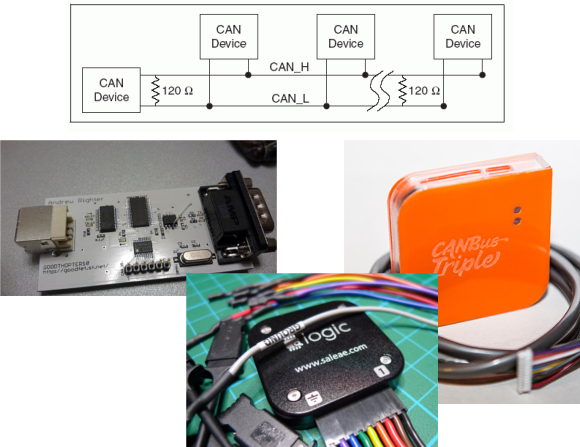
CAN needs to be terminated, preferably by a 120 ohm resistance on either end of the bus. In practice, you can stick a single 120 ohm resistor across the bus to deal with termination.

Tools

A good CAN tool will let you transmit and receive CAN messages, interpret live data using CAN databases, and talk CAN protocols. The tools with this feature set are proprietary and expensive, but some hacker friendly options exist.

GoodThopter
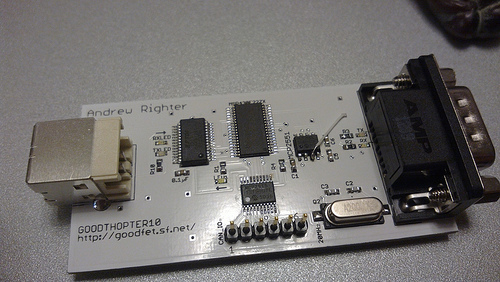
The GoodThopter12

Based on [Travis Goodspeed’s] GoodFET, the GoodThopter by [Q] uses the Microchip MCP2515 CAN to SPI controller to access the bus. The open hardware tool lets you send and receive messages using Python scripts.

CAN Bus Triple

CAN Bus Triple

The CAN Bus Triple device provides an interface to three CAN buses, and can be programmed in an environment similar to Arduino. The open source code provided lets you muck with the second generation Mazda 3. Unfortunately, the hardware does not appear to be open source.

Saleae Logic
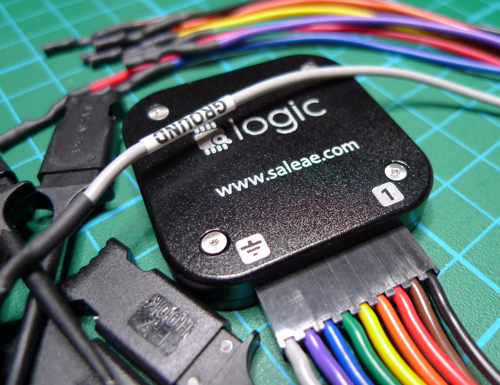
Saleae Logic

It’s not open source, but the Saleae Logic is a very handy and cheap tool for looking at CAN buses. It can capture, decode, and display CAN traffic. This is most useful when you’re building your own CAN hardware.

DIY

The Parts

If you want to design your own hardware for CAN, you’ll need two things: a CAN controller, and a CAN transceiver.

The CAN controller generates and interprets CAN messages. There’s many microcontrollers on the market with built-in CAN controllers, such as the Atmel ATmega32M1, Freescale S08D, and the TI Tiva C Series. When using a built-in CAN controller, you’ll have to use an external oscillator, internal oscillators are not sufficiently accurate for high-speed CAN. If you want to add CAN to an existing microcontroller, the MCP2515 is an option. It’s a standalone CAN controller that communicates over SPI.

The transceiver translates signals from the controller to the bus, and from the bus to the transceiver. Different transceivers are needed for high-speed and low-speed CAN networks. The NXP TJA1050 works with high-speed buses, and the ON Semi NCV7356 works with low-speed, single wire buses.

Dev Boards

There’s a ton of development boards out there featuring microcontrollers with a CAN controller. The Arduino Due‘s SAM3 processor has a controller, but there’s no transceiver on the board. You can pick up a CAN bus shield, and the Due CAN Library to get started.

The ChipKIT Max32 is similar to the Due. It has two CAN controllers, but you’ll need to provide external transceivers to actually get on a bus. Fortunately there’s a shield for that. The ChipKIT is officially supported by Ford’s OpenXC Platform, so you can grab their firmware.

That concludes our discussion of CAN Hacking. Hopefully you’re now ready to go out and experiment with the protocol. If you have questions, send them along to our tip line with “CAN Hacking” in the subject, and we’ll compile some answers. If you liked this series and want to suggest a topic for the next set of posts we’d love to hear that as well!

CAN Hacking

HHH: CNC Winners

hhh-cnc-winners

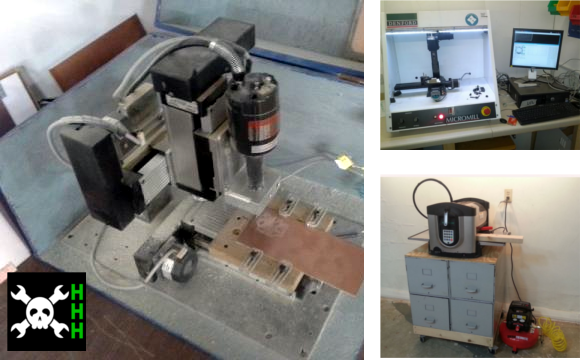
Congratulations to the winners of the first Hackaday Hackerspace Henchmen series. We asked hackerspace members to send us stories about CNC hacks. Here’s a roundup of the three winners:

[Rich] from the Connecticut Hackerspace gets the top spot having sent in the story of their desktop CNC mill hacks. He gets a $50 gift card to the parts vendor of his choosing.

[Barnaby] is also a winner for sharing the story of how they hacked a script to translate G-Code into the proprietary format accepted by the desktop CNC mill at rlab.

And [Tim’s] submission showed how a movable storage base was built for the CNC carving machine at The Rabbit Hole.

We had hoped for more entries and planned to send out stickers to all and shirts to the top five. We’ll be sending both shirts and stickers to the three winners. We’re undecided as to whether we should continue the HHH program with a new theme. We’d love to hear what you think about it in the comments section.