Sad news for kids and adults alike as Lego announces the end of the Mindstorms line. The much-wish-listed line of robotics construction toys will be discontinued by the end of this year, nearly a quarter-century after its 1998 introduction, while support for the mobile apps will continue for another couple of years. It’s probably fair to say that Mindstorms launched an entire generation of engineering careers, as it provided a way to quickly prototype ideas that would have been difficult to realize without the snap-fit parts and easily programmed controllers. For our money, that ability to rapidly move from idea to working model was perhaps the strongest argument for using Mindstorms, since it prevented that loss of momentum that so often kills projects. That was before the maker movement, though, and now that servos and microcontrollers are only an Amazon order away and custom plastic structural elements can pop off a 3D printer in a couple of hours, we can see how Mindstorms might no longer be profitable. So maybe it’s a good day to drag out the Mindstorms, or even just that big box of Lego parts, and just sit on the carpet and make something.

Slider4949 Articles
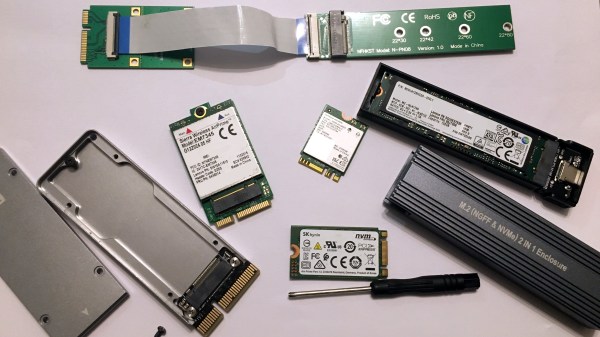
M.2 For Hackers – Expand Your Laptop
You’ve seen M.2 cards in modern laptops already. If you’re buying an SSD today, it’s most likely an M.2 one. Many of our laptops contain M.2 WiFi cards, the consumer-oriented WWAN cards now come in M.2, and every now and then we see M.2 cards that defy our expectations. Nowadays, using M.2 is one of the most viable ways for adding new features to your laptop. I have found that the M.2 standard is quite accessible and also very hackable, and I would like to demonstrate that to you.
If you ever searched the Web trying to understand what makes M.2 tick, you might’ve found one of the many confusing articles which just transcribe stuff out of the M.2 specification PDF, and make things look more complicated than they actually are. Let’s instead look at M.2 real-world use. Today, I’ll show you the M.2 devices you will encounter in the wild, and teach you what you need to know to make use of them. In part 2, I will show you how to build your own M.2 cards and card-accepting devices, too!
Well Thought-Out, Mostly
You can genuinely appreciate the M.2 standard once you start looking into it, especially if you have worked with mPCIe devices for some amount of time. mPCIe is what we’ve been using for all these years, and it gradually became a mish-mash of hardly-compatible pinouts. As manufacturers thought up all kinds of devices they could embed, you’d find hacks like mSATA and WWAN coexistence extensions, and the lack of standardization is noticeable in things like mPCIe WWAN modems as soon as you need something like UART or PCM. The M.2 specification, thankfully, accounted for all of these lessons.
Computing Fluidly
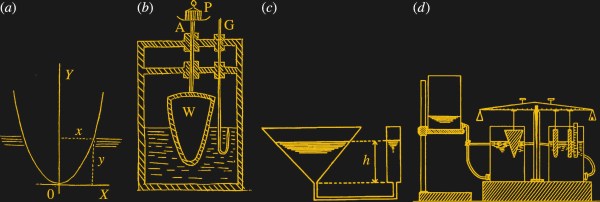
Computers come in many forms, depending on your definition. We’ve seen computers and computer gates built out of things as diverse as marbles, relays, and — of course — transistors. However, there are logic gate systems that use a property of moving fluids to form logic gates and a bistable element. That’s all the pieces you need to build a working computer.
It may sound far-fetched, but there have been general-purpose computers built using this technology. It is also used in specialized applications where fluids are already flowing, like shower heads, automotive transmissions, and in places where electronics are prone to misbehave. Many think the field will see a resurgence when we need to build logic at the molecular level for nanotech applications, too.
Basics
In its most basic form, a fluidic gate uses flow as a logic 1 and less flow to be a logic 0. Merging two streams together provides an OR gate. Using a supply stream that you can divert with a control stream provides a NOT function. Given enough inverters and OR gates, you can build everything else.
Robots Are Folding Laundry, But They Suck At It
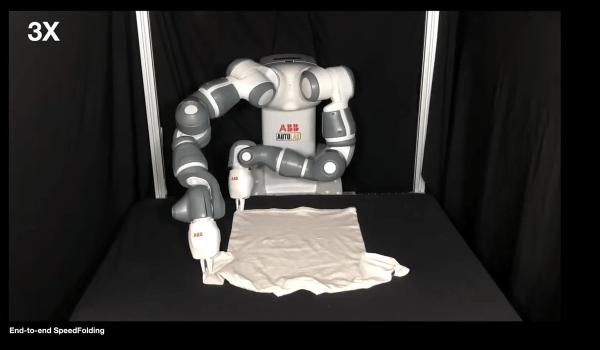
Robots are used in all sorts of industries on a wide variety of tasks. Typically, it’s because they’re far faster, more accurate, and more capable than we are. Expert humans could not compete with the consistent, speedy output of a robotic welder on an automotive production line, nor could they as delicately coat the chocolate on the back of a KitKat.
However, there are some tasks in which humans still have the edge. Those include driving, witty repartee, and yes, folding laundry. That’s not to say the robots aren’t trying, though, so let’s take a look at the state of the art.
Continue reading “Robots Are Folding Laundry, But They Suck At It”
Mastercard’s New Card: Safer From Quantum Attacks?
Quantum computers present a unique threat to many aspects of modern information technology. In particular, many cryptographic systems could be at risk of compromise in the event a malicious actor came into possession of a capable quantum computer.
Mastercard is intending to stay ahead of the game in this regard. It has launched a new contactless credit card that it says is impervious to certain types of quantum attack.
Continue reading “Mastercard’s New Card: Safer From Quantum Attacks?”
Bare-Metal STM32: Setting Up And Using SPI
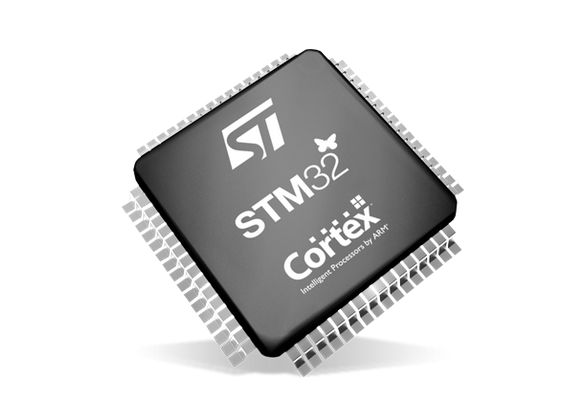
The Serial Peripheral Interface (SPI) interface was initially standardized by Motorola in 1979 for short-distance communication in embedded systems. In its most common four-wire configuration, full-duplex data transfer is possible on the two data (MOSI, MISO) lines with data rates well exceeding 10 Mb/s. This makes SPI suitable for high-bandwidth, full-duplex applications like SD storage cards and large resolution, high-refresh displays.
STM32 devices come with a variable number of SPI peripherals, two in the F042 at 18 Mb/s and five in the F411. Across the STM32 families, the SPI peripheral is relatively similar, with fairly minor differences in the register layout. In this article we’ll look at configuring an SPI peripheral in master mode.
Continue reading “Bare-Metal STM32: Setting Up And Using SPI”
Dancers Now Help Power Glasgow Nightclub
Humanity thus far has supplied most of its electricity needs by burning stuff, mostly very old stuff that burns great but is hard to replace. That stuff is getting increasingly expensive, and the pollution is a bother too, so renewable sources of energy are becoming more popular.
While wind or solar power are commonly used at the grid level, one Glasgow nightclub has taken a different tack. It’s capturing energy from its patrons to help keep the lights on.