Review: Lidl Parkside Micrometer

A couple of years ago we published a look at precision measurement tools, in particular vernier calipers and micrometer screw gauges. It featured a look at how they work and how they’re used, and a comparison of good and bad quality instruments. When comparing micrometers we had three of them, a Mitutoyo and a Moore & Wright representing decent quality, and an £8 ($9.41) Daniu from Banggood from the cheaper end of the market. As you might expect, the Daniu was laughably bad, with noticeable play in its thread and jaws that were not parallel to the extent you could see light between them. You might consider it case closed for cheap micrometers then, were it not that while on my summer travels through the Benelux countries I spied a Parkside micrometer in a Lidl supermarket for €8.99 ($8.92). I had to buy it and investigate.

Some Measuring Devices With Your Groceries?
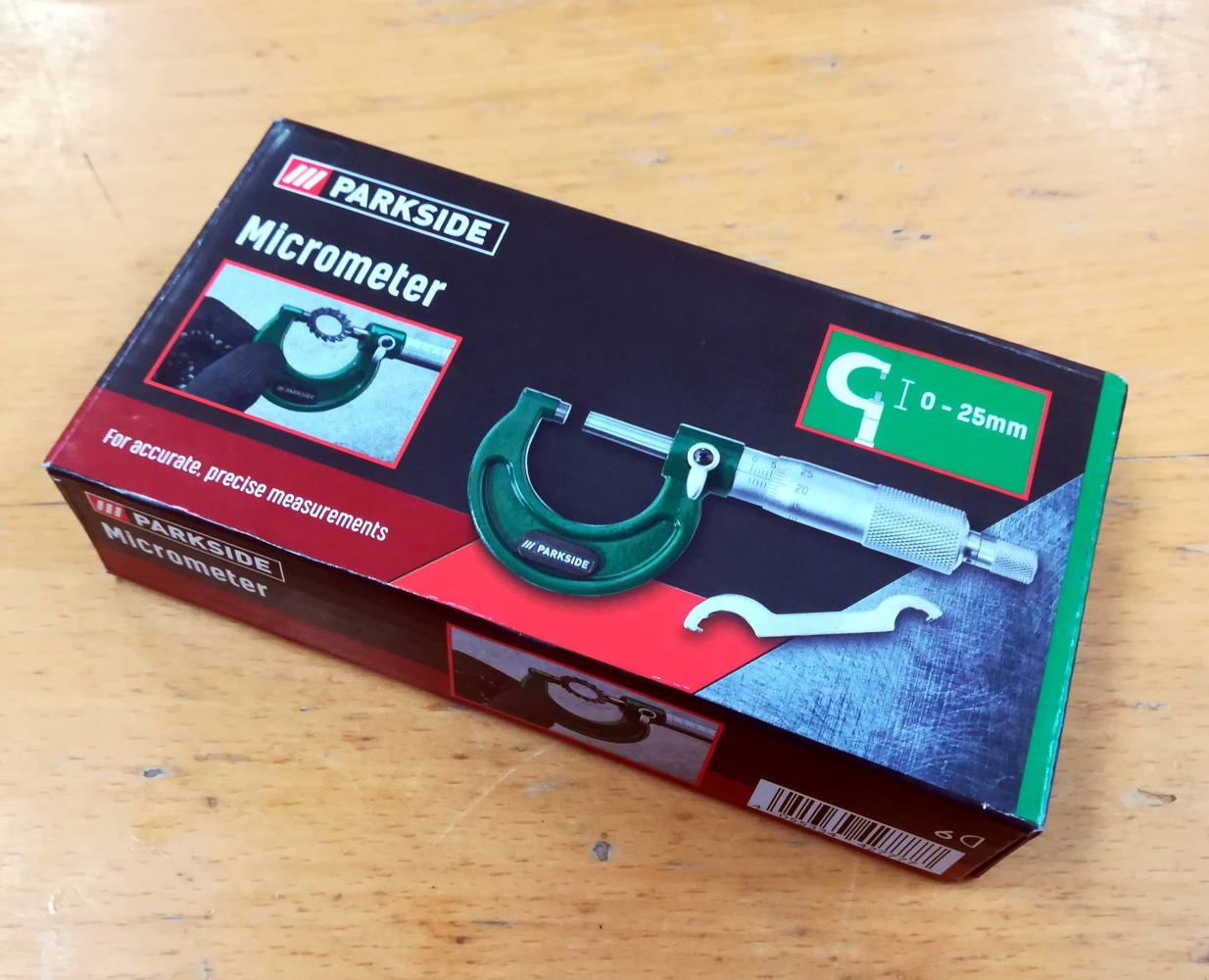
The Parkside micrometer in its boxLidl is a German supermarket chain that can be found all over Europe, and like their arch-competitor Aldi they feature the “Middle of Lidl” aisles full of all sorts of useful stuff that changes on a regular basis. Among this is a comprehensive range of tools under the Parkside brand, which is basically on par with the good stuff from Harbor Freight, and are in fact quite good for the price. Thus even though it’s about the same price as the Daniu I had higher expectations for the Parkside micrometer.

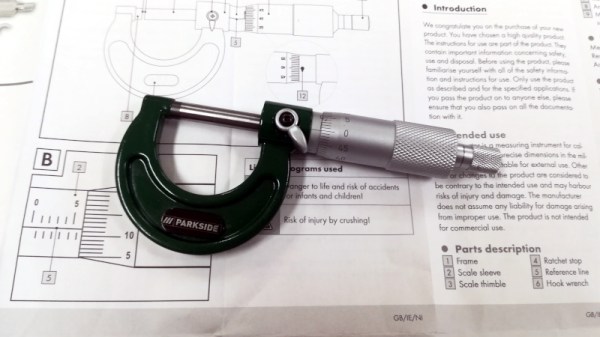
The micrometer is packaged in the usual plastic case in a small cardboard box, and comes with a large paper instruction sheet and a small spanner for zero adjustment. Taking it out of the case, it follows exactly as you’d expect from a micrometer with a solid drop-forged frame and an aluminium barrel on the micrometer head. It can measure up to 25 mm at a resolution of 0.01 mm, exactly like the others I tested in 2020. So my nine dollars or so has got me a micrometer, but is it any good? How do you evaluate a micrometer screw gauge? I re-borrowed the two comparison instruments from 2020, and set out to find out.

The Tiniest Sliver Of Light Gives It Away
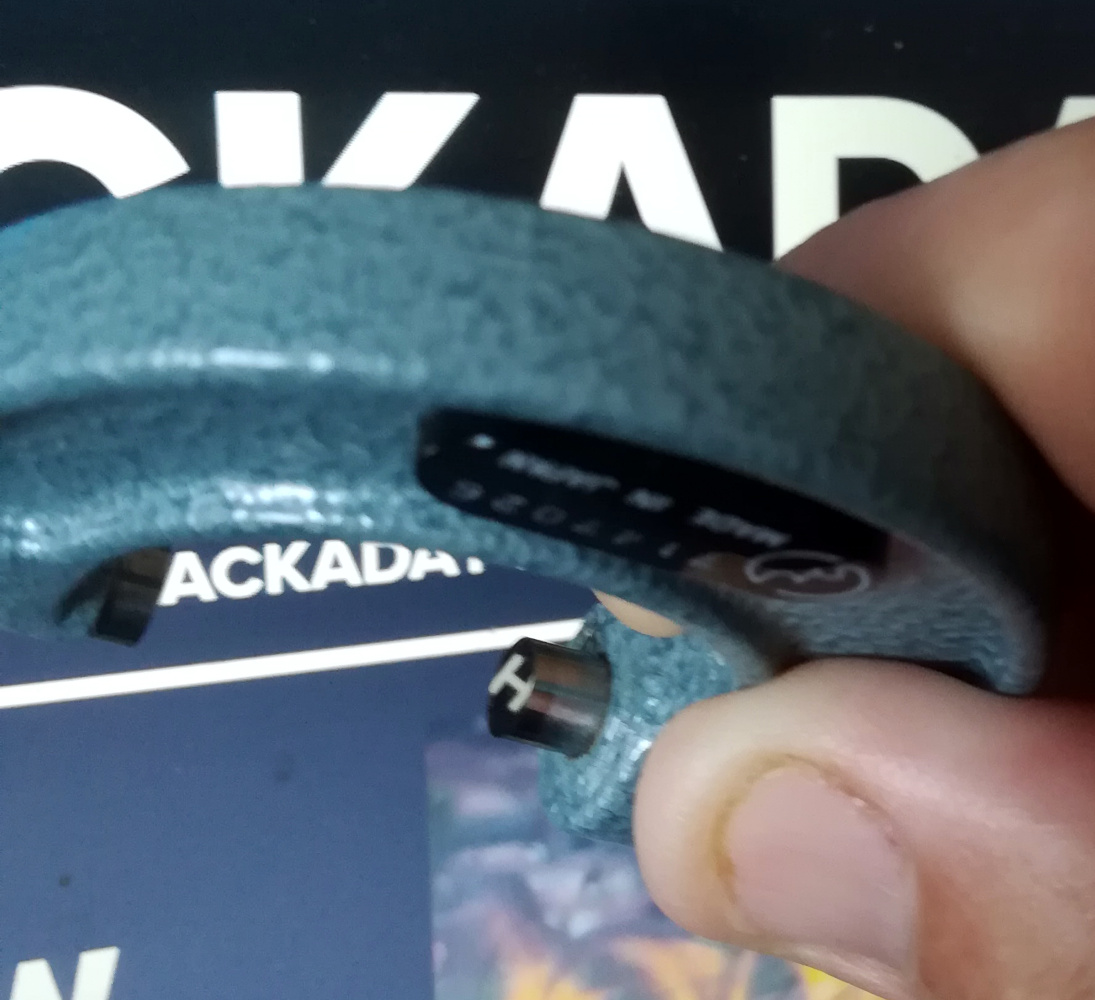
The mirror finish on the Mitutoyo jaw face reflecting the "H" of the Hackaday website.
The mirror finish on the Mitutoyo jaw face reflecting the “H” of the Hackaday website.

It’s worth saying that the jaw faces are polished, but not to a mirror finish as those on the Mitutoyo and neither do they appear to have been hardened. In the first instance, comparing with the Daniu I closed the jaws against the force of the ratchet, and held it up against the light to spot any imperfections in the way they meet. Against the blue sky through my window I couldn’t see any, but a friend did the same thing against the more intense point source of an electric light and indeed there was the tiniest discernable sliver of light. Not the obvious wedge of light I caught with the Daniu back in 2020 and less than the visible sliver of light when it is measuring a human hair, but definitely enough to knock a few hundredths of a milimetre off my trust in its accuracy.

The next step in the evaluation involves opening the  jaws about half way, and feeling for any play in the thread. None discernable, at least one win over the Daniu which had the barrel flapping around with significant play. Then a zero test, after adjusting the zero position with the spanner a few repeated closings with the ratchet, to check that it always returns to the same zero point. In this case as with all micrometers it’s possible to overshoot the zero and damage the thread if you apply too much force, but just on the ratchet it would land in the same place.  A pass on a couple of tests then, so while it’s not the worst micrometer ever it’s obvious that the low price brings at least one compromise.

A Tiny Discrepancy In Measurement

Opening up the three micrometers from the 2020 piece again it’s immediately obvious in the silky feel of the thread and the lack of wobble in the ratchet just where the money goes in an expensive micrometer, and just how comedically bad the Daniu was by comparison. But it’s the Parkside in our sights today, so it’s time to make a few comparitive measurements between it and the Mitutoyo. First up were the old standbys of a piece of paper and a human hair in which the Parkside returned the same as the Mitutoyo, and then the machined shaft of the Moore & Wright which returned a difference of 0.01 mm.

Parkside Mitutoyo
Sheet of paper 0.12 mm 0.12 mm
Human hair 0.05 mm 0.05 mm
Moore & Wright shaft 6.79 mm 6.80 mm

The discrepancy in this table when measuring the shaft may be small, but it harks back to that sliver of light from imperfectly aligned jaws. As expected if the shaft meets the jaws at anything but the highest point of the jaw it will return a slightly smaller reading, thus it immediately has an error on everything it returns. Discussing it with friends there was raised the intriguing possibility of lapping the faces by drawing a sheet of exceptionally fine abrasive through the closed jaws, however I have my doubts as to whether this would do anything but make the gap worse.

What I can say about the Parkside micrometer screw gauge is that it appears reasonably well-built, but I can’t present it as the equal of the more expensive instruments when its faces are anything but parallel. I would say therefore that it would be good for basic measurements when machining or in CAD work where an error of 0.01 mm or 0.02 mm wouldn’t matter too much, but perhaps I wouldn’t quite trust it when working with extremely fine tolerances. Still, it’s not the worst among cheap micrometers and it’s on sale for a very reasonable price even if it’s not in the same precision instrument league as the Mitutoyo. If you don’t have a micrometer screw gauge yet then you could do a lot worse at this end of the market.


Visual Mandela Effect: You Don’t Know Iconic Images As Well As You Think

Pop quiz, hotshot: does the guy on the Monopoly box (standard edition) wear a monocle? Next question: does the Fruit of the Loom logo involve a cornucopia? And finally, does Pikachu have a black-tipped tail? If you answered yes to any of these, I am sad to say that you are wrong, wrong, wrong.

So, what’s the deal? These are all examples of the visual version of the Mandela effect (VME), which is named after the common misconception/mass false memory that anti-Apartheid activist Nelson Mandela died decades ago in prison, despite leading South Africa in the latter half of the ’90s and living until 2013. Many people even claim having seen TV coverage of his funeral, or say they learned about his death in school during Black History Month. The whole thing has VICE wondering whether CERN is causing these mass delusions somehow with the LHC.

The more attention VME gets, the more important it seems to be to study it and try to come to some conclusion. To that end, University of Chicago researchers Deepasri Prasad and Wilma A. Bainbridge submitted an interesting and quite readable study earlier this year purporting that the VME is ‘evidence for shared and specific false memories across people’. In the study, they conducted four experiments using crowd-sourced task completion services.

Continue reading “Visual Mandela Effect: You Don’t Know Iconic Images As Well As You Think”

Hackaday Links Column Banner

Hackaday Links: August 28, 2022

The countdown for the first step on humanity’s return to the Moon has begun. The countdown for Artemis 1 started on Saturday morning, and if all goes well, the un-crewed Orion spacecraft atop the giant Space Launch Systems (SLS) booster will liftoff from the storied Pad 39B at Cape Canaveral on Monday, August 29, at 8:33 AM EDT (1233 GMT). The mission is slated to last for about 42 days, which seems longish considering the longest manned Apollo missions only lasted around 12 days. But, without the constraint of storing enough consumables for a crew, Artemis is free to take the scenic route to the Moon, as it were. No matter what your position is on manned space exploration, it’s hard to deny that launching a rocket as big as the SLS is something to get excited about. After all, it’s been 50 years since anything remotely as powerful as the SLS has headed to space, and it’s an event that’s expected to draw 100,000 people to watch it in person. We’ll have to stick to the NASA live stream ourselves; having seen a Space Shuttle launch in person in 1990, we can’t express how much we envy anyone who gets to experience this launch up close.
Continue reading “Hackaday Links: August 28, 2022”

Hackaday Podcast 183: Stowaway Science, Cold Basements, And Warm Beers

This week, Editor-in-Chief Elliot Williams and Assignments Editor Kristina Panos met up on a secret server to discuss the cream of this week’s crop of hacks. After gushing about the first-ever Kansas City Keyboard Meetup coming up tomorrow — Saturday the 27th, we start off by considering the considerable engineering challenge of building a knife-throwing machine, the logistics of live-streaming on the go, and the thermodynamics of split-level homes.

This week, Kristina came up with the What’s-That-Sound and managed to stump Elliot for a while, though he did eventually guess correctly after the tape stopped rolling. Think you know what it is? Then fill out the form and you’ll earn the chance to win a genuine Hackaday Podcast t-shirt!

Later in the show, we look at a macro pad that breaks the mold, an ASCII terminal like it’s 1974, and a Z80 that never was (but definitely could have been). Stick around as we root for the CubeSats hitching a ride aboard Artemis I, and at last call on the ‘cast, it’s lagers vs. ales (vs. ciders).

Direct download.

Check out the links below if you want to follow along, and as always, tell us what you think about this episode in the comments!

Continue reading “Hackaday Podcast 183: Stowaway Science, Cold Basements, And Warm Beers”

I3C — No Typo — Wants To Be Your Serial Bus

Remember old hard drives with their giant ribbon cables? They went serial and now the power cables are way thicker than the data cables. We’ve seen the same thing in embedded devices. Talking between chips these days tends to use I2C or SPI or some variation of these to send and receive data over a handful of pins. But now there is I3C, a relatively new industry standard that is getting a bit of traction.

I2C and SPI are mature but they do have problems. I2C can be relatively slow and SPI usually requires extra pins for each device. Besides that, there is poor support for adding and removing devices dynamically or discovering devices automatically.

I3C, created by the MIPI Alliance, aims to fix these problems. It does use the usual two wires, SCL for the clock and SDA for data.  One device acts as a controller. Other devices can be targets or secondary controllers. It is also backward compatible with I2C target devices. Depending on how you implement it, speeds can be quite fast with a raw speed of 12.5 Mbps and using line coding techniques can go to around 33 Mbps.

Continue reading “I3C — No Typo — Wants To Be Your Serial Bus”

Space-Based Solar Power: Folly Or Stroke Of Genius?

The Sun always shines in space, unless a pesky planet gets in the way. That’s more or less the essential thought behind space-based solar power (SBSP) as newly pitched by ESA’s director general, Josef Aschbacher on Twitter. Rather than putting photovoltatic solar panels on the Earth’s surface which has this annoying property of constantly rotating said panels away from the Sun during what is commonly referred to as ‘night’, the panels would be put stationary in space, unaffected by the Earth’s rotation and weather.

Although a simple idea, it necessitates the solving of a number of problems. The obvious first question is how to get these panels up in space, hundreds of kilometers from the Earth’s surface, to create a structure many times larger than the International Space Station. The next question is how to get the power back to Earth, followed by questions about safety, maintenance, transfer losses and the inevitable economics.

With organizations ranging from NASA to China’s Academy for Space Technology (CAST), to US institutions and others involved in SBSP projects, it would seem that these problems are at the very least deemed to be solvable. This raises the question of how ESA’s most recent proposal fits into this picture. Will Europe soon be powered from orbital solar panel arrays?

Continue reading “Space-Based Solar Power: Folly Or Stroke Of Genius?”

How Resilient Is The Natural Gas Grid?

A few years ago, I managed to get myself on a mailing list from a fellow who fancied himself an expert on energy. Actually, it seemed that no area was beyond his expertise, and the fact that EVERY EMAIL FROM HIM CAME WITH A SUBJECT LINE IN CAPS WITH A LOT OF EXCLAMATION POINTS!!!! really sealed the deal on his bona fides. One of the facts he liked to tout was that natural gas was the perfect fuel. Not only is it clean-burning and relatively cheap, it’s also delivered directly to consumers using a completely self-powered grid. Even under “zombie apocalypse” conditions, he claimed that natural gas would continue to flow.

At the time, it seemed a bit overstated, but I figured that there was at least a nugget of truth to it — enough so that I converted from an electric range and water heater to gas-powered appliances a couple of years ago, and added gas fireplaces for supplemental heat. I just sort of took it for granted that the gas would flow, at least until the recent kerfuffle over the Nordstream pipeline. That’s when I got a look at pictures of the immense turbine compressors needed to run that pipeline, the size and complexity of which seem to put the lie to claims about the self-powered nature of natural gas grids.

Surely a system dependent on such equipment could not be entirely self-powered, right? This question and others swirled doubt in my mind, and so I did what I always do in these cases: I decided to write an article so I could look into the details. Here’s what I found out about how natural gas distribution works, at least in North America.

Continue reading “How Resilient Is The Natural Gas Grid?”