Taking The Pulse (Width Modulation) Of An FPGA

I like to think that there are four different ways people use FPGAs:

  1. Use the FPGA as a CPU which allows you to add predefined I/O blocks
  2. Build custom peripherals for an external CPU from predefined I/O blocks
  3. Build custom logic circuitry from scratch
  4. Projects that don’t need an FPGA, but help you learn

I’d bet the majority of FPGA use falls into categories one and two. Some FPGAs even have CPUs already built-in. Even without an onboard CPU, you can usually put a CPU “core” (think reusable library) into the chip. Either way, you can always add other cores to create UARTs, USB, Ethernet, PWM, or whatever other I/O you happen to need. You either connect them to a CPU on the chip, or an external one. With today’s tools, you often pick what you want from a list and then your entire project becomes a software development effort.

Continue reading “Taking The Pulse (Width Modulation) Of An FPGA”
Retrocomputing On A Chip

New electrical components enable us to reconstruct old wiring more efficiently. Especially, the accessible and cheap FPGA kits which offer the possibility to put together wiring of many old computers as an “on-a-chip” solution.

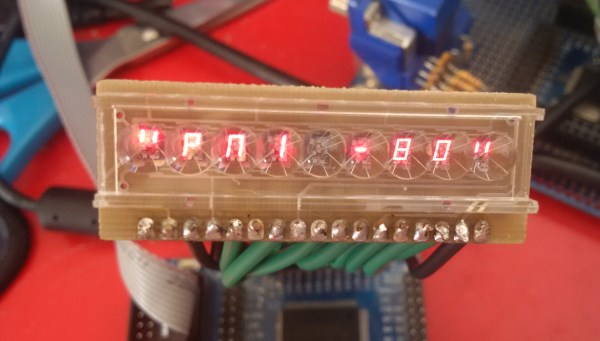
When I managed to get a hold of an old bubble LED display and a pretty mechanical matrix keyboard, I decided to build a replica of an old single board computer. Logical options seemed to be to build either KIM-1 or Heathkit ET-3400. Replicas of KIM-1 already exist, even for Arduino, so my task would be reduced to connect the keyboard and display. But then I told myself that I would use the fact that my bubble display has 9 positions as an excuse to build the legendary Czechoslovak Single Board Computer PMI-80 which used the same display. My replica is an FPGA, or rather an FPGA emulator of this very computer.

Continue reading “Retrocomputing On A Chip”

FleaFPGA + Arduino Uno = FleaFPGAUno

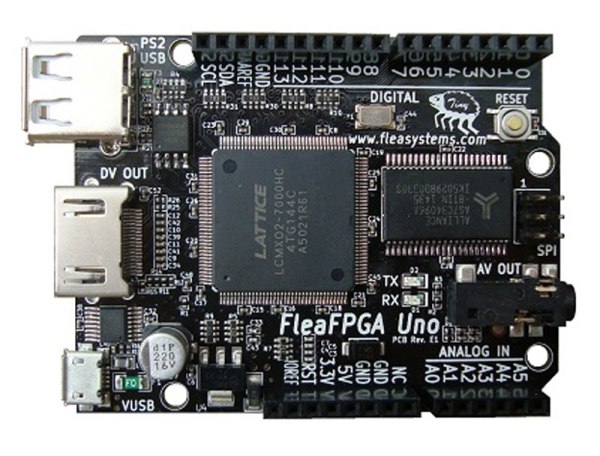
Some things are better together: me and my wife, peanut butter and jelly, and FPGAs and Arduino Unos. Veteran hacker [Valentin Angelovski] seems to agree: the FleaFPGA Uno is his latest creation that combines an FPGA (a Lattice MachX02 700HC) with an Arduino-compatible CPU.

It’s a step-up model from the origional FleaFPGA. With a few other components thrown in (such as a HDMI and composite video output and a WiFi option), you have a killer combination for experimenting with FPGAs or building an embedded system. That is because the Arduino part frees the FleaFPGA Uno from the breadboard: you can easily program, control and interface with the FPGA over a serial line or a wireless link using the Arduino IDE. There is even support for Arduino shields (albeit only 3.3V ones), making it even more expandable. This would be an awesome starting point for a retro gaming system, as many 8-bit consoles can be easily emulated in an FPGA. [Valentin] is currently selling the boards directly, and they are very reasonably priced at $50 or $60 for the WiFi version.

Continue reading “FleaFPGA + Arduino Uno = FleaFPGAUno”

Programmable Logic: Build Yourself A CPLD Module

A Complex Programmable Logic Device (CPLD) is a great piece of hardware to have in your repertoire. As its name implies, you can program these chips to serve the logic functions you need. This might be replacing an obsolete chip, or maybe just a way to learn and try different techniques. What better way to learn than to get your hands on a CPLD and give it a try?

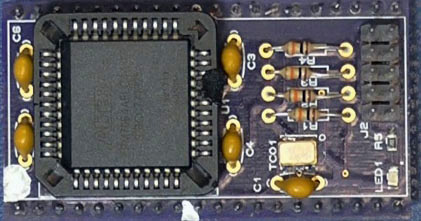
I created a CPLD module with the intent of being able to plug it into lots of things including solderless breadboards, but I screwed up. It seems that the plugin space available on a solderless breadboard is 1.1”, I had made the footprint 1” wide leaving no room for a row of wires on both sides. Duh.

But let me back up and show more about what I’m doing , I wanted to make a programmable piece of logic that could be built as a kit one could easily solder at home, could be programmed in-circuit, and could work at 3.3 or 5 volts.

Image5bTo implement an easily solderable kit I went with an older CPLD part that also has 3.3v and 5v versions that will maintain its programming regardless of power. The logic itself is a CPLD IC from the Altera Max family with two versions that fit the board with either 32 or 64 macrocells. A macrocell is the basic logic building block and it is programmed with logic “terms” and then interconnected to other macrocells through a programmable interconnect.

Continue reading “Programmable Logic: Build Yourself A CPLD Module”

FPGAs For The Raspberry Pi

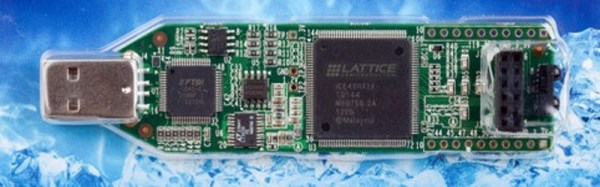
FPGA development has advanced dramatically in the last year, and this is entirely due to an open-source toolchain for Lattice’s iCE40 FPGA. Last spring, the bitstream for this FPGA was reverse engineered and a toolchain made available for anything that can run Linux, including a Raspberry Pi. [Dave] from Xess thought it was high time for a Raspberry Pi FPGA board. With the help of this open-source toolchain, he can program this FPGA board right on the Raspberry Pi.

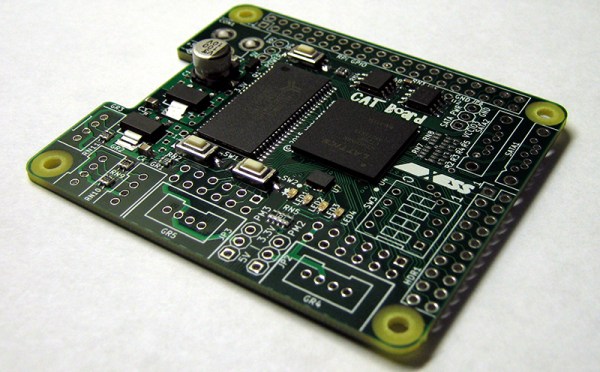
The inspiration for [Dave]’s board came from the XuLA and StickIt! boards that give the Raspberry Pi an FPGA hat. These boards had a problem; the Xilinx bitstreams had to be compiled on a ‘real’ PC and brought over to the Raspberry Pi world. The new project – the CAT Board – brings an entire FPGA dev kit over to the Raspberry Pi.

The hardware for the CAT Board is a Lattice iCE-HX8K, 32 MBytes of SDRAM, a serial configuration flash, LEDs, buttons, DIP switches, grove connectors, and SATA connectors (although [Dave] is just using these for differential signals; he doesn’t know if he can get SATA hard drives to work with this board).

Despite some problems with his board house, [Dave] eventually got his FPGA working, or at least the bitstream configuration part, and he can blink a pair of LEDs with a Raspberry Pi and programmable logic. The Hello World for this project is done, and now the only limit is how many gates are on this FPGA.

Continue reading “FPGAs For The Raspberry Pi”

Flying High With Zynq

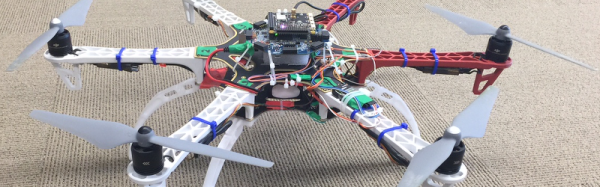
[Aerotenna] recently announced the first successful flight of an unmanned air vehicle (UAV) powered by a Xilinx Zynq processor running ArduPilot. The Zynq is a dual ARM processor with an onboard FPGA that can offload the processor or provide custom I/O devices. They plan to release their code to their OcPoC (Octagonal Pilot on a Chip) project, an open source initiative that partners with Dronecode, an open source UAV platform.

Continue reading “Flying High With Zynq”

Open Source FPGA Pi Hat

Over on Hackaday.io, [Dave Vandenbout] has posted the CAT board, a Raspberry Pi daughterboard hat that features a Lattice FPGA, 32 MB of RAM, EEPROM, and a few Grove and PMOD connectors. The CAT takes advantage of the open source tool chain available for Lattice including the Python-based MyHDL (although, you could just use Verilog directly, if you prefer) and Icestorm. One interesting point: you can run the tool chain on the Raspberry Pi, resulting in a self-contained and largely portable FPGA development environment.

Continue reading “Open Source FPGA Pi Hat”