Homebrew Retro Console Runs On PIC32

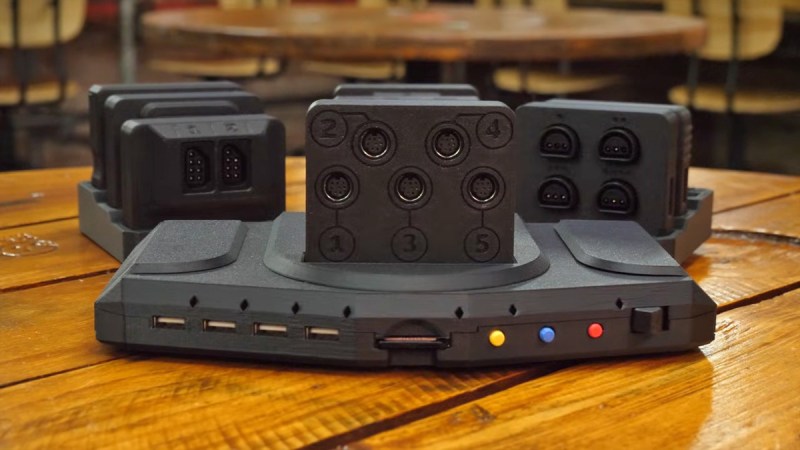
[Chad Burrow] decided to take on a noble task—building a “retro” style computer and video game console. Only, this one is built using somewhat modern hardware—relying on the grunt of the PIC32MZ2048EFH144 to get the job done. Meet the Acolyte Hand PIC’d 32.

It’s name might be a mouthful, but that chip can pull off some great feats! With a clock speed of 200 MHz, it’s not  short on processing power, though RAM and flash storage are somewhat limited at just 512 KB and 2MB respectively. [Chad] was able to leverage those constraints to get a VGA output working at a resolutions up to 800 x 600, with up to 65,000 colors—though 256 colors is more practical due to memory concerns. The Acolyte Hand also rocks two 8-bit audio channels. It has a pair of Genesis-compatible controller ports as well as PS/2 and USB for keyboards and mice, along with more modern Xbox 360 controllers.

[Chad] cooked up some software to put it through its paces, too. It’s got a Tetris clone on board, and can also run Game Boy games at full speed via the Peanut-GB emulator. That provides for a pretty rich game library, though [Chad] notes he plans to develop more native video games for his system to demo at his local college. Design files are on Github for the curious.

This project is a great example of just how powerful modern microcontrollers have become. Once upon a time, just driving a simple black-and-white graphical LCD might have taken some real effort, but today, there are pixels and clock cycles to spare in projects like these. Truly a wonderous world we live in!

Gaming Table Has Lights, Action

We couldn’t decide if [‘s] Dungeons and Dragons gaming table was a woodworking project with some electronics or an electronics project with some woodworking. Either way, it looks like a lot of fun.

Some of the features are just for atmosphere. For example, the game master can set mood lighting. Presets can have a particular light configuration for, say, the woods or a cave.

But the table can also be a game changer since the game runner can send private messages to one or more players. Imagine a message saying, “You feel strange and suddenly attack your own team without any warning.”

Continue reading “Gaming Table Has Lights, Action”

Regular (Expression) Chess

[Nicholas Carlini] found some extra time on his hands over the holiday, so he decide to do something with “entirely no purpose.” The result: 84,688 regular expressions that can play chess using a 2-ply minmax strategy. No kidding. We think we can do some heavy-duty regular expressions, but this is a whole other level.

As you might expect, the code to play is extremely simple as it just runs the board through series of regular expressions that implement the game logic. Of course, that doesn’t count the thousands of strings containing the regular expressions.

Continue reading “Regular (Expression) Chess”

How Crane Games Are Playing Claw Games With The Player

Fresh from AliExpress, [Big Clive] got another fascinating item to tear down: a crane claw, as used in those all too familiar carnival games. These games feature a claw the player moves into position above a pile of toys or other items. Lower the claw gently down in the hopes that it grabs the target item. In a perfect world, the claw will move your prize and deposit it, via a chute, into your waiting hands. Of course, everyone knows that these games are rigged and rely less on skill or luck than the way that they are programmed, but the way that this works is quite subtle, as you can see in the video below.

Despite how complex these crane claws may appear, they are simply solenoids, with the metal rod inside providing the claw action. The weight of the rod and claw section opens the claw via gravity. The strength of the claw is thus fully dependent on how strongly the solenoid is being driven, which, as [Clive] demonstrates, depends on the voltage and the duty cycle. At only 12V, the target plushie will easily slip away again as the claw barely has any strength, while at 24V, it’s pretty solid.

Continue reading “How Crane Games Are Playing Claw Games With The Player”

Puzzle Bobble on a screen with a physical gadget in front

Crafting A Cardboard Tribute To Puzzle Bobble

What do you get when you cross cardboard, deodorant rollers, and a love for retro gaming? A marvel of DIY engineering that brings the arcade classic Puzzle Bobble to life—once again! Do you remember the original Puzzle Bobble aiming mechanism we featured 12 years ago? Now, creator [TomTilly] has returned with a revamped version, blending ingenuity with a touch of nostalgia. [Tom] truly is a Puzzle Bobble enthusiast. And who could argue that? The game’s simplicty makes for innocent yet addictive gameplay.

[Tom]’s new setup recreates Puzzle Bobble’s signature aiming mechanic using surprising materials: deodorant roller balls filled with hot glue (to diffuse LED colours), bamboo skewers, and rubber bands. At its heart is an Arduino UNO, which syncs the RGB LED ‘bubbles’ and a servo-driven aiming arm to the game’s real-time data. A Lua script monitors MAME’s memory locations to match the bubble colours and aimer position.

But this isn’t just a static display. [Tom] hints at a version 2.0: a fully functional controller complete with a handle. Imagine steering this tactile masterpiece through Puzzle Bobble’s frantic levels!

Need more inspiration? Check out other quirky hacks like [Tom]’s deodorant roller controller we featured in 2023. Whether you’re into cardboard mechanics or retro gaming, there’s no end to what clever hands can create.

Continue reading “Crafting A Cardboard Tribute To Puzzle Bobble”

Protect Your Site With A DOOM Captcha

We all know that “Can it run DOOM?” is the first question of a hardware hacker. The 1993 first person shooter from id Software defined an entire genre of games, and has since been made open source, appearing on almost everything. Everything, that is, except a Captcha, those annoying “Are you a human” tests where we’re all expected to do a search giant’s image classification for them. So here’s [Guillermo Rauch] with a DOOM captcha, in which you must gun down three bad guys to proceed.

As a way to prove you’re a human we can’t imagine a more fitting test than indiscriminate slaughter, and it’s interesting to read a little about what goes on behind the scenes. It’s a WebAssembly application as you might have guessed, and while it’s difficult to shake that idea from the early ’90s that you needed a powerful computer to run the game, in reality it shows just how powerful WebAssembly is, as well as how far we’ve come in three decades.

We’d prefer a few different entry points instead of always playing the same level, and we were always more handy with the mouse than the keyboard back in the day, but it’s certainly a bit of fun. It’s worth noting that simply playing the game isn’t enough to verify your humanity — if you’re killed in the game before vanquishing the required three foes, you’ll have to start over. As the game is running at “Nightmare” difficulty, proving your worth might be a tad harder than you’d expect…

Need more DOOM? How about seeing it on hardware nobody would have believed in 1993?

Sega Dreamcast console banner image

Fan Made Dreamcast Port Of GTA 3 Steals The Show

As it turns out, Sega’s long defunct Dreamcast console is still thinking. The company behind the machine cut support long ago due in part to the commercial pressures applied by Sony’s PlayStation 2 console, but that never stopped the most dedicated of Dreamcast fans from seeking out its true potential. Thanks to [Stefanos] and his team, the genre defining Grand Theft Auto III (GTA 3), can now run on Sega’s hardware. Their combined efforts have yielded a fully playable port of the PC version of the game for the Dreamcast.

The porting effort was years in the making. It began with reverse engineering the entire source code of GTA 3 then implementing it into the homebrew SDK for the Dreamcast, KallistiOS. All the in-game graphic and sound assets are only pulled from a user provided PC copy of the game. Steps for those seeking to compile a bootable Dreamcast image of their own have been provided on the project’s website. Real hardware enthusiasts will be pleased as the port runs fine on the twenty-five year old Dreamcast as evidenced in the video below.

This port of GTA 3 represents what could have been a true butterfly effect moment in console gaming history. The game was a major hit in the early days of the PlayStation 2, and it has been theorized that it could have proven to be a major commercial success for Sega as well had it been pressed onto a Dreamcast GD-ROM disc. Recently one of the original developers of GTA 3, Obbe Vermejj, divulged that the game actually began development on the Dreamcast. The project was obviously transferred onto PlayStation 2 for commercial reasons, but with this port from [Stefanos] and crew we no longer have to dream of what could have been.

Continue reading “Fan Made Dreamcast Port Of GTA 3 Steals The Show”