With a long history of nearly universal hate for their products, you’d think printer manufacturers would by now have found ways to back off from the policies that only seem to keep aggravating customers. But rather than make it a financially wiser decision to throw out a printer and buy a new one than to buy new ink cartridges or toners, manufacturers keep coming up with new and devious ways to piss customers off. Case in point: Hewlett-Packard now seems to be bricking printers with third-party ink cartridges. Reports from users say that a new error message has popped up on screens of printers with non-HP cartridges installed warning that further use of the printer has been blocked. Previously, printers just warned about potential quality issues from non-HP consumables, but now they’re essentially bricked until you cough up the money for legit HP cartridges. Users who have contacted HP support say that they were told the change occurred because of a recent firmware update sent to the printer, so that’s comforting.

Hackaday Columns4720 Articles
This excellent content from the Hackaday writing crew highlights recurring topics and popular series like Linux-Fu, 3D-Printering, Hackaday Links, This Week in Security, Inputs of Interest, Profiles in Science, Retrotechtacular, Ask Hackaday, Teardowns, Reviews, and many more.
Computers For Fun
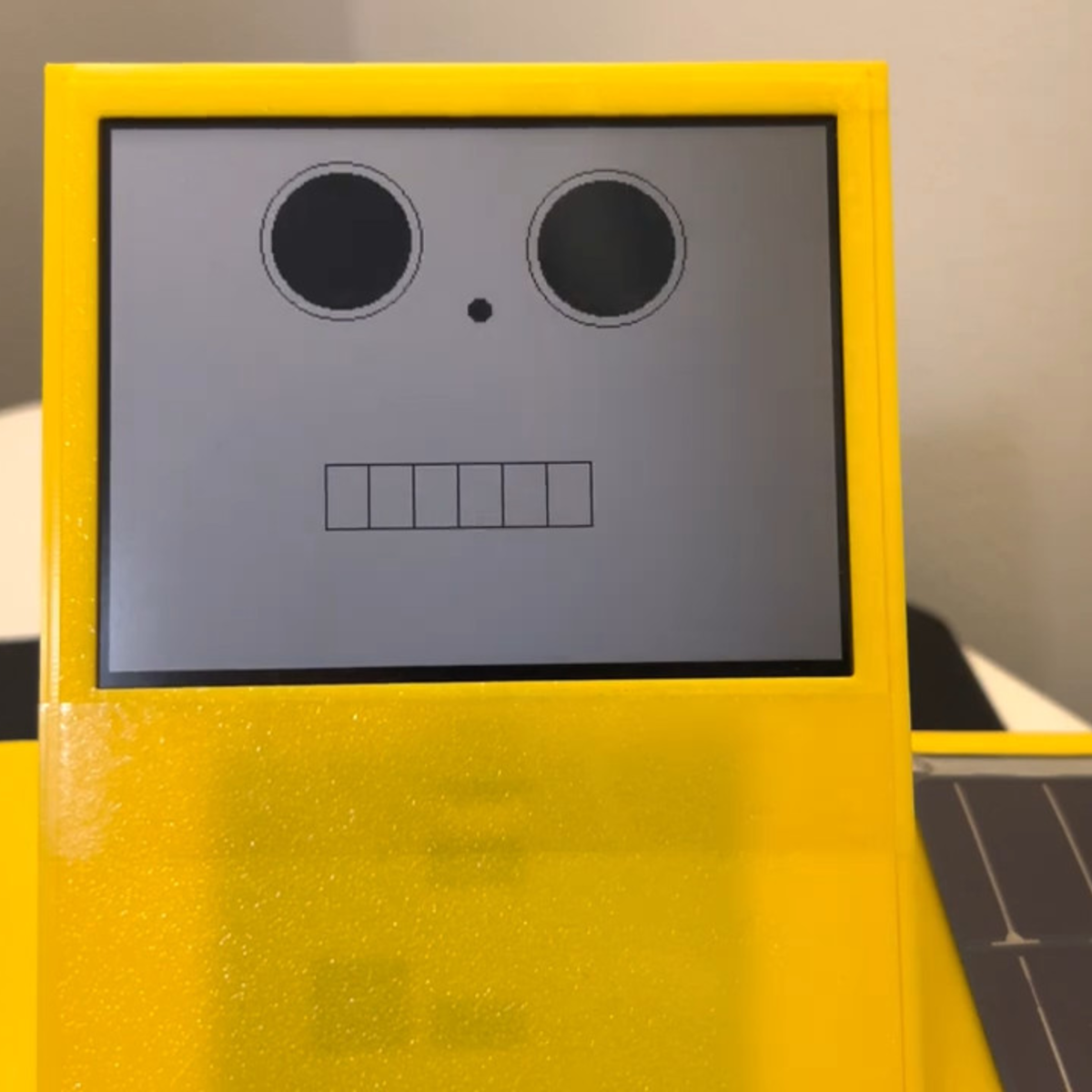
The last couple years have seen an incredible flourishing of the cyberdeck scene, and probably for about as many reasons as there are individual ’deck designs. Some people get really into the prop-making, some into scrapping old tech or reusing a particularly appealing case, and others simply into the customization possibilities. That’s awesome, and they’re all different motivations for making a computer that’s truly your own.
But I really like the motivation and sentiment behind [Andreas Eriksen]’s PotatoP. (Assuming that his real motivation isn’t all the bad potato puns.) This is a small microcomputer that’s built on a commonly available microcontroller, so it’s not a particularly powerful beast – hence the “potato”. But what makes up for that in my mind is that it’s running a rudimentary bare-metal OS of his own writing. It’s like he’s taken the cyberdeck’s DIY aesthetic into the software as well.
What I like most about the spirit of the project is the idea of a long-term project that’s also a constant companion. Once you get past a terminal and an interpreter – [Andreas] is using LISP for both – everything else consists of small projects that you can check off one by one, that maybe don’t take forever, and that are limited in complexity by the hardware you’re working on. A simple text editor, some graphics primitives, maybe a sound subsystem. A way to read and write files in flash. I don’t love LISP personally, but I love that it brings interactivity and independence from an external compiler, making the it possible to develop the system on the system, pulling itself up by its own bootstraps.
Pretty soon, you could have something capable, and completely DIY. But it doesn’t need to be done all at once either. With a light enough computer, and a good basic foundation, you could keep it in your backpack and play “OS development” whenever you’ve got the free time. A DIY play OS for a sandbox computing platform: what more could a nerd want?
Hackaday Podcast 209: HDMI Tempest, Norm Upscaled, Seeing Electrons, And When The Radios Go Silent
It was one of those weeks, where Elliot and Dan found a bounty of interesting hacks to choose from for the podcast, making it hard to pick. But pick we did, and we found so many deep and important questions. What good is a leaky HDMI cable? Good for falling down a TEMPEST-like rabbit hole, that’s what. Why would you use a ton of clay to make a car? Because it’s cool, that’s why. What does an electron look like? A little like a wiggling wire, but mostly it looks like a standing wave… of waves.
Is artificial intelligence going to take over all the code and start suing us for copyright violations? Maybe yes, maybe no, but we’re definitely in a strange, new world. And when all our media is on demand, what is the spectrum that broadcasters currently use going to be good for?
It’s not all heavy questions, of course; we found a lot of fun hacks, like an extreme drill press makeover, a couple of low-power cyberdecks, the return of Norm Abram in glorious AI-generated HD, getting up close and personal with flip dot displays, and a sled that lets you go uphill as easily as going downhill.
Check out the links below if you want to follow along, and as always, tell us what you think about this episode in the comments!
Download your own personal copy!
Hacker Hotel 2023 Had A Very Cool Badge
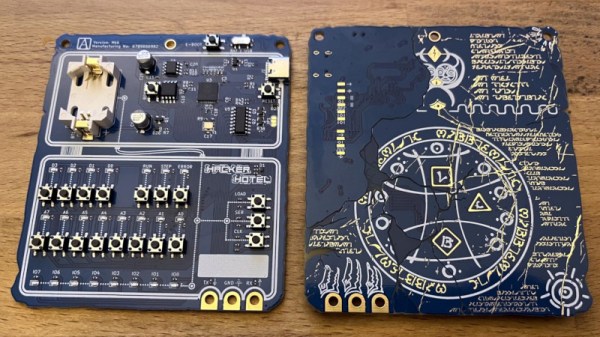
One effect of the global pandemic was that there were relatively few events in our sphere for a couple of years. This and that other by-product of COVID-19, the chip shortage, meant that over the past year we’ve been treated to several event badges that should have appeared in 2020 or 2021, but didn’t due to those cancelled events. We were lucky enough to receive probably the last of these delayed badges in mid February, as we made the journey to the central part of the Netherlands to Hacker Hotel 2023.
A Puzzle, A 4-Bit Computer, And An Artwork
The badge takes the form of a rectangular PCB with all parts on the top side. The brains of the operation is an RP2040, and it’s powered by a CR2032 coin cell in a holder. It’s divided into two parts, the top third which carries the circuitry and the lower two thirds of which as a row of buttons and LEDs. It’s pretty obvious from the start that it has data and address lines of a 4-bit computer, and as well as these there is an evident serial port and a USB socket. The artwork comes form the same artist whose work graced both the previous Hacker Hotel badge and the MCH2022 badge, and the rear of the PCB makes full use of all layers to create a mystical puzzle. The sum is to create a puzzle game intended to entertain the visitor, take them round the venue, and find clues to an eventual solution. I love the design both from an artistic and technical viewpoint, but have to admit that the puzzle aspect isn’t really my thing. Thus here we’ll concentrate on the badge hardware and production, and mention the puzzles only in passing. Continue reading “Hacker Hotel 2023 Had A Very Cool Badge”
New Raspberry Pi Camera With Global Shutter
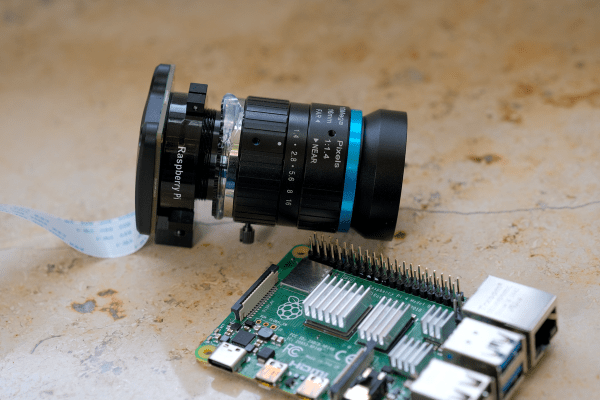
Raspberry Pi has just introduced a new camera module in the high-quality camera format. For the same $50 price you would shell out for the HQ camera, you get roughly eight times fewer pixels. But this is a global shutter camera, and if you need a global shutter, there’s just no substitute. That’s a big deal for the Raspberry Pi ecosystem.
Global vs Rolling
Most cameras out there today use CMOS sensors in rolling shutter mode. That means that the sensor starts in the upper left corner and rasters along, reading out exposure values from each row before moving down to the next row, and then starting up at the top again. The benefit is simpler CMOS design, but the downside is that none of the pixels are exposed or read at the same instant.
Continue reading “New Raspberry Pi Camera With Global Shutter”
Supercon 2022: Alec Vercruysse Can See Through Murky Water
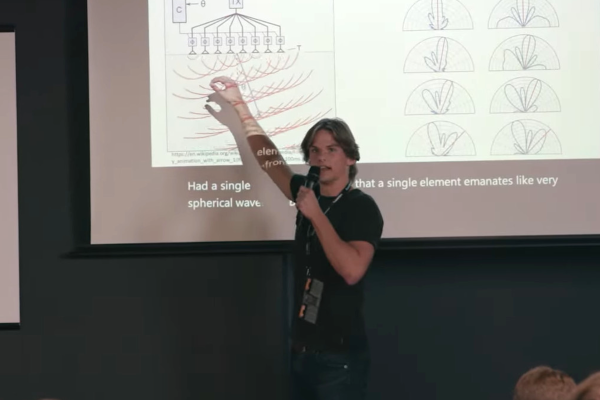
Detecting objects underwater isn’t an easy challenge, especially when things get murky and dark. Radio waves don’t propagate well, so most techniques rely on sound. Sonar is itself farily simple, simply send out a ping and listen for an echo, and that will tell you how far something is. Imaging underwater is significantly harder, because you would additionally need to know where each echo is coming from.
To answer the question of whether it is possible to put together an ultrasonic 3D imager that would cheaply enable anyone to image objects underwater, [Alec Vercruysse] and fellow team members at the Harvey Mudd College set out to create a system that does exactly that. You can read the presentation slides (PDF) or check out the entire project in the GitHub repository.
Continue reading “Supercon 2022: Alec Vercruysse Can See Through Murky Water”
Hackaday Berlin: First Round Of Talks
We’re super excited to announce the first round of speakers for Hackaday Berlin! We’re set to convene on Friday night, March 24th for an evening warm up before the main show on Saturday, March 25. Featuring the triumphant return of Voja’s 4-bit badge, a crew of awesome speakers, lightning talks, workshops, music, food, badge hacking, and all the best of the Hackaday community, this will be a day to remember. And then we’ll chill out Sunday morning with a Bring-a-Hack brunch.
So without further ado: the first round of speakers!
![]()
Hacking Closed-Source: Reverse Engineering Real-World Products
Closed-source software is prevalent in our everyday lives, limiting our ability to understand how it works, which privacy implication it poses to the processed data, and addressing potential issues in time. Despite the growth of open-source movements, users often have no choice but to rely on closed-source solutions, e.g., for medical devices and IoT products. We’ll discuss key techniques to help you get started with reverse engineering. Hacking your own devices can be challenging, bricking a device is not uncommon, but so is celebrating the moments of a revived and modified device.
![]()
Being a Full-Time YouTuber
YouTube is my full-time job and has been for four years. I create STEM education content using everything from 3D printing, CNC, Welding, to Microcontrollers and Coding. Find out how I got started, how I make money, what goes on in the background, and what my future plans are. I’ll tell you how you can do it too!
![]()
Hacking your dishwasher for cloudless appliances
Why does your dishwasher, laundry or coffee-pot need to talk to the cloud? In this presentation, Trammell Hudson shows how he reverse engineered the encrypted connections between Home Connect appliances and the Bosch-Siemens Cloud servers, and how you can control your own appliances with your self-hosted MQTT home automation system by extracting the devices’ authentication keys and connecting to their local websocket ports. No cloud required!
![]()
Oops, my project ended up in a museum
Parameterized design allows for the adaption of projects to different needs but can also change the aesthetic to a persons liking. Bleeptrack will walk you through the creation process and tools of her generative projects, talk about her experience manufacturing unique pieces and explains how to cope when your freshly finished project gets locked up in an art exhibition for a few months.
![]()
Creating Hardware Development Platforms for Real-World Impact: FlowIO Platform
What does it really take do create and deploy a development platform for real-world impact? Why do we need development platforms and how can they democratize emerging fields and accelerate innovation? Why do most platform attempts fail and only very few succeed in terms of impact? I will discuss the key characteristics that any platform technology must have in order for it to be able to useful for diverse users. FlowIO was the winner of the 2021 Hackaday Grand Prize as well as over a dozen other engineering, research, and design awards.
Come join us!