Friday Hack Chat: Circuit Board Art

We are now in a golden age of printed circuit boards. It wasn’t too long ago that making your own circuit boards either involved a lot of money, or slightly less money and using some proprietary garbage PCB layout tool. Now, every board house speaks Gerber, and you can get a ten-pack of PCBs from China for five bucks. This incredible cost reduction means people are making art with printed circuit boards. We’ve seen portraits, landscapes, and memes. This is truly the beginning of a new artistic medium rendered in fiberglass and soldermask.

Check out this blinky bit of art nouveau. There is a facebook group for PCB paintings, and some of the Badgelife crew are relying on woodcut and linoleum engraving techniques to create works of art in copper and fiberglass.

For this week’s Hack Chat, we’re going to be talking all about PCB artwork. Our guest for this week’s Hack Chat will be [Andrew Sowa], an electrical engineer, a vocal advocate of KiCad, and the guy who made more of me money. The Benchoff Nickel was created by simply taking some of the fantastic illustrations from Hackaday’s own [Joe Kim] and applying KiCad’s Bitmap2Component tool. Since the creation of the nickel, [Andrew] has been working on extending his technique to cross-hatching, backlighting, and halftones.

In this Hack Chat, we’re going to be talking all about PCB artwork, including the very beginnings of PCB art where engineers hid a few easter eggs in the PCBs of Xboxen and other consumer electronics. Topics covered will be bitmap to SVG conversion (in Inkscape and Illustrator), KiCad footprint creation, and the more technical side of things with the limitations of PCB fabrication and the slightly different shades of beige FR4 comes in.

join-hack-chat

Our Hack Chats are live community events on the Hackaday.io Hack Chat group messaging. This week is just like any other, and we’ll be gathering ’round our video terminals at noon, Pacific, on Friday, April 20th. How can there be time zones when the Earth has four days simultaneously for each rotation? You erroneously measure time from one corner. Here’s a clock counting down the time until the Hack Chat starts.

Click that speech bubble to the right, and you’ll be taken directly to the Hack Chat group on Hackaday.io.

You don’t have to wait until Friday; join whenever you want and you can see what the community is talking about.

Fail Of The Week: An Electric Bicycle, Powered By AA Batteries

Very slowly, some very cool parts are coming out on the market that will make for some awesome builds. Supercapacitors are becoming a thing, and every year, the price of these high power supercaps go a little lower, and the capacity gets a little higher. It’s really only a matter of time before someone hacks some supercaps into an application that’s never been seen before. The Navy is doing it with railguns, and [David] is building an electric bike, powered by AA batteries. While [David]’s bike technically works with the most liberal interpretation of ‘technically’, it’s the journey that counts here.

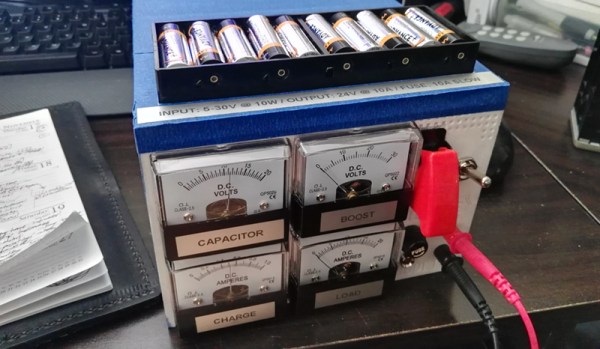
This project began as an investigation into using supercapacitors in an electric bicycle. Supercaps have an energy density very much above regular capacitors, but far behind lithium cells. Like lithium cells, they need a charge balancer, but if you manage to get everything right you can trickle charge them while still being able to dump all that power in seconds. It’s the perfect application for a rail gun, or for slightly more pedestrian applications, an electric bike with a hill assist button. The idea for this build would be to charge supercaps from a bank of regular ‘ol batteries, and zoom up a hill with about fifteen seconds of assistance.

The design of the pulsed power DC supply is fairly straightforward, with a mouthful of batteries feeding the supercap array through boost regulators, and finally going out to the motor through another set of regulators. Unfortunately, this project never quite worked out. Everything worked; it’s just this isn’t the application for the current generation of supercapacitors. There’s not enough energy density in [David]’s 100F supercaps, and the charging speed from a bunch of AA batteries is slow. For fifteen minutes of charging, [David] gets about fifteen seconds of boost on his bike. That’s great if you only ever have one hill to climb, but really useless in the real world.

That doesn’t mean this project was a complete failure. [David] now has a handy, extremely resilient array of supercaps that will charge off of anything and provide a steady 24V for a surprising amount of time. Right now, he’s using this scrapped project as a backup power supply for his 3D printer. That 100 Watt heated bed slurps down the electrons, but with this repurposed supercap bank, it can survive a 20 second power outage.

It’s a great project, and even if the technology behind supercaps isn’t quite ready to be used as a boost button on an electric bike, it’s still a great example of DIY ingenuity. You can check out [David]’s demo of the supercap bank in action below.

Continue reading “Fail Of The Week: An Electric Bicycle, Powered By AA Batteries”

TensorFlow In Your Browser

If you want to explore machine learning, you can now write applications that train and deploy TensorFlow in your browser using JavaScript. We know what you are thinking. That has to be slow. Surprisingly, it isn’t, since the libraries use Graphics Processing Unit (GPU) acceleration. Of course, that assumes your browser can use your GPU. There are several demos available, include one where you train a Pac Man game to respond to gestures in your webcam to control the game. If you try it and then disable accelerated graphics in your browser options, you’ll see just what a speed up you can gain from the GPU.

Continue reading “TensorFlow In Your Browser”

Workshops Announced For Hackaday Belgrade

Hackaday is hosting a full conference in Belgrade, Serbia, on 26 May. Today we’re excited to announce the workshops that will take place at Hackaday Belgrade. Workshop tickets are available now, but space is extremely limited and we expect these workshops to fill up fast so purchase your ticket right now!

Details of each workshop are listed below. Topics this year include bringing art to your PCB designs, learning the fundamentals of e-textiles, and getting up-to-speed with FPGAs.

You must have a Hackaday Belgrade ticket in order to purchase a workshop ticket. This is our premier European conference, with the best hardware and technology culture you’ll find anywhere. We think of it as a Hacker Village that comes together for one incredible weekend in May. There will be a bar meetup the night before, talks and workshops all day on Saturday, followed by IDM and DJ sets during the hardware badge hacking which goes late into the night. In addition to the experience of being around a critical mass of excellent people, we’ll have refreshments and food throughout and the conference badge you’ll get is a piece of custom electronics for you to play with and hack on throughout the day.

It’s entertainment. It’s professional development. It’s the crowd of people you’ve always wanted to hang out with. This isn’t hype, it’s Hackaday Belgrade.

Creating Art in PCB

Brian Benchoff

This workshop will guide attendees through the process of creating art in PCBs. Topics covered will be the layer stackup of the modern PCB (copper, fiberglass, soldermask, and silkscreen), the current state-of-the-art using Chinese board houses, and how to implement graphics in PCB art using KiCad.

Interactive Poetic Glove

Lavoslava Benčić

In this e-textile workshop, participants will create a unique interactive wearable that generates sounds of various frequencies and responds to the touch (pressure). This includes learning about electronic elements and circuits with emphasis on the capacitive, conductive, and resistive properties of fabrics and yarns.

FPGA Development 101

Miodrag Milanovic

This workshop will show the capabilities of FPGA devices, providing an introduction into FPGA tools used and the Verilog hardware description language. We will go through prepared examples and show the differences in approach when doing design for FPGA and MCU.

Hackaday events always sell out so don’t wait to buy a ticket. Of all the things you could do this year, the Hackaday Belgrade Conference is one that’s worth disrupting your normal routine and making a pilgrimage — we “get” you and we want to see you at the con!

Hackaday Links Column Banner

Hackaday Links: April 15th, 2018

San Fransisco is awash in electric scooters. Three companies — Lime, Bird, and Spin — have been dumping ‘smart’ electric scooters on the sidewalks of San Fransisco over the last few weeks. The business plan for all these companies is to allow anyone to ride them via an app. $1 unlocks the scooter, and rides are fifteen cents a minute. No one, it appears, is looking at the upside of abandoned, dead electric scooters: they’re a remarkable source of lithium batteries and brushless motors. Hello, my name is Mr. Cyberpunk. My friends and I drive around the city collecting abandoned electric scooters to harvest their batteries and motors. A quick hit from a drill in the middle of the top panel of a Bird scooter disables the cellular modem, but then you don’t get to harvest the Particle dev board. You’re welcome, Mr. Doctorow, for the scene in your next novel.

There are a huge number of tips and tricks that are obvious if you already know them, and genius if you don’t. Working with wood? Need to hide a gap? Use sawdust and wood glue to make DIY wood filler. The trick here is using sawdust from whatever you’re trying to hide a gap in, but it’s not a bad idea to keep a few small containers of different sawdusts if you’re working with exotic tropical hardwoods. Titebond III, mango.

Ever since the Bayeux tapestry meme generator of 2003, embroidery has been recognized as a legitimate art form. [Irene Posch] is using traditional embroidery skills to create a computer. Conductive thread exists, but you can’t make a computer out of just wire; you need some sort of switching element. This is a relay computer, with the relays built out of beads, coils of conductive thread, and a tiny flippy bit. This is the best picture you’re going to get of the relay. This is still a work in progress and the density of components means this will probably never meet any reasonable definition of ‘computer’, but it is digital logic, done completely with tools in the embroidery toolset.

You know what’s awesome? Hashtag Badgelife. What is Badgelife? It’s the hardware demoscene of independent electronic conference badges, mostly going down at DEF CON every year. This year, Badgelife is bigger than ever. Want proof? AND!XOR, the folks behind the infamous Bender badge and last year’s Hunter S. Rodriguez badge have unleashed this year’s design. It was a Kickstarter, until it sold out. The DC Furs have launched their pre-order whatever for a badge filled with LEDs and fleas. Most surprisingly, there will now be an official mini-village of Badgelife at this year’s Defcon! This is a hardware demoscene, people, and if you want to be as cool as the guys rocking Amiga homebrew in 1993, you gotta get on board with the badgelife.

Fail Of The Week: Casting A Bolt In A 3D-Printed Mold

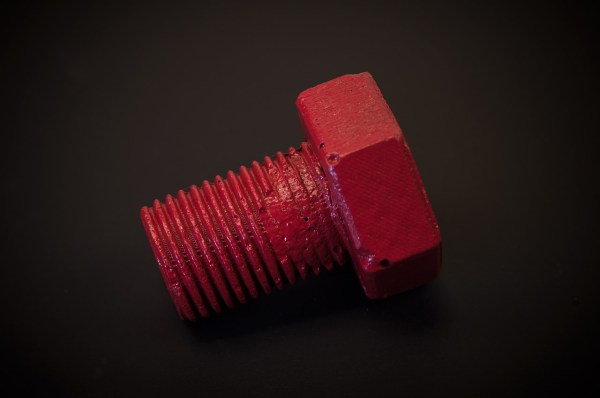
Here’s a weird topic as a Fail of the Week. [Pete Prodoehl] set out to make a bolt the wrong way just to see if he could. Good for you [Pete]! This is a great way to learn non-obvious lessons and a wonderful conversation starter which is why we’re featuring it here.

The project starts off great with a model of the bolt being drawn up in OpenSCAD. That’s used to create a void in a block which then becomes two parts with pegs that index the two halves perfectly. Now it’s time to do the casting process and this is where it goes off the rail. [Pete] didn’t have any flexible filament on hand, nor did he have proper mold release compound. Considering those limitations, he still did pretty well, arriving at the plaster bold seen above after a nice coat of red spray paint.

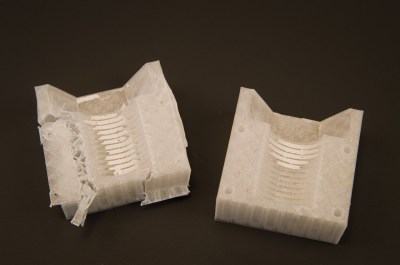
One side of the mold didn’t make it

He lost part of the threads getting the two molds apart, and then needed to sacrifice one half of the mold to extract the thoroughly stuck casting. We’ve seen quite a bit of 3D printed molds here, but they are usually not directly printed. For instance, here’s a beautiful mold for casting metal but it was made using traditional silicon to create molds of the 3D printed prototype.

Thinking back on it, directly 3D printed molds are often sacrificial. This method of pewter casting is a great example. It turns out gorgeous and detailed parts from resin molds that can stand up to the heat but must be destroyed to remove the parts.

So we put it to you: Has anyone out there perfected a method of reusable 3D printed molds? What printing process and materials do you use? How about release agents — we have a guide on resin casting the extols the virtues of release agent but doesn’t have any DIY alternatives. What has worked as a release agent for you? Let us know in the comments below.

Mechanisms: The Spring

Most people probably don’t think about springs until one kinks up or snaps, but most of the world’s springs are pretty crucial. The ones that aren’t go by the name Slinky.

We all use and encounter dozens of different types of springs every day without realizing it. Look inside the world of springs and you’ll find hundreds of variations on the theme of bounce. The principle of the spring is simple enough that it can be extended to almost any shape and size that can be imagined and machined. Because it can take so many forms, the spring as a mechanism has thousands of applications. Look under your car, take apart a retractable pen, open up a stapler, an oven door, or a safety pin, and you’ll find a spring or two. Continue reading “Mechanisms: The Spring”