Friday Hack Chat: Energy Harvesting

Think about an Internet-connected device that never needs charging, never plugs into an outlet, and will never run out of power. With just a small solar cell, an Internet of Thing module can run for decades. This is the promise of energy harvesting, and it opens the doors to a lot of interesting questions.
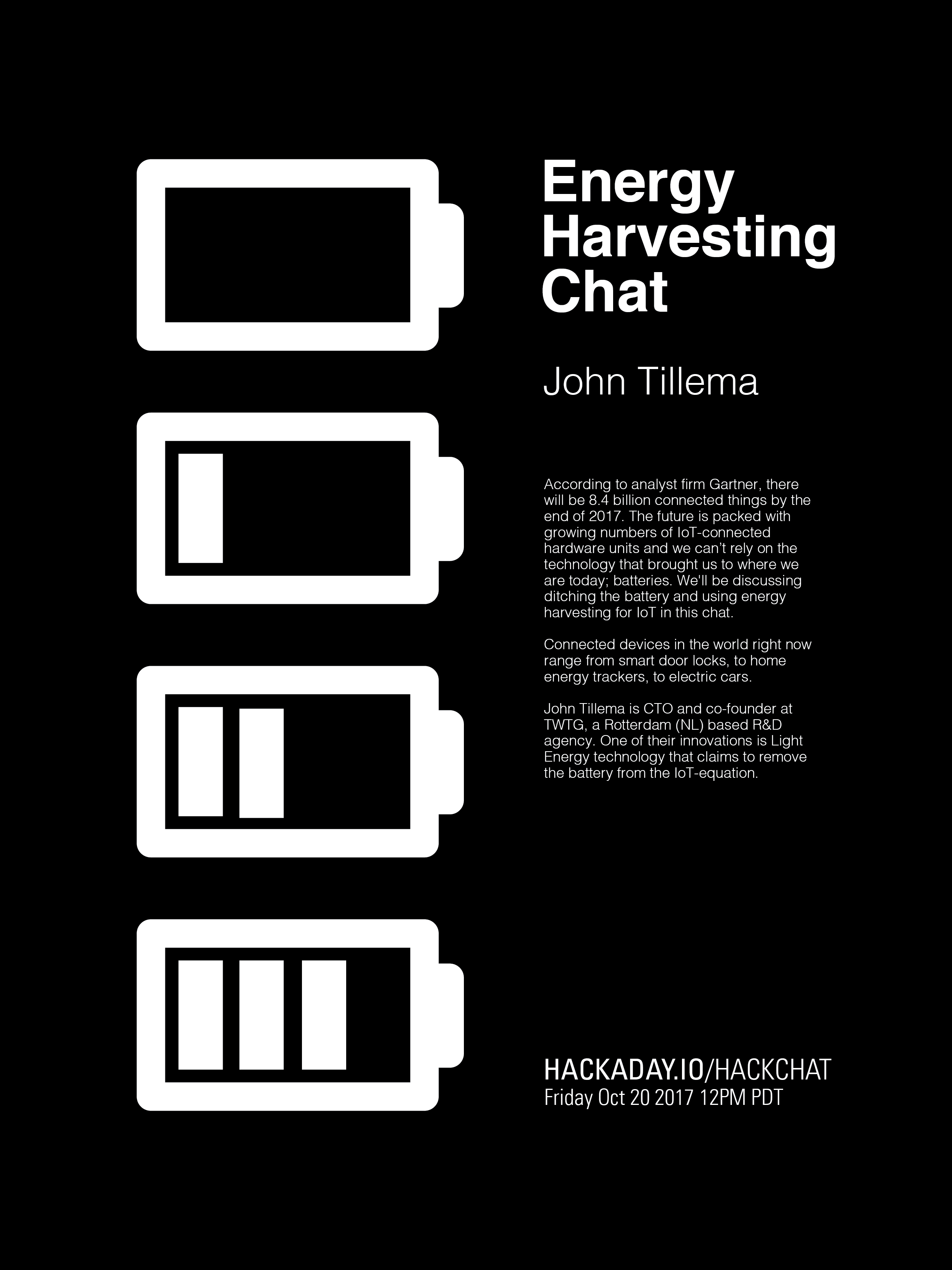
Joining us for this week’s Hack Chat will be [John Tillema], CTO and co-founder of TWTG. They’re working on removing batteries completely from the IoT equation. They have a small device that operates on just 200 lux — the same amount of light that can be found on a desktop. That’s a device that can connect to the Internet without batteries, wall warts, or the black magic wizardry of RF harvesting. How do you design a device that will run for a century? Are caps even rated for that? Are you really going to download firmware updates several decades down the line?

For this week’s Hack Chat, we’ll be discussing what energy harvesting actually is, what TWTG’s ‘light energy’ technology is all about, and the capabilities of this technology. Going further, we’ll be discussing how to design a circuit for low-power usage, how to select components that will last for decades, and how to measure and test the entire system so it lives up to the promise of being always on, forever, without needing a new battery.

This is a community Hack Chat, so of course we’ll be taking questions from the community. If you have a question, add it to the discussion sheet

join-hack-chatOur Hack Chats are live community events on the Hackaday.io Hack Chat group messaging. This Hack Chat will be going down noon, Pacific time on Friday, October 20th. Is it always five o’clock somewhere? Yes, so here’s a time zone converter!

Click that speech bubble to the right, and you’ll be taken directly to the Hack Chat group on Hackaday.io.

You don’t have to wait until Friday; join whenever you want and you can see what the community is talking about.


Active Discussion About Passive Components

People talk about active and passive components like they are two distinct classes of electronic parts. When sourcing components on a BOM, you have the passives, which are the little things that are cheaper than a dime a dozen, and then the rest that make up the bulk of the cost. Diodes and transistors definitely fall into the cheap little things category, but aren’t necessarily passive components, so what IS the difference?

Continue reading “Active Discussion About Passive Components”

Hackaday Links Column Banner

Hackaday Links: October 15, 2017

For the last few months we’ve been running The Hackaday Prize, a challenge for you to build the best bit of hardware. Right now — I mean right now — you should be finishing up your project, crossing your t’s and dotting your lowercase j’s. The last challenge in the Prize ends tomorrow. After that, we’re going to pick 20 finalists for the Anything Goes challenge, then send the finalists off to our fantastic team of judges. Time to get to work! Make sure your project meets all the requirements!

It’s been a few weeks, so it’s time to start talking about Star Trek. I’m paying ten dollars a month to watch Star Trek: Discovery. I was going to pay that anyway, but I think this might actually be worth it. Highlights include Cardassian voles and Gorn skeletons. Also on the Star Trek front is The Orville, [Seth MacFarlane]’s TNG-inspired show. The Orville has far surpassed my expectations and is more Star Trek than Discovery. Leave your thoughts below.

It’s a new edition of Project Binky! Two blokes are spending years stuffing a 4WD Celica into a Mini. It’s the must-watch YouTube series of the decade.

AstroPrint now has an app. If you’re managing a 3D printer remotely and you’re not using Octoprint, you’re probably using AstroPrint. Now it’s in app format.

Have fifty bucks and want to blow it on something cool? A company is selling used LED display tiles on eBay. You get a case of ten for fifty bucks. Will you be able to drive them? Who knows and who cares? It’s fifty bucks for massive blinkies.

[Peter] is building an ultralight in his basement. For this YouTube update, he’s making the wings.

Oh it’s deer season, so here’s how you make deer jerky.

If you’re messing around with Z-Wave modules and Raspberry Pis, there’s a contest for you. The grand prize is an all-expense paid trip to CES2018 in Las Vegas. Why anyone would be enthusiastic about a trip to CES is beyond me, but the Excalibur arcade has Crazy Taxi, so that’s cool.

Go is the language all the cool kids are using. GoCV gives Go programmers access to OpenCV.

Ask Hackaday: What Tools Do You Reach For First?

Let’s face it, in your workshop there are convenient tools, and there are quality tools, but so often they aren’t both. Think back to the tools you reach for first. Very often for me, speed and convenience win out. I don’t want to look too hard for that drill or saw, and want them to work as expected when I reach for them. At the same time, there are some tools that simply must be stored away, and can’t perch on my workbench forever or sit on a shelf.

It really is a balancing act sometimes. I don’t have a sure fire formula for when to break out the expensive tools, and what jobs are easy with the less expensive. I’ll lay out some of my most-often utilized tools in my arsenal, then I want to hear from you on your own faves.

Continue reading “Ask Hackaday: What Tools Do You Reach For First?”

Retrotechtacular: Radio To Listen To When You Duck And Cover

CONELRAD may sound like the name of a fictional android, but it is actually an acronym for control of electronic radiation. This was a system put in place by the United States at the height of the cold war (from 1951 to 1963) with two purposes: One was to disseminate civil defense information to the population and, also, to eliminate radio signals as homing beacons for enemy pilots.

Continue reading “Retrotechtacular: Radio To Listen To When You Duck And Cover”

Hackaday’s Open Hardware Summit Experience

Last week was the Open Hardware Summit in Denver Colorado. This yearly gathering brings together the people and businesses that hold Open Hardware as an ideal to encourage, grow, and live by. There was a night-before party, the summit itself which is a day full of talks, and this year a tour of a couple very familiar open hardware companies in the area.

I thought this year’s conference was quite delightful and am happy to share with you some of the highlights.

Continue reading “Hackaday’s Open Hardware Summit Experience”

Hackerspaces Are Hard: Safety

Safety is one of those topics that often elicits a less-than-serious response from some tool users. For these folks, they assume their elite skills will protect them and as long as they pay attention, they never will get hurt. This explains the prevalence of the nickname “Stubby” among this population. On the opposite end of the spectrum, safety is also one of those areas where people who don’t know a lot about tools can overreact. Imagine a whole table of kids wearing goggles as one of them gingerly melts some solder. You don’t want solder in your eye, but that’s just not going to happen under normal circumstances.

And then there are freak accidents, which are a reality. On September 20th, a leaking propane tank exploded at Sector67’s new workshop, severely injuring Chris Meyer. Far from a noob, Chris is one of the most experienced people in the shop and was a co-founder of the space. He has a long road of healing ahead of him, and as seems to be the sad necessity these days, he has a GoFundMe campaign to help both with his medical expenses and to help refurbish the workshop. The Foothills Community Workshop also burned to the ground recently, although fortunately no one was injured.

All in all, hackerspaces seem to be reasonably safe, particular considering the challenges they face — or more fairly, the risks associated with the typical hackerspace’s openness. Most hackerspaces allow anyone who pay dues to be a member. There is a wide range of backgrounds, competencies, and judgments represented with, how shall I put it, some unusual viewpoints that might hinder rule-following. And once the member has a fob or key, it’s open season on any kind of tool in the place right? Not everything can have a lock on it.

Here are a few simple rules that have emerged over the years, and may help your hackerspace navigate the twin dangers of complacency and paralyzed fear while preparing for the freak accidents that may simply come to pass.

Continue reading “Hackerspaces Are Hard: Safety”