Ask Hackaday: The Latest Advances In Perfboard

It’s no secret the Hackaday tip line gets a lot of email from Kickstarter campaigns and PR firms managing Kickstarter campaigns. Most of these are terrible products. Want a five-pound battery that can’t be recharged? Yeah, stuff like that.

Every once in a while, we come across a tip that’s a completely original idea. There’s a balance between ingenuity and practicality with these ideas, and I can’t figure out where this one sits. It’s a Kickstarter for perfboard, yes, but not like any perfboard you’ve ever seen.

Busboard, or solderable breadboard

Before we dig into this, let’s get some definitions straight. Perfboard is a sheet with holes drilled on a 0.1″ grid. The holes are plated on both sides, and each hole is an individual electrical node. Veroboard, or stripboard is a bunch of holes on a 0.1″ grid. These holes are also plated, but all the holes in a column are a single electrical node. You can cut the tracks between holes, but the basic idea here is to reduce the number of wires needed to connect components. Busboard, seen left, is a continuation of Veroboard, and is laid out like a solderless breadboard.

And so we come to the new invention, Perf+, the perfboard reinvented. This perfboard again is a series of plated holes on a 0.1″ grid. Alongside these holes is a plated bus. This bus does not connect to any hole; instead, a little bit of solder is used to connect it to holes on the same row or column. “Selective Veroboard,” you could call it.

Now for the real trick: on one side of the board, the plated busses run vertically. On the other side of the board, the plated busses run horizontally. This means any two holes on the protoboard can be connected as one electrical node simply with a bit of solder.

If ever there was an idea you could point to and simultaneously say, “that’s clever” and “I have no idea how to use this,” there you go. I’m pretty sure this idea isn’t better than a piece of stripboard, but it is different. If you have any idea of how to used this new, strange, and otherworldly protoboard for something useful, put a note in the comments.

Fail Of The Week: Re-addressing Your RAM DIMM

It doesn’t work and we’re not surprised considering the can of worms that comes with RAM addressing. Right off the bat we assume timing problems due to variance in the trace lengths and EM issues. But you have to hand it to [cyandyedeyecandy] for even trying. The self-proclaimed upgrade seeks to readjust how the DIMM works without changing the edge pinout.

The stick shown here is a 512 MB module that, because of the computer using it (unspecified in the post), is only allowing access to 256 MB. The added chips and free-form circuit make up an AND for the chip-select line, and flip-flop for the bank address.

The post is a gorgeous cry for help. We already weighed in from the peanut gallery at the top (seriously, that’s somewhat baseless guessing) so step up to the computer-engineering plate and let us know what needs to be done to make this most-awesome-of-non-working hacks actually work.

Once you’ve figured this out, here’s another one to scratch at your brain with.

Hacklet 41 – Prosthetics Projects

Throughout human history, mankind has worked to enable those with disabilities. This applies especially to those who have missing limbs, either from injury or since birth. Every time technology improves, prosthetics improve along with the way. Unfortunately this now means prosthetics have become expensive systems. Hackers, makers, and engineers are working to make prosthetics more affordable, and more available to everyone. This week’s Hacklet focuses on some of the best prosthetics projects on Hackaday.io!

bionic1We start with [Open Bionics] and Affordable Bionic Hands For Amputees. The [Open Bionics] team are using 3D printers to bring the cost of a prosthetic arm and hand down from up to $100,000 USD to just $1000 USD. They’ve also reduced the time to create a custom device from weeks to just 5 days. The team’s current hand has five degrees of freedom, uses electromyography (EMG) for control, and weighs just 268 grams. [Open Bionics] discovered that many amputees are willing to trade off functions for a lighter weight device. Having a sensor and motor studded hand won’t help much if the wearer is worn out after just a couple of hours!

bionic2Next up is [yash.gajra56] and RE-ARM. RE-ARM is a prosthetic arm project which aims to help both those who have lost limbs, and those with full or partial paralysis of a limb. Movement is provided by radio control style servos. Control is via voice commands and Bluetooth from a cell phone. [Yash] has incorporated feedback into RE-ARM by using flex sensors. Processing is handled by an Arduino. We like the low-cost, low tech approach RE-ARM uses. We’d love to see everyone have access to a 3D printer, but unfortunately the world isn’t there quite yet. RE-ARM uses readily available components to build a functional prosthetic. Nice work [yash]!

bionic3[OpenBionics] brings us  Affordable Prosthetic Hands. No, you didn’t read that name wrong. There are two “Open Bionics” on Hackaday.io! This [OpenBionics] team has no space, and is based in Athens, Greece. The other [Open Bionics] team does have a space between the words, and is based in Bristol in the United Kingdom. We’re hoping the two groups can come together and collaborate now that they’re both using Hackaday.io. This [OpenBionics] team is working on prosthetic hands, in the sub $200 USD price range. The team has come up with a novel thumb design which provides nearly full functionality with only one rotating joint. [OpenBionics] also allows their users to selectively lock digits, which allows for up to 144 different grasping postures.


bionic4

Finally we have [Daniel Mead] with Third World Medical Equipment (Arm). [Daniel] created this project as an independent study back in high school. The idea is create a simple arm with a gripper out of cheap or freely available items. The gripper is fashioned from a bicycle brake. The fitting system is especially novel. [Daniel] used an old soda bottle to create a custom mold for the amputee’s residual limb. Plastic bottles are generally made of polyethylene terephthalate, or PET, a thermoplastic. [Daniel] placed a wet sock over his arm, and a plastic bottle over the sock. Holding the plastic bottle above a fire created enough heat to shrink the bottle to his arm. the sock provided room for padding, and insulated him from getting burned during the molding process.

Not satisfied? Want more prosthetics? Check out the Prosthetics list over on Hackaday.io! If any of these projects inspire you, don’t forget that prosthetics are a great starting point for an entry in The Hackaday Prize!

That’s about all the time we have for this week’s Hacklet. As always, see you next week. Same hack time, same hack channel, bringing you the best of Hackaday.io!

We Have A Problem: Food Supply

Hackaday, we have a problem. Supplying fresh, healthy food to the world’s population is a huge challenge. And if we do nothing, it will only get more difficult. Rising water prices and (eventually) rising fuel prices will make growing and transporting food more costly. Let’s leverage our collective skill and experience to chip away at this problem. We hope this will get you thinking toward your entry for the 2015 Hackaday Prize.

There are big science breakthroughs that have taken us this far. For instance, The Green Revolution developed wheat with stronger stalks to support the weight of higher kernel yields. If you’re equipped to undertake that kind of bio-hacking we’d love to see it. But the majority of us can still work on ideas to make a difference and (heartwarming moment approaching…) feed the world.

As with the shower feedback loop and electricity monitoring installments of We Have a Problem, I’ll start you off with an uber-simple idea. It’s up to you to think further and wider to get at solutions that are worth more exploration.

Can Technology Give Me a Green Thumb?

warm-dirt-greenhouse-controller-e1332183513993We see it all the time around here, people are building projects to monitor and control their own gardening projects. The one shown here couldn’t be simpler, it’s a hot-box which lets your gardening continue through the winter. It uses heat tape to keep the soil warm, and features a motorized lid which actuates to regulate humidity and temperature.

This concept is a good one. It doesn’t take up a lot of space and it tackles the easy part of automation (how hot is it? how wet is it?). But does it have the potential to make an impact on the source of your household’s food? Maybe the concept needs to be applied to community garden areas so that you can achieve a larger yield.

Robots

robot-weed-pickerPerhaps robots are an answer to a different problem. This little bot, already entered in the 2015 Hackaday Prize, is an experiment with automatic weed elimination versus the use of herbicides.

But it does get us thinking. One of the problems you need to overcome when trying to achieve wide adoption of local food supply is that not everyone enjoys the work that goes into it. Do you have an idea of how your mad robot skills can do the work for us?

buckybotStepping back onto the side-track of changes to industrial farming, let’s take a look at one of the way-out-there-ideas from last year. A huge amount of water usage is in food production. What if we turned entire farms into greenhouses in order to capture and reuse water that is normally lost into an all-to-dry atmosphere? Domes my friends, domes. A swarm of 3D printing robots given locomotion and unleashed to print out translucent covers over the fields on the kilometer-scale. Hey, doesn’t hurt to dream (and do some back of the envelope calculations to gauge how wild that idea actually is).

Your Turn

That should be enough to get the conversation started. Toss around some ideas here in the comments, but don’t let the brainstorm stop there. All it takes to enter the Hackaday Prize is an idea. Write it down as a project on Hackaday.io and tag it “2015HackadayPrize” to get your entry started.


The 2015 Hackaday Prize is sponsored by:

Retrotechtacular: Wising Up With The SAGE System

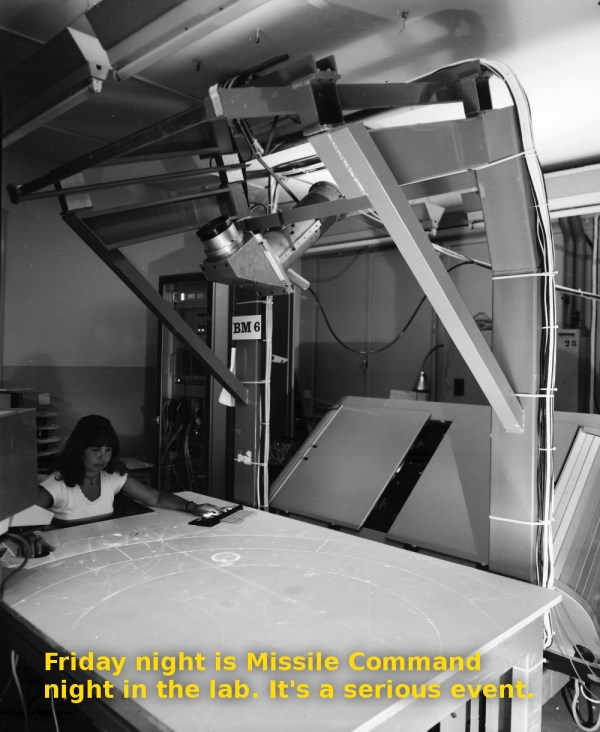
The birth of the supersonic jet made the United States’ airstrike defenses look antiquated. And so, during the Cold War, the government contracted a number of institutions and vendors to create and maintain the Semi-Automatic Ground Environment (SAGE) aircraft detection system with Western Electric as project manager.

SAGE was developed at MIT’s Lincoln Laboratory on computers built by IBM. It used the AN/FSQ-7 in fact, which was The Largest Computer Ever Built. SAGE operated as a network of defense sectors that divided the continental U.S. and Canada. Each of these sectors contained a directional center, which was a four-story concrete blockhouse that protected and operated a ‘Q7 through its own dedicated power station. The SAGE computers employed hot standby processors for maximum uptime and would fail over to nearby direction centers when necessary.

Information is fed into each directional center from many radar sources on land, in the air, and at sea. The findings are evaluated on scopes in dimly-lit rooms on the front end and stored on magnetic cores on the back end. Unidentifiable aircraft traces processed in the air surveillance room of the directional center are sent to the ID room where they are judged for friendliness. If found unfriendly, they are sent to the weapons direction room for possible consequences.

Continue reading “Retrotechtacular: Wising Up With The SAGE System”

Fail Of The Week: Easy Cheese? Printer Says No

Well, this is timely. We saw a lot of things at Midwest RepRap Festival this year on both the printer and the material fronts. We told you about the delicious offerings made possible through remote extruder setups, strong and heavy filaments infused with copper and other metals, and a printer built out of K’NEX. No one was printing with canned cheese, though, and maybe for good reason.

[Andrew] here has created a 3D-printed arm that holds a can of aerosol cheese-like substance in place. A motor causes the holder to move the spout to the side, dispensing the goo. At first he squirts it in a coiled pile on to a cracker. That goes pretty well until it’s time to move away from the cracker. [Andrew]’s later attempt to build up four cheesy walls had us cheering. You can see what we mean after the break.

There are a couple of issues at play. Sometimes the add-on just plain falls off the end of the spout. Other times, air in the can interrupts the flow, just as it does during manual operation. And every once in a while, it just seems that the spout was too close to the substrate.

What do you think about the viability of cheese printing? Would it work better if the extrusion took place remotely, and the cheese was pushed through a thinner tip? Would a cooled print bed help? Let us know.

Continue reading “Fail Of The Week: Easy Cheese? Printer Says No”

New Part Day: Modern PALs

Back in the bad old days, if you needed a little bit of custom logic you would whip out a tiny chip known as a PAL. A Programmable Logic Array is just what it sounds like and is the forerunner of modern, unsolderable CPLDs and FPGAs.

PALs and GALs have died off, left to the wastes of the Jameco warehouse, and now it seems the only programmable logic you can buy are huge, 100-pin monstrosities. [Nick] at Arachnid Labs was working on his Tsunami signal generator when a user asked if they could add just one more feature: a programmable divider to count 256 iterations of a clock. This is the perfect application for dumb logic, but if you’re looking for a part that’s not recommended for new designs, you only need to look to old programmable logic.

Enter the Greenpak. [Nick] had a dev kit for these ‘modern PALs’ sitting around and decided to give it a go. They’re small – they max out at 20 pins – but there are a few features that make it a little more interesting than a simple array of AND and OR gates. The Greenpak3 features analog comparators, look-up tables, RC oscillators, counters, and GPIO that will work well enough as circuit glue. They also work at 5V, something you’re just not going to find in more complex programmable logic.

These tiny chips are programmed in a graphical IDE, but the datasheet (PDF) includes full documentation for the bitstream; someone needs to write a Verilog or VHDL compiler for it soon. The one downside with these chips is that they’re tiny; 0.4mm pitch QFN packages. If you can solder that, you’re too good at soldering.