Hackaday Links: March 23, 2014

hackaday-links-chain

[Jack] sent us a link to a Metropolitan Museum of Art video showing off a mechanized desk that plays music and has a ton of hidden compartments. Furniture makers of yore built hidden compartments in furniture all the time. After all, there weren’t credit cards back in the day and you had to keep important documents, cash, and everything else on hand. What strikes us is that this mates woodworking of the highest caliber with precision mechanics.

Before you get rid of that old box spring, ask yourself if you need to store dimensional goods. If you rip off the outer fabric, the network of wire inside makes a reasonable lumber rack.

And since we’re talking trash, we enjoyed seeing this water bottle wire spool minder which [Daniel] sent our way.

You know those portable DVD players you can hang from a headrest to entertain the kids on long trips? Well [John’s] broke, and like chasing the dragon, once you’re hooked on watching videos during car trips there’s no going back. Luckily he was able to throw a Raspberry Pi at the problem. He now has a portable OpenElec XBMC device controlled via a smartphone.

[Jaromir] posted some breakout board footprints that you can use. It’s not the footprints that impress us, but the idea of using them to fill up board space when spinning a new PCB. [Thanks Sarah]

LEGO Gachapon. Need we say more? Okay, truth be told we had to look it up too; Wikipedia says it’s spelled Gashapon. These are coin-operated machines that dispense toys inside of plastic capsules. This one’s made of LEGO and it’s awesome.

[Mikhail] actually built his own ballast resistors for some HeNe laser tubes. This is a bit easier than it might sound at first, as they are much lower power than the tubes used in cutters. But none-the-less an interesting, and successful, experiment.
Fail Of The Week: The Demise Of Lil’ Screwy

fotw-demise-of-lil-screwy

The subject of this Fail of the Week installment is entertaining if nothing else. [Chris] decided to see what kind of forces his home-built 100 ton press could stand up to. Turns out the press failed at punching a 1.5″ hole through 1/2″ plate steel.

If you didn’t see it back in February make sure you take a gander at the premier of Lil’ Screwy. The diminutive press packed quite a bit of punch, using four hand-cranked screws to knock out holes in metal. [Chris] decided to tie-one-on and take his lathe for a spin to machine the larger 1.5″ punch set.

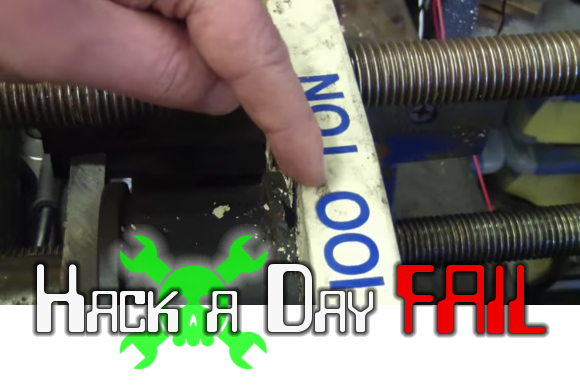
He probably should have known when he switched from a 4-foot ratchet to a crescent wrench with a 12-foot pipe for leverage that this was going to be more than the press could handle. The bottom plate seen in the image above is beginning to cup, which in turn jams up the screws in the off-kilter threads.

We fell a bit guilty in admitting we love to see equipment pushed to the point of failure like this. But perhaps that’s part of what this column is all about. Our favorite is still the PCB shear failure, but this comes in at a close second. Check out the video presentation after the break; just be warned that there’s a bit of rough language as part of the narrative.

Continue reading “Fail Of The Week: The Demise Of Lil’ Screwy” →

MRRF: Roundtable And Roundup

Last weekend Hackaday made a trip out to the Midwest RepRap Festival in Goshen, Indiana. We met a ton of interesting people, saw a lot of cool stuff, and managed to avoid the Amish horse and buggies plying the roads around Goshen.

We’ve already posted a few things from MRRF, including [Jordan Miller] and co.’s adventures in bioprinting, a very cool printable object repo that’s backed by a nonprofit LLC, some stuff from Lulzbot that included a new extruder, stretchy filament, and news of a 3D scanner that’s in development, ARM-based CNC controllers including the Smoothieboard and capes for the Beaglebone, 3D printed resin molds, the newest project from [Nicholas Seward], creator or the RepRap Wally, Simpson, and Lisa, and 3D printed waffles. It really was an amazing event and also the largest DIY 3D printer convention on the planet. How this happened in Goshen, Indiana is anyone’s guess, but we’d like to give a shout out to SeeMeCNC for organizing this event.

With so many famous RepRappers in one place, it only made sense to put together a round table discussion on the state of RepRap, 3D printers, and microfabrication. We have a 40-minute long video of that, which you can check out after the break.

Continue reading “MRRF: Roundtable And Roundup” →

Ask Hackaday: Auto Bed Leveling And High Temperature Force Sensitive Resistors

FSR

[Johann] over on the RepRap wiki has an ingenious solution for making sure a borosilicate glass bed is completely level before printing anything on his Kossel printer: take three force sensitive resistors, put them under the build platform, and wire them in parallel, and connect them to a thermistor input on an electronics board. The calibration is simply a bit of code in the Marlin firmware that touches the nozzle to the bed until the thermistor input maxes out. When it does, the firmware knows the print head has zeroed out and can calculate the precise position and tilt of the bed.

Great, huh? A solution to bed leveling that doesn’t require a Z-probe, uses minimal (and cheap) hardware, and can be retrofitted into just about any existing printer. There’s a problem, though: these force sensitive resistors are only good to 70° C, making the whole setup unusable for anything with a heated bed. Your challenge: figure out a way to use this trick with a heated bed.

The force sensitive resistors used – here’s a link provided by [Johann] – have a maximum operating temperature of 70° C, while the bed temperature when printing with ABS is around 130° C. The FSRs are sensitive to temperature, as well, making this a very interesting problem.

Anyone with any ideas is welcome to comment here, on the RepRap forums, the IRC, or anywhere else. One idea includes putting an FSR in the x carriage, but we’re thinking some sort of specialized heat sink underneath the bed and on top of the FSRs would be a better solution.

Video of the auto bed leveling trick in action below.

Continue reading “Ask Hackaday: Auto Bed Leveling And High Temperature Force Sensitive Resistors” →

Retrotechtacular: Breaking Atoms To Break The Ice

retrotechtacular-lenin-nuclear-icebreaker

This documentary from 1959 gives a satisfyingly thorough look inside a nuclear powered icebreaking ship called Lenin. This actually set a couple of world’s-firsts: it was the first nuclear powered surface vessel and the first civilian vessel to be powered thusly.

The ship was built to clear shipping paths to the northern ports of Russia. Testing of both ice and models of the ship design point to the ability to break ice layers that are two meters thick. This requires a lot of power as ice-breakers generally use their hull shape and gravity to break the ice by driving up onto it to bend the ice to the breaking point. The Lenin achieved this power using its nuclear reactor to heat steam which drove electric generators. The energy produced drove three screws to power the vessel.

Of course this was back in the day when control panels were substantial, which you can get a peek at starting half-way through the twenty-minute film. This includes a demonstration of the ship’s network of radiation sensors which alert the control room, and sound a local alarm when they are triggered. During it’s 30-year operational life the vessel had a couple of accidents stemming from refueling operations. You can find more on that over at the Wikipedia page, but stick with us after the jump to see the vintage reel.

Continue reading “Retrotechtacular: Breaking Atoms To Break The Ice” →

Hackaday Links: March 16, 2014

hackaday-links-chain

Tape decks are fertile hacking ground. In this offering from [Erich] the speed of the motor has been turned into a MIDI instrument. Drive it faster and the pitch rises, slower and it falls. There are all kinds of other magnetic tape hacks around here, this tape delay is a classic.

[Dbever] needed a reason to use a big 7-segment display module. He opened up the drill press at his Hackerspace, Pumping Station One, and added a sensor which shows the RPM of the drill on the display. Hackaday was lucky enough to be invited for a tour of the space last fall.

There’s a lot of hype about 3D printing… and rightly so since it’s the radest; which is even better than being “the most rad”. But if you don’t have access to one that shouldn’t stop you. Here’s an example of making robot parts using polymorph instead of 3D printing (or laser cutting) them.

If you’re living in the east-coast metroplex and are unable to travel to Maker Faire Bay Area this Spring you can still get in on some live hacking. Check out MassHack which takes place the same May weekend but in Boston instead of San Fran.

Blimps; not as cool as quadcopters but orders of magnitude less likely to go down in flames (as it were). Draw some inspiration for your own build from silent_runner. The graceful travel of these lighter-than-air-craft make for an interesting camera platform. Here’s a POV video inside of a church, and some shots from the ground while in the woods. [Thanks Oliver]

We try not to pimp crowd-funding campaigns just for the sake of getting them to the goal. But we hope you’ll agree that the Gamebuino we saw a few months back makes a strong argument for backers. Their Indiegogo for the Arduino-compatible handheld gaming rig is over half-way there after just a couple of days.

Developed On Hackaday: Security And Arduino Compatibility

2013-12_Developed_on_Hackaday

Some of our readers noticed that the Hackaday community open-source offline password keeper (aka Mooltipass) has two incompatible characteristics: being secure and Arduino compatible.

Why is that? Arduino compatibility implies including a way to change the device firmware and accessing the microcontroller’s pins to connect shields. Therefore, some ill-intentioned individuals may replace the original firmware with one that would log all user’s inputs and passwords, or in another case simply sniff the uC’s signals. The ‘hackers’ would then later come to extract the recorded data. Consequently, we needed a secure tamper-proof Mooltipass version and an Arduino-compatible one, while allowing the former to become the latter.

Olivier’s design, though completely closed, will have several thinner surfaces directly above the Arduino headers. As a compromise, we therefore thought of sending a bootloader-free assembled version to the people only interested in the password keeper functionality, while sending a non-assembled version (with a pre-burnt bootloader) to the tinkerers. The Arduino enthusiasts would just need to cut the plastic at the strategic places (and perhaps solder headers to save costs). The main advantage of doing so is that the case would be the same for both versions. The drawback is that each board would have a different firmware depending on who it is intended for.

What do our reader think? For more detailed updates on the Mooltipass current status, you can always join the official Google group.