Hackaday Trims Its Own Resistors

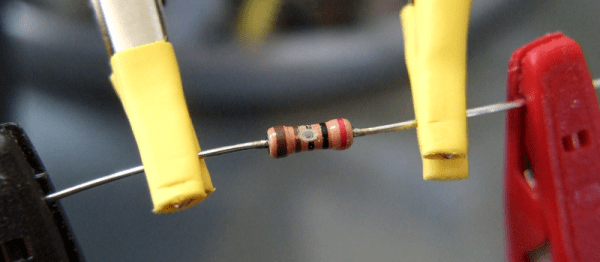
There are times when you might want an odd-value resistor. Rather than run out to the store to buy a 3,140 Ω resistor, you can get there with a good ohmmeter and a willingness to solder things in series and parallel. But when you want a precise resistor value, and you want many of them, Frankensteining many resistors together over and over is a poor solution.

Something like an 8-bit R-2R resistor-ladder DAC, for instance, requires seventeen resistors of two values in better than 0.4% precision. That’s just not something I have on hand, and the series/parallel approach will get tiresome fast.

Ages ago, I had read about trimming resistors by hand, but had assumed that it was the domain of the madman. On the other hand, this is Hackaday; I had some time and a file. Could I trim and match resistors to within half a percent? Read on to find out.

Continue reading “Hackaday Trims Its Own Resistors”

Industrial Indicator Makes The Move From PLC To FPGA

Industrial controls are fun to use in a build because they’re just so — well, industrial. They’re chunky and built to take a beating, both from the operating environment and the users. They’re often power guzzlers, though, so knowing how to convert an industrial indicator for microcontroller use might be a handy skill to have.

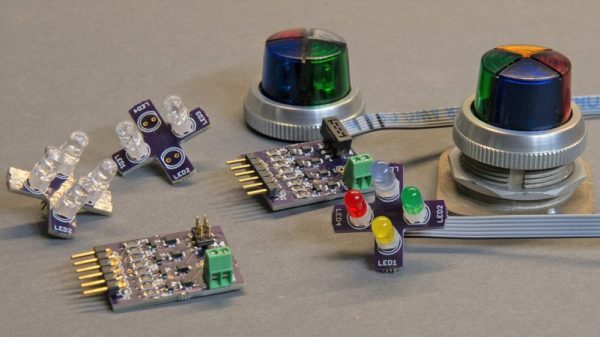
Having decided that an Allen-Bradley cluster indicator worked with the aesthetic of his project, a Halloween prop of some sort, [Glen] set about dissecting the controls. Industrial indicators usually make that a simple task so that they can be configured for different voltages in the field, and it turned out that the easiest approach to replacing the power-hungry incandescent bulbs with LEDs was to build a tiny PCB to fit inside the four-color lens.

The uniquely shaped board ended up being too small for even series resistors for the LEDs, so a separate driver board was also fabbed. The driver board is set up to allow a single 5-volt supply and logic levels of 3.3-volt or 5-volt, making the indicator compatible with just about anything. The finished product lends a suitably sinister look to the prop.

If you’re not familiar with the programmable logic controllers such an indicator would be used with in the field, then maybe you should try running Pong on a PLC for a little background.

New Fonts For GEDA PCB Tool

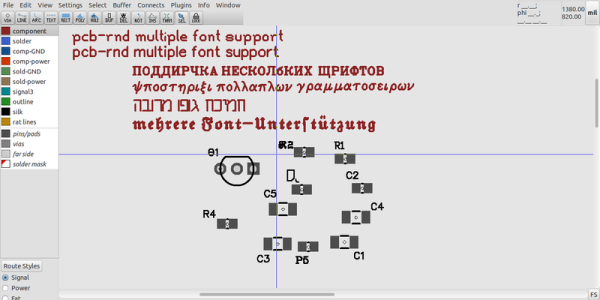
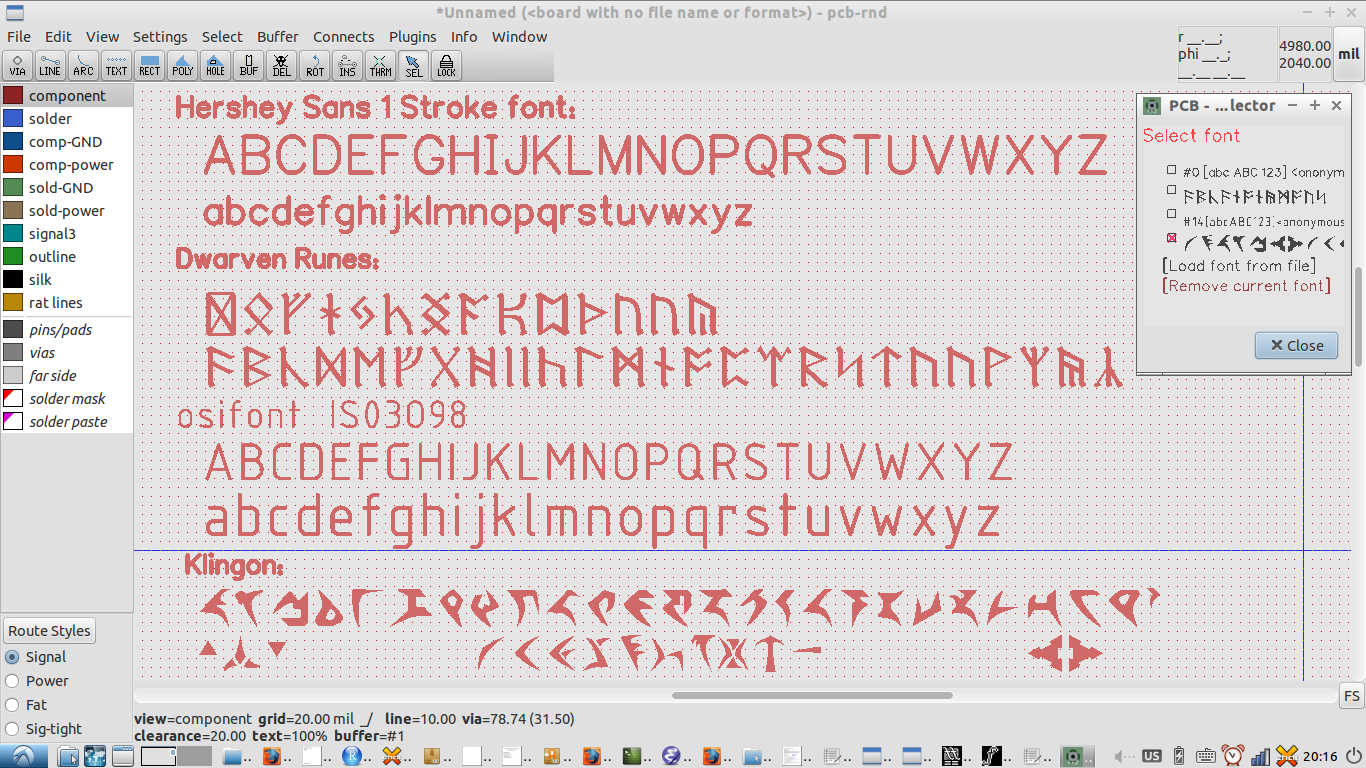
In the open-source world, there are two main choices for PCB design: KiCad and gEDA. But if you’re tired of the boring Hershey fonts telling you which resistor is which, or if you need to comply with ISO 3098, there’s one clear choice: PCB-RND, the improved fork of gEDA’s PCB tool. Why?

Because PCB-RND now supports osifont, which supports a ridiculous number of languages. In addition to the usual suspects, like Azerbaijani through Vietnamese, support has also been added for legacy users, including those of Middle Earth, who build PCBs that can only be read when the thrush knocks by the setting sun of the last light on Durin’s Day.

And they haven’t stopped there. Looking forward to the Treaty of Organia in 2267, you can now create PCBs that are fully plqaD-HaSta compliant.

We’re glad to see these important steps made toward reaching out to underserved PCB-constructing communities. However, we’re appalled at the continuing lack of support for Rihannsu. This will have to be rectified by anyone who wants to push their projects in the Beta Quadrant.

Robot Arm From Recyclables

A robot assistant would make the lives of many much easier. Luckily, it’s possible to make one of your own with few fancy materials. The [circuito.io] team demonstrates this by building a robot arm out of recyclables!

With the exception of the electronics — an Arduino, a trio of servo motors, and a joystick — the arm is made almost completely out of salvaged recyclables: scrap wood, a plastic bottle, bits of plastic string and a spring. Oh, and — demonstrating yet another use for those multi-talented tubers — a potato acts as a counterweight.

Instead of using screws or glue, these hackers used string made from a plastic bottle as a form of heat shrink wrap to bind the parts of the arm together. The gripper has only one pivoting claw for greater strength, and the spring snaps it open once released. Behold: your tea-bag dunking assistant.

Continue reading “Robot Arm From Recyclables”

Sir, It Appears We’ve Been Jammed!

In a move that would induce ire in Lord Helmet, [Kedar Nimbalkar] has recreated Instructables user spacehun’s version of WiFi jammer that comes with a handful of features certain to frustrate whomever has provoked its wrath.

The jammer is an ESP8266 development board — running some additional custom code — accessed and controlled by a cell phone. From the interface, [Nimbalkar] is able to target a WiFi network and boot all the devices off the network by de-authenticating them. Another method is to flood the airspace with bogus SSIDs to make connecting to a valid network a drawn-out affair.

This kind of signal interruption is almost certainly illegal where you live. It does no permanent damage, but once again raises the existing deauth exploit and SSID loophole. [Nimbalkar]’s purpose in recreating this was for educational purposes and to highlight weaknesses in 802.11 WiFi protocols. The 802.11w standard should alleviate some of our fake deauth woes by using protected frames. Once the device authenticates on a network it will be able to detect fake deauth packets.

We featured a more targeted version of this hack that can be done using a PC — even targeting itself! And more recently there was a version that can target specific devices by jumping on the ACK.

Continue reading “Sir, It Appears We’ve Been Jammed!”

Arch Your Eyebrow At Impression Products V. Lexmark International

When it comes to recycled printer consumables, the world seems to divide sharply into those who think they’re great, and those who have had their printer or their work ruined by a badly filled cartridge containing cheaper photocopy toner, or God knows what black stuff masquerading as inkjet ink. It doesn’t matter though whether you’re a fan or a hater, a used printer cartridge is just a plastic shell with its printer-specific ancilliaries that you can do with what you want. It has performed its task the manufacturer sold it to you for and passed its point of usefulness, if you want to fill it up with aftermarket ink, well, it’s yours, so go ahead.

There is a case approaching the US Supreme Court though which promises to change all that, as well as to have ramifications well beyond the narrow world of printer cartridges. Impression Products, Inc. v. Lexmark International, Inc. pits the printer manufacturer against a small cartridge recycling company that refused to follow the rest of its industry and reach a settlement.

At issue is a clause in the shrink-wrap legal agreement small print that comes with a new Lexmark cartridge that ties a discounted price to an agreement to never offer the cartridge for resale or reuse. They have been using it for decades, and the licence is deemed to have been agreed to simply by opening the cartridge packaging. By pursuing the matter, Lexmark are trying to set a legal precedent allowing such licencing terms to accompany a physical products even when they pass out of the hands of the original purchaser who accepted the licence.

There is a whole slew of concerns to be addressed about shrink-wrap licence agreements, after all, how many Lexmark owners even realise that they’re agreeing to some legal small print when they open the box? But the concern for us lies in the consequences this case could have for the rest of the hardware world. If a precedent is set such that a piece of printer consumable hardware can have conditions still attached to it when it has passed through more than one owner, then the same could be applied to any piece of hardware. The prospect of everything you own routinely having restrictions on the right to repair or modify it raises its ugly head, further redefining “ownership” as  “They really own it”. Most of the projects we feature here at Hackaday for example would probably be prohibited were their creators to be subject to these restrictions.

We’ve covered a similar story recently, the latest twist in a long running saga over John Deere tractors. In that case though there is a written contract that the farmer buying the machine has to sign. What makes the Lexmark case so much more serious is that the contract is being applied without the purchaser being aware of its existence.

We can’t hold out much hope that the Supreme Court understand the ramifications of the case for our community, but there are other arguments within industry that might sway them against it. Let’s hope Impression Products v. Lexmark doesn’t become a case steeped in infamy.

Thanks to [Greg Kennedy] for the tip.

Lexmark sign by CCC2012 [CC0].

Before There Were Nixie Tubes, There Were Edge-Lit Displays?

We’ve seen a bunch of replacements for nixie tubes using LEDs and edge-lit acrylic for the numbers. But one of the earliest digital voltmeters used edge-lit Lucite plates for the numbers and a lot of incandescent lamps to light them up.

[stevenjohnson] has a Non-Linear Systems Model 481 digital voltmeter and he’s done a teardown of it so we can get a glimpse of the insides. Again, anyone who’s seen the modern versions of edge-lit numeric displays knows what they are: A series of clear plastic plates with numbers (or characters) etched into them, each with a light source beneath them. You turn one light on to light one plate, another to light another, and so on. The interesting bit here is the use of incandescent bulbs and the use of sequential relays to cycle through the lights. The relays make a lot of racket, especially with the case open.

[stevenjohnson] also notes that he might have made a mistake opening up the part of the machine where the plates are stored as it took him a bit to get the plates back in place and back in the unit. We’d imagine it was pretty loud if you were taking a lot of measurements with this machine, although it looks great inside and, obviously, the idea is a pretty good one. Check out this edge-lit nixie tube display or these edge-lit numeric modules.

[via boingboing]

Continue reading “Before There Were Nixie Tubes, There Were Edge-Lit Displays?”