An Open Source Cortex-M0 Halogen Reflow Oven Controller With LCD

reflow oven controller

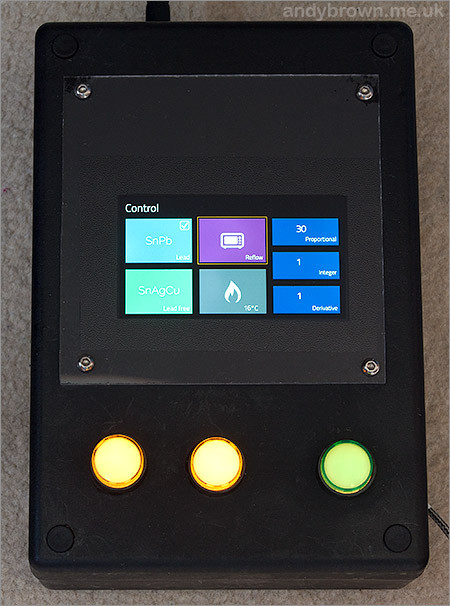
Homemade reflow ovens are a great inexpensive way to quickly solder multiple prototypes at once. [Andy] may just have built one of the best ones we’ve featured so far on Hackaday. For his project a £25 1300W 12litre halogen oven was chosen because of its low cost and fast heating time, the latter being required to follow typical reflow profile ramp-up stages.

To control the AC power [Andy] first bought a chinese Fotek Solid State Relay (SSR) on ebay, which was quickly replaced by an american one after reading concerning reports on the internet. He then made the same ‘mistake’ by buying the typical MAX6675 thermocouple-to-digital converter from the same website, as he spent much time understanding why the measurements were wrong when the IC was just defective. His final build is based around a 640×360 TFT LCD that he previously reverse engineered, the cortex-M0 STM32F051C8T7, a SPI flash, some power regulators and buttons. The firmware was written in C++ and we’ll let our readers visit [Andy]’s page to see how well  his oven performs.

Custom Nixie Tube PSU Is A Lesson In Good PCB Design

Nixie HVPSU

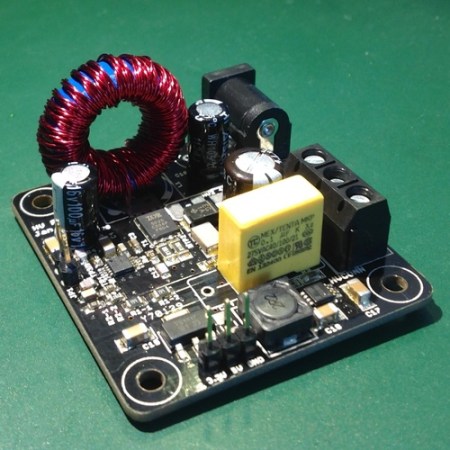
[Jan Rychter] was sick and tired of not being able to find the right power supply for his Nixie tube projects, so he decided to design his own. [Jan] started out designing around the MAX1771 (PDF) DC-DC controller, but quickly discovered he was having stability problems. Even after seven board revisions, he was still experiencing uncontrolled behavior. He ended up abandoning the MAX1171 and switching to the Texas Instruments TPS40210. After three more board designs, he finally has something that works for him. [Jan] admits that his design is likely not perfect (could have fooled us!), but he wanted to release it to the world as Open-Source Hardware to give back to the community.

The end result of [Jan’s] hard work is a 5cm x 5cm board that generates four separate output voltages from a single 12V source. These include both a 3.3V and 5V output for digital logic as well as a 220V out put for Nixie tubes and a 440V maximum output for dekatrons. The circuit also features several safety features including over-current protection, thermal shutdown, and slow-start. Be sure to check out [Jan’s] webpage to view out the schematics and technical information for this awesome circuit.

Need some Nixie tubes to go with that circuit? We know some resources for you to check out. Or you could always just build your own. How can you use this board in your next project?

The Phidgets Solar Powered Weather Station

weather

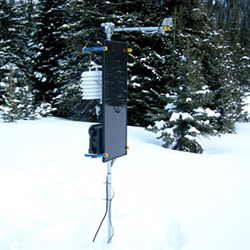
Yes, it’s a weather station, one of those things that records data from a suite of sensors for a compact and robust way of logging atmospheric conditions. We’ve seen a few of these built around Raspberry Pis and Arduinos, but not one built with a Phidget SBC, and rarely one that has this much thought put in to a weather logging station.

This weather station is designed to be autonomous, logging data for a week or so until the USB thumb drive containing all the data is taken back to the lab and replaced with a new one. It’s designed to operate in the middle of nowhere, and that means no power. Solar it is, but how big of a solar panel do you need?

That question must be answered by carefully calculating the power budget of the entire station and the battery, the size of the battery, and the worst case scenario for clouds and low light conditions. An amorphous solar cell was chosen for its ability to generate power from low and indirect light sources. This is connected to a 12 Volt, 110 amp hour battery. Heavy and expensive, but overkill is better than being unable to do the job.

Sensors, including temperature, humidity, and an IR temperature sensor were wired up to a Phidgets SBC3 and the coding began. The data are recorded onto a USB thumb drive plugged into the Phidgets board, and the station was visited once a week to retrieve data. This is a far, far simpler solution than figuring out a wireless networking solution, and much better on the power budget.

Via embedded lab

[Bunnie]’s Laptop Gets A 900MHz Scope Addon

Scope

Now that [Bunnie]’s open hardware laptop – the Novena – is wrapping up its crowdfunding campaign, it only makes sense that development around the Novena project would move over to the more interesting aspects of a completely hackable laptop. The Novena has a huge FPGA on board, with 2 Gbit of very fast memory hanging off it. Also, every single signal pin of the FPGA is broken out on high-speed connectors, making for some very, very interesting possible add-on boards. [Bunnie] has always wanted a portable, high-end oscilloscope to carry with him, and with the new oscope module, he has something that blows out of the water every scope priced below a thousand dollars.

The oscilloscope module [Bunnie] is working on has either two 8-bit channels at 1 GSPS or one 8-bit channel at 2 GSPS with an analog bandwidth of up to 900MHz. The module also has 10 digital channels, so if you need a logic analyzer, there you go.

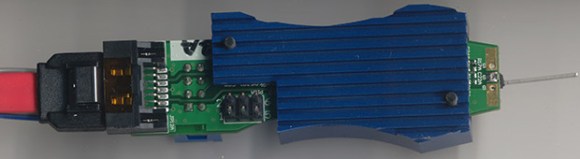
Being a fairly high-end scope, the hardest part of engineering this scope is the probes. The probes for fast, high-end scopes cost hundreds of dollars by themselves, so [Bunnie] looked for a clean-sheet redesign of the lowly oscope probe. To connect the probe to the module, [Bunnie] realized a SATA cable would be a great solution; they’re high bandwidth, support signals in the GHz range, and are rated for thousands of insertions. These active probes can be combined with a number of front ends for application specific probes – digital probes, ones for power signature analysis, and ones for capturing signals across small loops of wire.

The module itself isn’t quite ready for production yet, but by the time the Novena crowdfunding campaign starts shipping, [Bunnie] will probably be working on the next add-on module for his crazy awesome laptop.


Neurogrid circuit board that replicates functions of the human brain.

The Neurogrid – What It Is And What It Is Not

What it is:

Some would argue that replicating the human brain in silicon is impossible. However, the folks over at Brains in Silicon of Stanford University might disagree. They’ve created a circuit board capable of simulating one million neurons and up to 6 billion synapses in real-time. Yes, that’s billion with a “B”. They call their new type of computer The Neurogrid.

The Neurogrid board boasts 16 of their Neurocore chips, with each one holding 256 x 256 “neurons”. It attempts to function like a brain by using analog signals for computations and digital signals for communication. “Soft-wires” can run between the silicon neurons, mimicking the brain’s synapses.

Be sure to stick around after the break, where we discuss the limitations of the Neurogrid, along with a video from its creators.

Continue reading “The Neurogrid – What It Is And What It Is Not”

Spin A PCB For Your Most Beloved Sensors

sensorstick-breakout

If you follow [Ioannis’] lead you’re going to thank yourself every time you sit down to work on a new prototype. He took all of the sensors which he most commonly uses and spun one dev board to host them all.

As long as you’re willing to wait for delivery, the cost of small-run professionally made PCBs has become unbelievably reasonable. That’s really nice when you need to test your layout before exploring larger production. But it also means you can develop your own dirt-cheap yet reliable dev tools. This example combines three sensors which all communicate via I2C:

  • MPU6050 accelermoter/gyro
  • BMP085 pressure sensor
  • SHT10 humidity sensor

Obviously this is a great idea, but key is the cheat sheet which [Ioannis] included on the bottom of the board. It testifies as to which chips are on the board, but also includes the device addresses for the data bus. We’ve adopted the mantra that if a breadboarded prototype is not working, it’s always a hardware problem. For those oft-used parts this should alleviate some of the heartache at your bench.

You could still make something like this without spinning or etching a board. You’ll just have to be creative with the soldering.

Listening To A Swarm Of Satellites In Orbit

kicksat

A few months ago, we heard of a Kickstarter with an amazing goal: give everyone with $300 burning a hole in their pocket their very own satellite orbiting Earth. Time passes, the mothership has been launched, and in just a few short hours, over a hundred of these personal femtosatellites will be released into low Earth orbit.

The Kicksat consists of a 3U cubesat that was recently launched aboard the SpaceX CRS-3 mission to the International Space Station. Inside this cubesat are over one hundred satellites called Sprites, loaded up with solar cells, magnetometers, a microcontroller and a radio to communicate with ground stations below. The current mission is a proof of concept, but if everything goes as planned, similar satellites can be deployed into the path of incoming asteroids, or whenever a mission calls for a swarm of small smart devices covering a huge area.

Already the Kicksat mothership has been tracked by a few enterprising amateur radio enthusiasts but the deployment of the Sprites isn’t scheduled until today at 4:00 PM EDT (20:00 GMT). After that, the Sprites will be on their own, spewing out data and the initials of kickstarter backers to most of the population of Earth.

For anyone worrying about these Sprites causing an ablation cascade or a Kessler syndrome, don’t. Orbital decay is a function of surface area and mass, and these extremely lightweight thin rectangles will burn up in the atmosphere in a few week’s time. The lack of radiation hardening on the Sprites won’t be a problem, either. This shouldn’t be a surprise, as they’re orbiting well within our wonderful, protective magnetosphere, and there are digital cameras, tablets, and other much more radiation sensitive electronics that have been working perfectly on the ISS for years now.

You can check out the current location of the orbiting Kicksat mothership on the project website, read the updates on the project blog, or check out our coverage of the Kicksat program from last year’s world maker faire in New York. Relevant videos below.

Oh, and if you have a USB TV tuner, a good antenna, LNA, and some experience with SDR, here’s what you need to listen in.

Continue reading “Listening To A Swarm Of Satellites In Orbit”