Herring Bone Bed With Secret Compartment

Why buy a bed when you can make an even fancier one — with a hidden compartment!? After [Vitiello] couldn’t quite find a bed frame he liked, he decided to make his own, using a herringbone pattern for the woodwork.

We’ve shared quite a few awesome home-made kid’s beds lately, like this beautifully hacked IKEA bed (complete with a hidden room!) and this Avenger’s themed Helicarrier bed, featuring a remote control dart turret. So after we got over feeling jealous that we weren’t three feet tall and able to have a bed as awesome as those, we saw this herringbone bed. And while it doesn’t have a hidden room, it does have a pretty awesome secret compartment which helps ease the pain.

Built out of about $250 worth of cedar planks, [Vitiello] did a great job with both the design and build. He purposefully made the headboard rather thick to accommodate an LED lit shelf, and of course, the hidden compartment accessible from the side. And since he could, the LEDs are remote controlled — and of course color changing.

[via r/DIY]

Wireless Water Meter Monitor Watches Waste

It’s no secret that hackers like to measure things. Good numbers lead to good decisions, like when to kick your wastrel teenager out of a luxuriously lengthy shower. Hence the creation of this wireless Arduino-based water meter interface.

We’ll stipulate that “wireless” is a bit of a stretch. Creator [David Schneider] chose to split the system into two parts – a magnetometer and an Arduino to sense impulses from the water company meter, and a Raspberry Pi to serve the web interface. The water meter is at the street rather than in his house, so the sensor is wired to the Pi with some telephone cable. But from there the system is wireless.

[David] goes into some good detail on the sensing problem he faced, which relies on detecting the varying magnetic field due to the spinny-bits inside the flowmeter and cleaning up the signal with the Arduino; he also addresses aliasing errors that occur when flow rate approaches the sampling rate of the magnetometer.

We like the fact that there’s a lot of potential to leverage this technique to monitor other processes with rotating magnetic fields. And like this optically coupled gas-meter monitor, it’s not invasive of the utility’s equipment either, which is a plus.

[via reddit]

Smart Coaster Informs You When Your Drink Is Ready

How many times have you made a cup of coffee or tea and it’s been too hot to drink, and then by the time you get to it, it’s become too cold? While very much a #firstworldproblem, [ToniTheAxe] decided to fix it — and enter a contest at the same time. He calls it the µCoaster, and essentially, it is a temperature sensing alarm clock.

The coaster uses a TMP006 infrared temperature sensor which measures the temperature of whatever you place on the coaster indirectly. It also doesn’t use much power. He designed the PCBs around this and created a very nice looking coaster that’s powered off of a button cell battery — he thinks it’ll last for around 6 months with daily usage — though that depends on how bad your caffeine addiction is.

Continue reading “Smart Coaster Informs You When Your Drink Is Ready”

Metalab Bypasses IR Remote With Audio Circuit

Infra-red (IR) remotes are great, unless you’re in a hackerspace that’s full of crazy blinking lights and random IR emissions of all kinds. Then, they’re just unreliable. Some smart folks at Metalab in Vienna, Austria cut out the IR middle-man with a couple transistors and some audio software. They call the project HDMI Whisperer, and it’s a cute hack.

Metalab’s AV system has a web-frontend so that nobody ever has to stand up unless they want to. They bought an incredibly cheap 5-to-1 HDMI Switch to switch between displaying multiple video streams. But how to connect the switch to the Raspberry Pi server?

Fortunately, the particular switch has a remote-mounted IR receiver that connects to the main unit through a stereo audio jack. Plugging this sensor into a laptop and running Audacity while pressing the buttons on the remote got them audio files that play the remote’s codes. Simply playing these back out of the Raspberry Pi’s audio out and into the switch’s IR input through a tiny transistor circuit does the trick. Now they have a networked five-way HDMI switch for $10.

Given the low data rates of most IR remotes, we could imagine using the same trick for devices that have built-in IR receivers as well. Simply clip out the IR receiver and solder in a couple wires and then inject your “audio” signal directly.

But IR hacks are loads of fun. We’ve seen a bunch here, from the classic camera shutter-release hack to a more general tutorials on cloning IR signals with Arduinos.

Thanks [overflo] for the tip!

Simple Devices Protecting Our Water System

We are all used to turning on the faucet and having clean, drinkable water on demand. But think about what happens afterwards in your home: that water is used to wash dishes or water lawns and many other uses that render it undrinkable. What stops this nasty water from flowing back into your pipes and out of your kitchen faucet? A backflow preventer. This simple, but vital, part of your plumbing turns your water pipes into one-way systems that give out clean, drinkable water. This isn’t just about making your water taste nice: backflow preventers protect your water supply from things like brain-eating amoeba and E Coli that could kill.

Continue reading “Simple Devices Protecting Our Water System”

Audio-coupled Smoke Alarm Interface Sends Texts, Emails

The Internet of Things is getting to be a big business. Google’s Nest brand is part of the trend, and they’re building a product line that fills niches and looks good doing it, including the Nest Protect smoke and CO detector. It’s nice to get texts and emails if your smoke alarm goes off, but if you’d rather not spend $99USD for the privilege, take a look at this $10 DIY smoke alarm interface.

The secret to keeping the cost of [Team SimpleIOThings’] interface at a minimum is leveraging both the dirt-cheap ESP8266 platform and the functionality available on If This Then That. And to keep the circuit as simple and universal as possible, the ESP8266 dev board is interfaced to an existing smoke detector with a simple microphone sensor. From what we can see it’s just a sound level sensor, and that should work fine with the mic close to the smoke detector. But with high noise levels in your house, like those that come with kids and dogs, false alarms might be an issue. In that case, we bet the software could be modified to listen for the Temporal-Three pattern used by most modern smoke detectors. You could probably even add code to send a separate message for a CO detector sounding a Temporal-Four pattern.

Interfacing to a smoke detector is nothing new, as this pre-ESP8266 project proves. But the versatile WiFi SoC makes interfaces like this quick and easy projects.

Continue reading “Audio-coupled Smoke Alarm Interface Sends Texts, Emails”

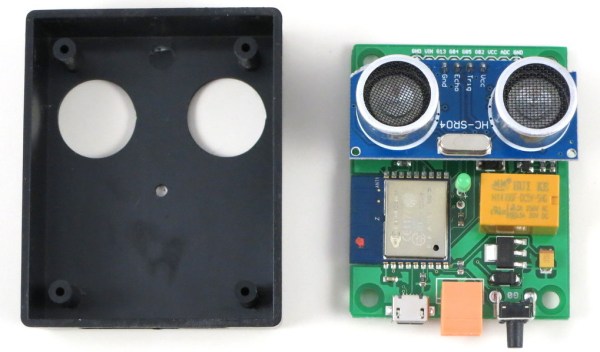
RFM69 To MQTT Gateway On The Super-Cheap

[Martin] is working on a RFM69-to-MQTT bridge device. If you’re at all interested in DIY home automation, this is going to be worth following. Why? When your home automation network gets big enough, you’re going to have to think seriously about how the different parts talk to each other. There are a number of ways to handle this messaging problem, but MQTT is certainly a contender.

MQTT is a “lightweight” publish-subscribe framework that’s aimed at machine-to-machine data sharing, and runs on top of a normal TCP/IP network. IBM has been a mover behind MQTT since the beginning, and now Amazon is using it too.

But most MQTT servers need a TCP/IP network, which pretty much means WiFi, and this can be a killer for remote sensors that you’d like to run on battery power, or with limited processing power. For these use cases, a low-power, simple sub-gigahertz radio module is a better choice than WiFi. But then how to do you get your low-power radios to speak to your MQTT devices?

That’s the point of [Martin]’s MQTT bridge. Previously he had built a sub-gig radio add-on for a Raspberry Pi, and let the Pi handle the networking. But it looks like there’s enough processing power in a lowly ESP8266 to handle the MQTT side of things (over WiFi, naturally). Which means that you could now connect your 868 MHz radio devices to MQTT for less than the cost of two pumpkin spice, double-pump lattes.

On the firmware side, [Martin] has enlisted the help of [Felix], who developed the Arduino-plus-RFM69 project, the Moteino. [Felix] has apparently ported his RFM69 library to the ESP8266. We’re dying to see this working.

For now, we’ve got some suggestive screenshots which hint at some LAN-exposed configuration screens. We’re especially interested in the RFM + MQTT debug console window, which should really help in figuring out what’s gone wrong in a system that spans two radio protocols.

The bottom line of all of this? Super-cheap, power-efficient RFM69-based radio nodes can talk with your sophisticated MQTT network. Keep your eyes on this project.