Counting Bees

This is the bee counter which [Hydronics] designed. It’s made to attach to the opening for a hive, and will count the number of bees entering and exiting. We’re not experienced bee keepers ourselves (in fact we’re more of the mind of getting rid of stinging beasties) but we understand their important role in agriculture and ecosystem so we’re glad someone’s making a nice home for them.

Most of the apparatus is a circuit board lined with reflective sensors. There is a double-row of pin sockets on the top of the board which accepts the Teensy+ which monitors those sensors. The bees must pass below this PCB every time they enter or leave the hive, thereby tripping a sensor. In the video after the break [Hydronics] shows off the system with a netbook used to monitor the output. But it sounds like he has plans for an integrated display system in future versions of the bee counter.

Continue reading “Counting Bees”

Home Automation With RC Wall Plugs And Raspberry Pi

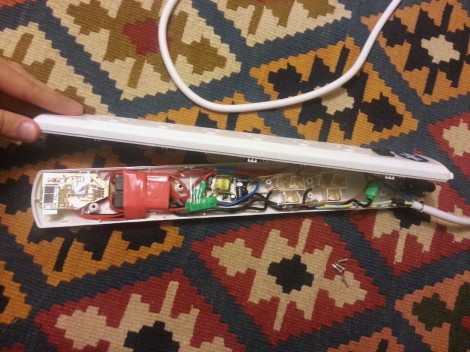
[Jake] took some cheap hardware and figured out a way to use it as a huge home automation network. He’s chose a Raspberry Pi board to connect the radio controlled power outlets to his network. He wrote about his project in two parts, the first is hacking the RC outlet controller and the second is using the Raspberry Pi to manipulate it.

These RC outlets are a pass-through for appliances that connect to mains (lamps, consumer electronics, christmas trees, etc). Often the protocol used by the cheap-as-dirt remote is difficult to work with, but [Jake] really hit it out of the part on this one. In addition to simulating button presses for up to fifteen devices on the remote, he replaced the DIP switch package. This lets him change the encoding, essentially allowing the one device to control up to 32 sets of outlets. Theoretically this lets him command 480 devices from the Raspberry Pi. Since that board is a web server it’s just a matter of coding an interface.

Some of the inspiration for this hack came from the whistle-controlled appliance hack.

Open Hardware Moodlamp With ATmega

[Daniel Andrade] has built a pretty cool mood lamp circuit. He was initially inspired by [Toon Beerton’s] Ikea lamp, but found he just didn’t have the knowledge to proceed with the PIC processor. He rushed out and bought an arduino to begin learning. Once he figured out how to properly make a mood lamp function, he created a custom circuit to utilize an ATmega chip instead of his whole arduino.  He’s now on his second revision of the circuit and is sharing all the files with whoever would like to download them.

His circuit utilizes a 3wRGB LED and any ATmega 8/168/328. He has left some space for expansion on the board as well just in case you’d like to add sensors of some kind (he mentions a temp sensor).


Building An RGB Mood Lamp Using An IKEA Mylonit

[Toon Beerten] had been experimenting with LED lamp construction. He had already built a pretty neat pyramid of LEDs as a mood lamp but wanted something a little higher quality for his living room. He ran out and picked up an IKEA lamp, which you can see above. From the store, the lamp can only display one color, and has a clear construction. [Toon] wanted RGB and an opaque finish, so he sanded the lamp and built a custom circuit.

He tore out the lamp circuit and replaced it with his own, consisting of a 3W LED, a heatsink, and a PIC 16F628 (and the supporting components). The main circuit actually fits underneath the lamp pretty well. You can download the full schematics and code from his site if you’d like to replicate it.

As you can see in the video, the effect is quite nice.

Continue reading “Building An RGB Mood Lamp Using An IKEA Mylonit”

Charting The Efficiencies Of Boiling Water

Water takes a lot of energy to heat up. If you’d like evidence of this, simply jump into a 50° F swimming pool on Memorial Day. Despite the difficulty of heating water, that simple act accounts for a lot of industrial processes. From cooking a steak to running a nuclear reactor, there isn’t much that doesn’t involve heating water.

[Tom Murphy], Physics prof at UCSD decided to test out exactly how efficiently he could boil water. Armed with a gas stove, electric kettle, microwave, and a neat laser pointer/photodiode setup on his gas meter to measure consumption, he calculated exactly how much energy he was using to make a cup of tea.

The final numbers from [Tom]’s experiment revealed that a gas stove – using a pot with and without a lid on large and small burners – was about 20% efficient. A gas-powered hot water heater was much better at 55% efficiency, but the microwave and electric kettle had a miserable efficiencies of around 15 and 25%, respectively. There is a reason for the terrible inefficiency of using electricity to heat water; if only the power from the wall is considered, the electric kettle put 80% of energy consumed directly into the water. Because the electricity has to come from somewhere, usually a fossil-fueled power plant that operates at around 30% efficiency, the electric kettle method of turning dinosaurs into hot water is only about 25% efficient.

The take-home from this is there’s a lot of power being wasted every time you run a bath, make some coffee, or wash the dishes. We would all do better by decreasing how much energy we use, much like [Tom]’s efforts in using 5 times less power than his neighbor. Awesome job, [Tom].

Adding Voice Labels To Real Life Objects For The Visually Impaired

[Matt Oppenheim] wrote in to share his work with us. He has been modifying the interfaces of electronics for the visually impaired. It started off with cassette decks. As [Matt] points out, many people who are visually impaired use cassettes for their audio books and newspapers. [Matt] added some touch sensors to the buttons so that he could have something announce what each button was as the user felt them. This allowed them to quickly learn the layout of the device.

After finding that the simple interface on the cassette player was learned very quickly, thereby making his addition no longer needed, he decided to go after something a little more complex. [Matt] set out to modify a digital radio with many more buttons that are less touch friendly. As you can see in the video after the break, he was able to pull this off quite nicely.

Continue reading “Adding Voice Labels To Real Life Objects For The Visually Impaired”

Building The Backend Of Internet Controlled Devices

[Adam] and [Jeremy] took on the challenge of designing a system that would make it easy to control appliances from the Internet. We’ve seen the concept many times before; it involves some method of switching mains power and connecting that mechanism to the Internet. This design is both well planned and nicely executed.

We’re always very interested in the power switching for a project like this. It’s good that an approved electrical box houses all of the high-voltage parts in the project. Here a GA8-2B02 solid state relay switches power between the incoming cord and the two outlets. We didn’t get a look in the box, but hopefully there’s a partition between those wires and the low-voltage control wiring which uses a standard 3.5 mm audio jack as an interconnect.

An ATmega644 drives the control signal for the relay. It’s connected via Ethernet cable to the Internet through the use of an ENC28J60 chip which takes care of LAN communications. This is essentially a light-weight web server that will be easy to adapt to receive commands from just about any web-connected sender.

[Thanks Bruce]