Portable Power Strip Control Lights And Appliances Using SMS

sms_triggered_appliance_control

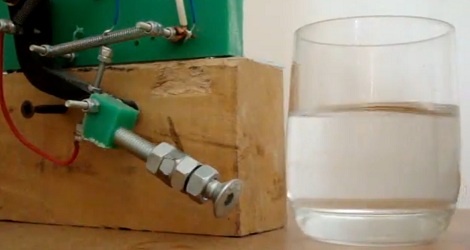
[Julian] wanted a way to remotely control various appliances and lights around his house without spending an arm and a leg on home automation. He also desired the ability to easily switch what items he was controlling without a ton of hassle. Since he couldn’t find anything reasonably priced to do what he desired, he built his own SMS-triggered remote control system.

He designed his system to be used like an extension cord, hence the portable junction box enclosure. This enables him to regulate up to four different items at a time, with the ability to swap out components or relocate his controller at will.

The power strip is controlled by an Arduino which receives commands from his PC via an Xbee module. Any text messages sent to his Gmail account are retrieved by his computer and then transmitted to the Arduino. The Arduino in turn triggers relays as designated by [Julain’s] text messages, utilizing H-bridges to provide the required current.

Check out his schematics and code if you’re interested in implementing something similar in your home.

Turning Pixels Into LEGO Pieces

Looking to spice up his living room with some modular plastic pieces, [Quentin] came up with a way to take digital pixels and convert them to LEGO building plans. The end result is a coffee table top that uses a font complete with anti-aliasing.

The first thing he did was figure out physical dimension and color palettes available from the popular building blocks. His search yielded all of the answers after he spent some time on Brickipedia. Armed with that knowledge he started bargain hunting, settling on a brick size that yielded adequate resolution without breaking the bank (he budgeted 87 Euros or about $125 for materials). From there he used Photoshop, along with a custom color palate that matches the LEGO colors, to generate the design. Image in hand, he finished the planning stage by writing a program to count the pixels, convert them into LEGO bricks, and spit out an order list and build instructions. He’s saving others the trouble of doing the same by releasing his source code.

Of course the project wouldn’t be nearly as fun if he hadn’t made a fast-time build video. We’ve embedded it after the break.

Continue reading “Turning Pixels Into LEGO Pieces”

Light Up Your Workshop With This Arcade Button Light Switch

arcade_button_light_switch

[Pete Mills] was browsing around online when he came across an arcade button light switch and immediately wanted one. He didn’t however want to pay the $35 asking price for the switch, so he decided to build it himself.

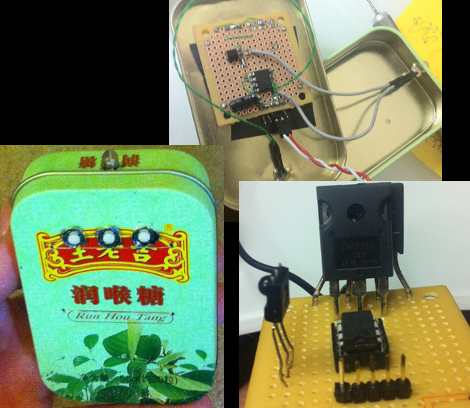
He says that his solitary arcade machine doesn’t warrant its own room, so he figured he would wire the switch up to an extension cord in his workshop instead. The switch was made with parts he had on hand, so seeing as he didn’t have any triacs, he opted to use a relay in its place. He thought about how he would construct a simple flip flop circuit for the switch, and settled on using a simple 555-based circuit instead of a pair of transistors.

The end result looks every bit as nice as the version available for sale online, and it works great as you can see in the video below. [Pete] has circuit schematics available on his site should you want to build your own, so if you do, let us know in the comments – we’d love to see different variations on the circuit design.

Continue reading “Light Up Your Workshop With This Arcade Button Light Switch”

Candlestick Phone Goes Modern.

[Adam Ben-Dror] recently tipped us off to a project that he worked on recently. In this build he gutted an old candlestick-style phone and added modern technology to make it work as a cordless phone. We really liked this project because he married together new and old technology into an elegant package. There are a few hacks that he had to perform to get this to work. One was converting the rotary pulses into DTMF tones. The other was making the cordless phone that he gutted recognize when the phone was on or off of the hook.

Details of his build after the break. Continue reading “Candlestick Phone Goes Modern.”

Retractable IPad Dock For The Kitchen

[Evan Flint] and his wife use a lot of online recipes in the kitchen. Rather than printing them out, they bought an iPad as a cooking companion. But in their cramped kitchen he needed to find a place for the high-end hardware that is out-of-the-way yet accessible. Some head scratching and parts bin diving led to this under-cabinet iPod dock.

The dock itself is a cradle made out of sheet aluminum. After cutting to shape, [Evan] bent up the sides and bottom to center the iPad. Since this is not a permanent fixture he needed to make the cradle collapsible. He used a CAD program to design the base tray to let the cradle lay flat, while giving several options to the angle when it is in use. Once the cooking is done just fold it up and the drawer slides make for easy under-cabinet storage.

Because he doesn’t own the house he didn’t want to make permanent alterations to the cabinet. But he does lament the unfinished look of the drawer slides. We’d just grab some pre-finished oak crown molding from the home store and wrap the entire thing. The left-edge of molding could slide out with the cradle when in use.

crazy_cat_elevator

A Cat Elevator, For The Discerning Lazy Feline In Your Life

Ah, to live the life of a cat. The lazing about, the food delivered on demand, and the elevators – oh the glorious elevators.

No you didn’t misread and we haven’t gone crazy. We were sent a link to the video below just the other day, and while it is nearly two years old, it was new to us. From the very brief description on YouTube, it looks as if the elevator senses the cat’s entry using infrared, locking the door behind the cat before transporting it to another level of the house. While it’s often implied that cats are incredibly lazy, this contraption definitely takes things above and beyond the norm.

It’s a pretty ridiculous system if you ask us, but it’s pretty compelling just the same. If you can find any more information on it, we’d love to hear about it in the comments. If you can’t, feel free to speculate as to how you would build a cat elevator, or elaborate on the crazy contraptions you’ve built for the lazy felines in your life.

Continue reading “A Cat Elevator, For The Discerning Lazy Feline In Your Life”

Controlling Dioder Light Strips Wirelessly

dioder_universal_io

[SeBsZ] does a lot of work in home automation, using Xbee modules, LEDs, and other home lighting systems. Naturally, people look to him for help with different electronics projects, but one thing he has been asked time and time again is if he can make a simple mood lighting solution that can be easily installed.

He has always been interested in playing around with RGB LEDs, but he wasn’t looking to reinvent the wheel with this project. Instead he based his work off the Ikea Dioder product, an off-the-shelf set of adjustable LED strips. As we’ve seen before, the control module for these LEDs leaves a bit to be desired, so he removed the Dioder’s onboard PIC and wired up a controller of his own. His “Universal IO Board” uses an Atmega88 for control and has all the pins required to attach an Xbee wireless module. With everything wired up, he now has full wireless control of the Dioder light strips, without a ton of fuss.

Although he’s selling a few different hardware kits, the schematics for his IO board are freely available on his site, should you want to make your own. The only thing that we didn’t see was the code for the Atmega, but we’re guessing he has that posted somewhere as well.