Hackaday Prize Entry: Biopotential Signal Library

With prosthetics, EEG, and all the other builds focused on the body and medicine for this year’s Hackaday Prize, it might be a good idea to take a look at what it takes to measure the tiny electrical signals that come from the human body. Measuring brain waves or heartbeats indoors is hard; AC power frequencies easily couple to the high impedance inputs for these measurements, and the signals themselves are very, very weak. For his entry to The Hackaday Prize, [Paul Stoffregen] is building the tools to make EEG, ECG, and EMG measurements easy with cheap tools.

If the name [Stoffregen] sounds familiar, it’s because he’s the guy behind the Teensy family of microcontroller boards and several dozen extremely popular libraries for everything from displays to real time clocks. The biopotential signal library continues in [Paul]’s tradition of building very cool stuff with just code.

The hardware used in this project is TI’s ADS1294, a 24-bit ADC with either 4 or 8 channels. This chip is marketed as a medical analog front end with a little bit of ECG thrown in for good measure. [Paul] is only using the ADS1294 initially; more analog chips can be added later. It’s a great project in its own right, and when you include the potential applications of this library – everything from prosthetics to body sensors – it makes for an awesome Hackaday Prize entry.



The 2015 Hackaday Prize is sponsored by:

Hackaday Prize Entry: Aspirin For Everyone

When it comes to the history of medicine and drugs, Aspirin, or more properly acetyl-salicylic acid, is one of the more interesting stories. Plants rich in salicalates were used as medicines more than four thousand years ago, and in the fourth century BC, [Hippocrates] noted a powder made from willow bark was an excellent analgesic. It was only in the 1800s that acetylated salicylic acid was first synthesized. In 1897, chemists at Bayer gave this ancient remedy a new name: Aspirin. It’s on the WHO List of Essential Medicines, but somehow millions of people don’t have access to this pill found in every pharmacy.

[M. Bindhammer] is working to make Aspirin for Everyone for his entry to the Hackaday Prize, using a small portable lab designed around chemicals that can be easily obtained.

The most common synthesis of Aspirin is salicylic acid treated with acetic anhydrate. Acetic anhydrate is used for the synthesis of heroin, and of course the availability of this heavily restricted by the DEA. Instead, [M. Bindhammer] will use a different method using salicylic acid and acetic acid. If you’re keeping track, that’s replacing a chemical on a DEA list of precursors with very strong vinegar.

[M. Bindhammer] even has a design for the lab that will produce the Aspirin, and it’s small enough to fit in a very large pocket. Everything that is needed for the production of acetyl-salicylic acid is there, including a reaction vessel with a heating element, a water/oil bath, flask, an Allihn condenser, and a vacuum filtering flask. Even if shipping millions of pills to far-flung reaches of the planet were easy, it’s still an exceptional Hackaday Prize entry.


The 2015 Hackaday Prize is sponsored by:

We Have A Problem: Health Care Where There Are No Health Care Workers

Hackaday, we have a problem. There are a lot of people on this earth and not a lot of health care workers. Let’s use our skills to help alleviate this problem. What can we do to give medical professionals a wider reach, to bridge the distances between hospital and patient, and make it easier for bystanders to administer lifesaving care.

Scope of the Problem

We’d wager that your most recent and vivid remembrance of a health care worker shortage is the Ebola outbreak in West Africa. The shortage of trained professionals and supplies certainly compounded the situation in the countries worst hit. But it didn’t create the problem. Check out this list of doctors per 1,000 people (sorted lowest-to-highest with 2010 numbers). The three countries hit hardest by the outbreak — Guinea, Liberia, and Sierra Leone — register a whopping 0.0 doctors for every 1000 people. Yeah, that’s years before the outbreak.

Keep scrolling down and you’ll see that this isn’t limited to one geographic location. All over the world there are low numbers, with India and Iraq both at 0.6, and interestingly Cuba and Qatar topping the list at 6.7 and 7.7 respectively.

This isn’t a statistics post so let’s pivot. The point is made that we’re a large world population. What kind of engineering solutions can we wield to help provide everyone with the care they need? Leave your comments below but also considered entering the Hackaday Prize with them. Write down your idea as a Hackaday.io project and tag it 2015 Hackaday Prize.

Proof That We Can Do This

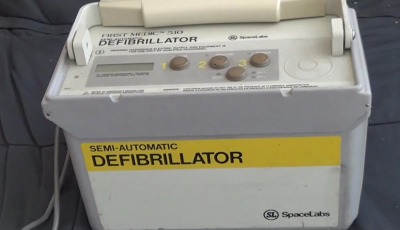
firstmedic-510-aedIt’s safe to say we’ve all seen engineering solve part of this problem already. Over the last decade, Automatic External Defibrillators have become ubiquitous. The life-saving hardware is designed to be used by non-doctors to save someone whose heart rhythms have become irregular. [Chris Nefcy] helped develop AEDs and one ended up saving his life. If that’s not proof that we can change the world with our builds we don’t know what is.

Pull on that thinking cap and jump into this conversation. What can we build? What problems need to be solved right now? Where should each of us be looking to make a difference in the availability of health care in the absence of the trained professionals?


The 2015 Hackaday Prize is sponsored by:

Dextrus V1.2 Robot Hand

Wounded Soldier Gets Robotic Hand Replacement

[Neal Muzzy], a local member of the Cedar Valley Makers makerspace, just made news on Open Bionics for his robotic prosthetic hand called Dextrus v1.2 which he made for his friend, and wounded war veteran, [Taylor].

In just two months, [Neal] worked with his friend to make this robotic prosthetic with the goal of having it more functional and easier to use than [Taylor]’s current prosthetic. The very first prototype was made by using the open-source Dextrus design, to test fit, and control using EMG sensors. Once they determined it would work — onto customizing!

They call it Dextrus V1.2, and it works better for [Taylor] than the original — but that’s the whole point of the Open Hand project — starting with a base design, and making it better. If you’re not familiar with the Open Hand Project, it was originally crowd-funded on Indiegogo, and is now an organization to make robotic prosthetic hands more accessible to amputees. We wrote about it in Hacklet 41 – Prosthetic Projects.

Continue reading “Wounded Soldier Gets Robotic Hand Replacement”

Measuring Heart Rate With A Piezo

Look around for heart rate sensors that interface easily to microcontrollers, and you’ll come up with a few projects that use LEDs and other microcontrollers to do the dirty work of filtering out pulses in a wash of light.

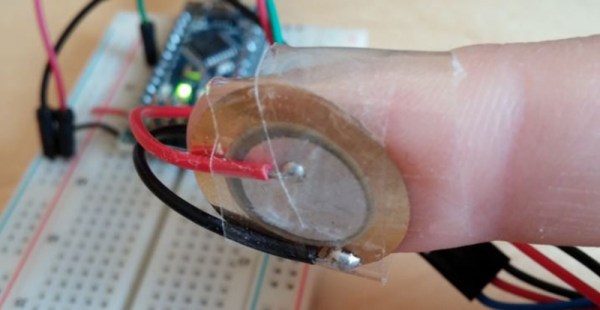
[Thomas] was working on a project that detects if water is flowing through a pipe with a few piezoelectric sensors. Out of curiosity, he taped the sensor to his finger, and to everyone’s surprise, the values his microcontroller were spitting out were an extremely noise-free version of his heart rate.

The piezo in question is a standard, off the shelf module, and adding this to a microcontroller is as easy as putting the piezo on an analog pin. From there, it’s just averaging measurements and extracting a heartbeat from the data.

It’s a much simpler solution to measuring a heart rate, and since two people haven’t heard of this technique, it’s likely a lot more people haven’t heard of this technique either. If you’re looking for an entry to The Hackaday Prize, this would be a great jumping off point for anything in either the fitness or medical domains.

Brains Controlling Labyrinths Without Hands

[Daniel], [Gal] and [Maxim] attended a hackathon last weekend – Brainihack 2015 – that focused on neuroscience-themed builds in a day and a half long build off. The trio are communications systems engineering and computer science students with no background in neuroscience whatsoever. You can’t build an FMRI in a day and a half, so they ended up winning the best project in the open source category with a brain-controlled labyrinth game.

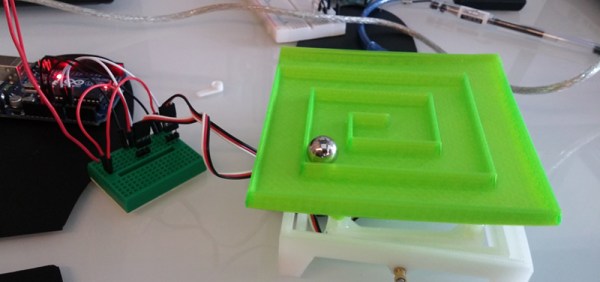
The labyrinth itself is entirely 3D printed and much, much simpler than the usual, ‘wooden maze with holes’ that’s generally associated with labyrinth puzzles. It’s really just a plastic spiral for a ball to follow. There’s a reason for this simplicity. The team is using EEG to detect brain waves and move the labyrinth on the X and Y axes.

The team is using OpenBCI for the interface between their brains and a pair of servos. This is actually an interesting piece of tech; unlike a few toys like the NeuroSky MindWave and the Star Wars Force Trainer, the OpenBCI gives you eight input channels that attach to anywhere on the scalp. The team used these inputs to measure Alpha waves and Steady State Visually Evoked Potential to control the pair of servos on the labyrinth frame.

It’s a great build, a wonderful demonstration of a device that outputs real EEG signals, and the team on a prize. What’s not to like?

2015 THP Inspiration: Medical Hacks

Last year’s Hackaday Prize focused on building something cool, useful, and open. This led to builds as impressive as quadcopters nicknamed the Decapitron, to devices as useful as an Everything Radio. It’s a big field, and if you want to build something that will win, you first need an idea.

This year we’re making that part of the process a little easier for you. We’re looking for builds that matter, be they devices that monitor pollution, feed entire populations, lay the groundwork for powering an entire city, or reduce the cost and increase access to medical care.

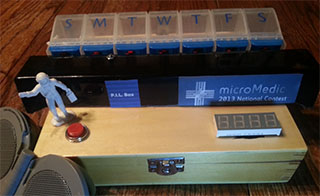
pillminderMedical builds are a tricky subject, but over the years we’ve seen a few that stand out. Some can be as simple as a pill dispenser that tells the Internet when you don’t take your meds. This type of build is actually pretty popular with several iterations, one that works with pill bottles.

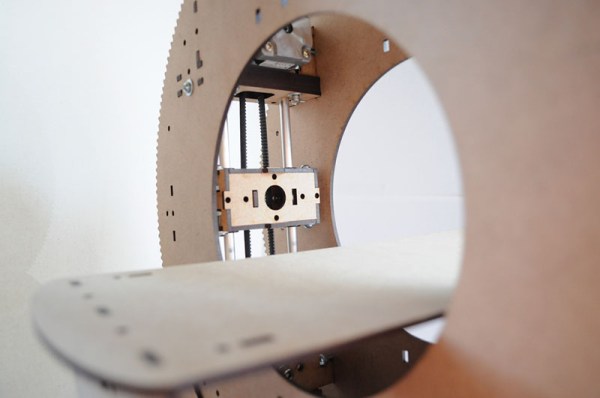
Maybe a gadget you could find in a drug store isn’t your thing. That’s okay, instead you can turn your attention to advanced medical imaging, like 3D printing a brain tumor and preventing a misdiagnosis. We’ve seen 3D printed MRI and CT scans for a while now, and coming up with a system that automates the process would be a great entry for the Hackaday prize.

prosOf course with 3D printers, you have a bunch of prosthesis applications; from a nine-year-old who designed his own prosthetic arm, a printed prosthetic arm for a stranger, or something simpler like our own [Bil Herd]’s quest to rebuild a finger.

These are all simple builds, but ones that clearly meet the criteria of doing something meaningful. The sky is the limit, and if you want to improve the desktop CT scanner, learn CPR (correctly) from an automated assistant, or be brought back to life with your own design, that’s all well within the goals of this year’s Hackaday Prize.