Image Sensor For Filling Wine Bottles

wine

A wine bottling company in New Zealand got in touch with [Boz] to solve a problem. They needed a way to automatically determine if a wine bottle was filled or not. What he came up with is a very simple yet very effective fill level sensor that can scan thousands of bottles an hour.

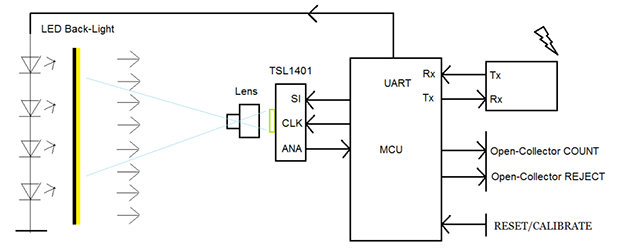
There were a few design decisions that went into the construction of this wine bottle sensor. [Boz] could have used a VGA camera sensor, but given the speed of the bottling line (half a meter per second), pushing all those pixels to a computer and doing real-time image analysis would be difficult. [Boz] settled on a much simpler solution – a 1×128 linear CCD analog image sensor. With a PIC microcontroller, this allows the device to check multiple bottles per second, calculate if the bottle is full or not (or overfilled), and send a ‘pass’ or ‘reject’ signal to the rest of the line.

The rest of the assembly is fairly straightforward with an LED backlight providing the illumination for the CCD and a Bluetooth transmitter for checking out the machine’s settings. On the bottling line, the device has 99% accuracy for both red wines in dark bottles and whites in green bottles. You can take a gander of this device in action on a New Zealand bottling line below.
Continue reading “Image Sensor For Filling Wine Bottles”

Once, Twice, Three Times A Nixie

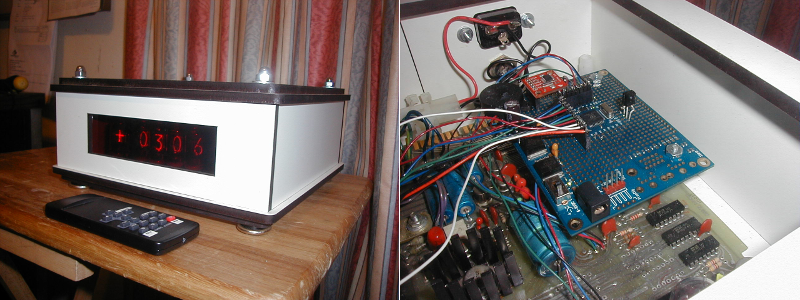
Try as he might, [Localroger] can’t seem to throw away a certain board that started life in one of the first digital industrial scales, the NCI DigiFlex model 5775. He recently gave it a third career as a nixie clock with an alarm.

[Localroger] says the board dates to about 1975. It’s all TTL, no microprocessor anywhere. He was headed to the Dumpster with it in the mid-1980s, but realized that he could hack it into something useful. Since the display wasn’t multiplexed, it would be fairly easy. He used it as a BCD tester for about 10 years until the method fell out of fashion.

After a decade on the shelf, [Localroger] started off for the Dumpster once more with the board. The nixie tube display cried out for another chance to glow, so he decided to repurpose it into a remote-controlled bedside clock with an alarm. He installed a Parallax Propeller Protoboard with headers for easy removal and subsequent servicing of the 5775 board. He added a few things to the protoboard: a piezo element for the alarm, a SparkFun RTC module, an IR receiver, and vertically-oriented header so the PropPlug can be plugged in from the top. But that’s not all. [Localroger] designed a custom melamine-finished MDF enclosure and laser cut it, giving the edges a nice contrast. It’s so tough, he can put his ceramic lamp on top of it to save space on the nightstand.

Nixie tubes are becoming more scarce all the time. If you can’t find any, we humbly suggest rolling your own.

[Thanks Localroger!]

Acoustic Wayfinder For The Visually Impaired

Ideally, technology is supposed to enhance our lives. [Shane and Eileen], two seniors at Cornell have found a great way to enhance the lives of visually impaired individuals with their acoustic wayfinding device. In brainstorming for their final project, [Shane and Eileen] were inspired by this Hackaday post about robots as viable replacements for guide dogs. They sought to provide wearable, hands-free guidance and detection of (primarily) indoor obstacles—namely chairs, benches, and other inanimate objects below eye level.

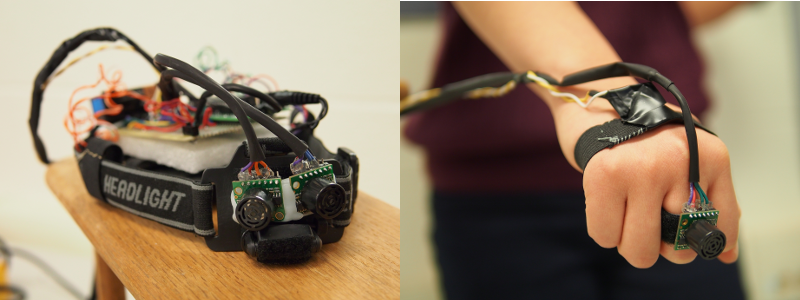
The wayfinder comprises two systems working in tandem: a head-mounted navigation unit and a tactile sensor worn on the user’s finger. Both systems use Maxbotix LV-MaxSonar-EZ0 ultrasonic rangefinder modules to detect obstacles and vibrating mini-disc motors to provide haptic feedback at speeds proportionate to the user’s distance from an obstacle.

The head unit uses two rangefinders and two vibrating motors. Together, the rangefinders have a field of view of about 120 degrees and are capable of detecting obstacles up to 6.45 meters away. The tactile sensor comprises one rangefinder and motor and is used in a manner similar to a Hoover cane. The user sweeps their hand to detect objects that would likely be out of the range of the head unit. Both parts are ergonomic and  size-adjustable.

At power up, [Shane and Eileen]’s software performs a calibration of the tactile sensor to determine the distance threshold in conjunction with the user’s height. They’ve used an ATMega 1284 to drive the system, and handled real-time task scheduling between the two subsystems with the TinyRealTime kernel. A full demonstration video is embedded after the break.

Continue reading “Acoustic Wayfinder For The Visually Impaired”

POV Display With An Element Of Danger

FZKU6SCHPFZR2KV.LARGE

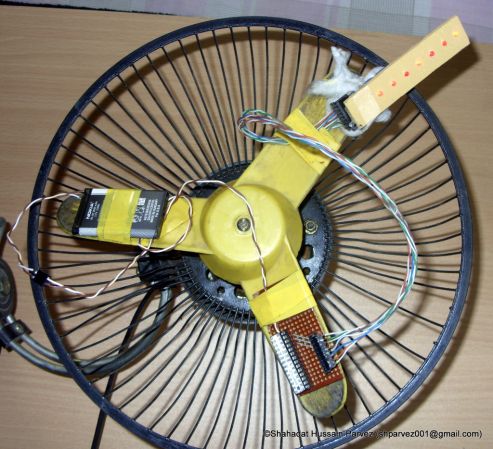
Persistence of vision displays are always cool, although we must admit this one looks like it could very well explode at high speeds…

Safety concerns aside, this desk fan based display provides a great starting point for learning about making POV displays. It makes use of an old cellphone battery, an ATmega8, some LEDs, Veroboard, assorted wires and solder and of course, a high-speed desk fan.

[shparvez001] also provides the full code on his blog for the project, making it very easy to replicate. Though we might also suggest you keep it small enough that the original fan cage still fits on top.

From an aesthetic point of view, the display looks fine in the dark — but when the lights are on you might get some odd looks. We can see this project being greatly improved by mounting the LEDs through one of the fan blades, and the control electronics on the back side of the other blades. Maybe throw in some wireless charging for the battery while the fan is off too?

Anyway, stick around after the break to see the display in action. If you want a more permanent fan POV try adding display hardware to a ceiling unit.

Continue reading “POV Display With An Element Of Danger”

Vibe Mirror

FLRGC76HP7M9BLI.LARGE

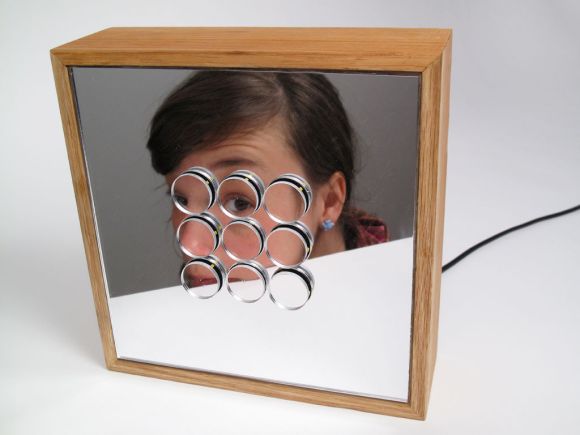
We love a good art-related project here at Hackaday, and [Wolfgang’s] vibrating mirror prototype is worth a look: into its distorting, reflective surface, of course.

[Wolfgang] began by laser cutting nine 1″ circles from an 8″ square mirror, then super glued a 1/4″ neoprene sheet to the back of the square, covering the holes. Each circular cutout received some custom acrylic backings, glued in place with a short piece of piano wire sticking out of the center. The resulting assemblage pushes through the neoprene backing like a giant thumbtack, thus holding all nine circular mirrors in place without restricting movement. The back end of the piano wire connects to yet another piece of acrylic, which is glued to a tiny vibrating motor.

He uses some shift registers and an Arduino Uno to control the motors, and although there’s no source code to glance it, we’re guessing [Wolfgang] simply designed the nine mirrors to buzz about in different patterns and create visually interesting compositions. Check out a quick video of the final effect after the break, and if you can help [Wolfgang] out with a name for his device, hit us up with your suggestions in the comments.

Continue reading “Vibe Mirror”

LED Matrix Mask Will Scare Up Holiday Cheer

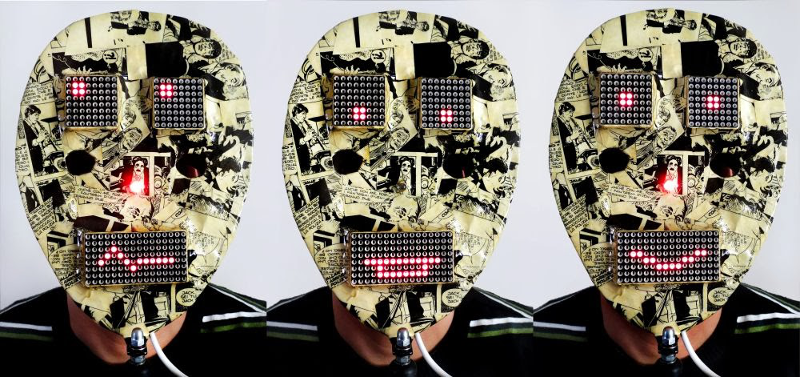
[Davide] sent us this fun LED matrix mask he built using an ATMega8 and 74LS595N shift registers. Each of the eyes is an 8×8 LED matrix, and the mouth is made from two 8x8s. [Davide] used a ULN2803A Darlington transistor array to drive the matrices.

When the user steps behind the mask, an IR sensor detects that a face is within range and activates the facial features. The code randomly runs the eye and mouth patterns. If the user starts speaking, a microphone element detects his voice and a separate speaking mouth pattern is executed.

The mask body and stand are découpaged with pages from Dylan Dog comics. [Davide] says he built the mask years ago, but decided to submit it to the 2013 Inverart Art Fair in Milan. As you can probably imagine, the mask has been a big hit with the kids so far. Stick around to see [Davide]’s Santa-fied demonstration after the jump. [Davide] didn’t give us any details on that sweet hat, unfortunately.

If you require a better degree of protection or more LEDs, check out this LED helmet.

Continue reading “LED Matrix Mask Will Scare Up Holiday Cheer”

IR Theremin Speaks In Four Voices

infraredTheremin

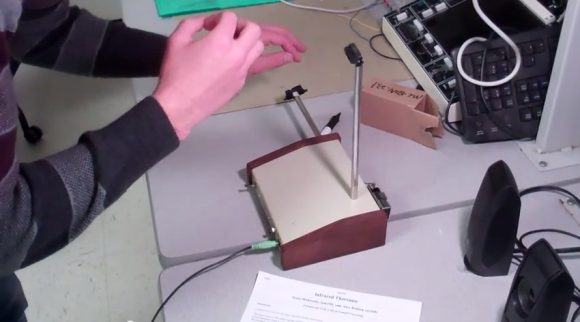
At the end of every semester, we get a bunch of cool and well-documented student projects from Cornell’s ECE4760 class. [Scott] and [Alex]’s infrared theremin is no exception.

The classic theremin design employs each of the player’s hands as the grounded plate of a variable capacitor in an LC circuit. For the pitch antenna, this circuit is part of the oscillator. For the volume antenna, the hand capacitor detunes another oscillator, changing the attenuation in the amplifier.

[Scott] and [Alex] put a twist on the theremin by using two IR sensors to control volume and pitch. The sensors compute the location of each hand and output a voltage inversely proportional to its distance from the hand. An ATMega1284P converts the signal to an 8-bit binary number for processing. They built four voices into it that are accessible through the push-button switch. The different voices are created with wave combinations and modulation effects. In addition to Classic Theremin, you can play in pure sine, sawtooth, and FM modulation.

If you’re just not that into microcontrollers, you could build this digital IR theremin instead. If you find IR theremins soulless or plebeian, try this theremincello.

Continue reading “IR Theremin Speaks In Four Voices”