14.4 Kbps Modem Makes Excuses For Everything

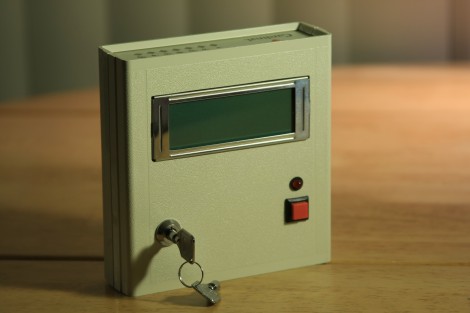
If your boss is like [Michael Scott] you probably find yourself in constant need of plausible reasons for your action or inaction. Now you won’t have to waste away the workday coming up with those ideas yourself because this little box will always provide you with an excuse. It’s actually a 14.4 Kbps modem, which brings back memories of the early ISP days when you’ve find banks of these in the corner to service incoming calls. [Alex] altered the circuit board to map out an ICSP port for the PIC 16F690 that controls the system. Just use your key to unlock the Emergency Excuse Generator and press the button to spit out a doozy. The 8,000 word memory on the microprocessor stores all of the excuses which can be combined a number of different ways based on how the rules files is built. This rule file is by far the most interesting part of the build and worth looking over.

We think this would be a nice addition to the other office electronics you built.

[via Dangerous Prototypes]
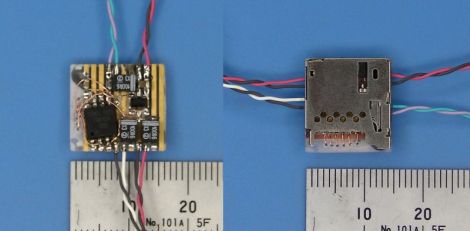
Micro Audio Player Can Hide Behind A Postage Stamp

The original iPod shuffle was a pretty small device, there’s no doubt about that. However, in the world of miniature audio players, [Chan] is no slouch either.

A few years ago, he set out to construct a micro audio player that used little more than a small microcontroller and a microSD memory card. He chose an ATinyX5 series microcontroller to run the show, utilizing its pair of PWM output pins to directly drive the speakers. Since there is no built-in amplifier, the audio volume is not loud, but it does sound reasonable if you use a set of high efficiency desktop speakers. He does mention that the sound can easily be amplified after passing the signal through a filter, so there is hope for those of you who like your music turned up to 11.

The only downside we can see is that the audio player can only process Wave files, but it’s hard to expect more from a DIY audio player smaller than a postage stamp. It would be great to see what sort of micro-handiwork [Chan] could perform if he were to update his design and build a full-functioning MP3 player based upon this project.

.Net OS For Your ARM

Pyxis 2 is a recently released new embedded operating system. The first Pyxis OS would run on an arduino with a touch screen, and provided a nice GUI. Pyxis 2 on the other hand has departed from most of its predicator, and is now made on top of the .NET micro framework, and natively supports FEZ Cobra and ChipworkX systems. It supports 320×240, 480×272, even 800×480 (if you have the ram), LCDs.

Some of the features of the OS include alpha blended desktop icons, file dialogs, prompts, input, color selection, file box, buttons, all the standard stuff to construct your applications, support for network, USB, SD and Mp3. Since it is .NET you can also use C# visual studio to construct everything without dedicating yourself to hardware until you are ready.

Join us after the break for a short video.

Continue reading “.Net OS For Your ARM”

Keypad Input Scanning By A 555 Timer

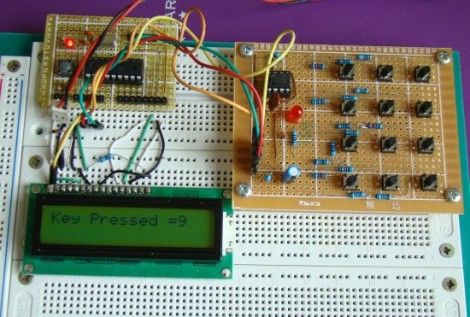
[R-B] designed a 555 timer circuit to scan a keypad. Keypads are common interfaces for small projects and require row and column scanning by a microcontroller. [R-B’s] setup allows you to reduce the number of pins used on the microcontroller to just two. One is an interrupt that is triggered when any of the buttons are pushed, the other reads the frequency from the 555 chip. Each button has its own resistance which alters the frequency of the 555. The microcontroller reads the frequency for 100ms using a timer. The number of timer overflows that occur during that period directly correspond to the button press (five overflows for the numeral 5, zero overflows for the numeral zero).

We usually debounce our button presses for 40 ms, this is more than twice that amount of time but still not a staggering difference. It does make us wonder if you will miss quick button presses? The only really way to know is to try this out yourself. Check out the video after the break and don’t forget to leave a comment with your own experiences in working with the circuit.

Continue reading “Keypad Input Scanning By A 555 Timer”

Earthquake Alert System


[Roteno’s] submission for the 555 timer design contest is an Internet connected earthquake alert system. It monitors the USGS website for earthquake data and plays a tune when an earthquake occurs. The data is available as a feed in the form of a TXT file which is pretty easy to parse using cURL. He chose an LPCXpresso board (which is an ARM development platform that can run a Linux kernel) along with an XPORT module to handle the Ethernet traffic.

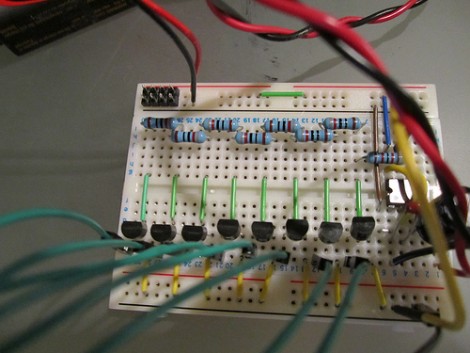
So where does the 555 timer see some action? It is responsible for playing the tone when an earthquake is detected. But playing just one pitch isn’t much fun. Instead, [Roteno] built the circuit above which creates a resistor network switched by a series of transistors. This way he can use GPIO from the microcontroller to choose different pitches. Check out the video after the break to hear the results. At power-up all eight pitches are played as a test, and the alert sound varies in pitch and tempo based on the magnitude of the earthquake.

Continue reading “Earthquake Alert System”

Gameduino

Gameduino is an FPGA based sound and graphics adapter for microcontrollers. Laid out as an Arduino shield, all it really takes is a microcontroller with SPI and some code to send commands to the board which lets you toggle registers, handle memory, and drawing functions.

Once the data gets there, it is greeted by a Xilinx FPGA which puts out a 800×600 72Hz SVGA sync signal, large 512×512 pixel character scrolling backgrounds, piles of 16×16 (up to 256 color) sprites, each with per pixel transparency, rotation, flip, and if that was not enough a 12 bit frequency synth that can do 16 independent voices.

All the resources to make one of these is listed on the site under the Making a Gameduino link, but if youre interested in getting a made board there is also a kickstarter page available. There are other ways to squeeze video out of micro controllers from the basic like hackvision to AVGA or even Lucidscience AVR VGA v2, and tons of propeller projects, but this one being stand alone and portable, has a certain appeal.

Join us after the break for a quick video.

Continue reading “Gameduino”

Racking Up Miles On A Bicycle Odometer

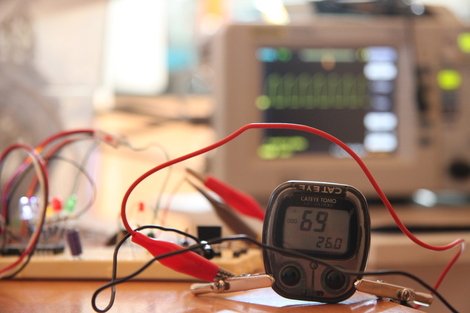
[jonh] religiously tracks the miles he rides on his bicycle. When his odometer’s battery started getting low, he wanted a way to run the miles up to where they were before, since replacing the battery resets everything to zero. [jonh] used an Atmel microcontroller to run up the miles on his bike computer so he could pick right back up where he left off. There is definitely a Ferris Bueller’s Day Off joke in here somewhere.

The bike computer itself is designed to plug into a base that connects to a magnet-triggered reed relay. It uses a wheel-mounted magnet to count the number of revolutions made and thus the distance traveled. [jonh] hooked up a simple microcontroller-driven circuit to these connectors to trick the bike computer into thinking it was moving, and moving fast! Since he knew the number of miles he wanted to sandbag onto the odometer, he was able to program it to run up the proper amount of miles and then stop. There’s no source code listing for the project, but this shouldn’t be too hard to reproduce. He provides a pencil-drawn schematic for the connection to the cyclometer from the microcontroller. At the end, there’s also some sage advice for those of you who are interested in building a decent hardware hacking lab on the cheap.