
Hacking Multiplication: Binary Multiply On Paper

We’ve often noted that whether had ancient man known binary, we could all count to 1023 on our fingers. We thought about that while watching [Numberphile’s] latest video about “Russian” multiplication (see below). Apparently, the method dates back quite a way, sometimes known as Ethiopian or peasant multiplication. Even the ancient Egyptians did a form of it.

If you’ve ever written long multiplication code for a microcontroller, you can probably tell how this works. Each halving of the number amounts to a right shift. Each doubling is a left shift. Throwing out the even numbers means you only take the values when the least-significant bit is zero. Booth’s algorithm is more efficient, but the “Russian” method is simple to do on paper.

Continue reading “Hacking Multiplication: Binary Multiply On Paper”

Custom Laser Tag Rifle Packs A Sonic Punch

Laser tag is rarely (if ever) referred to as “The Sport of Kings”, but is a fun pastime nonetheless. While some are content to play with off-the-shelf toys, others prefer to make their own gear to suit their needs. [Heine Nielsen] is just one such builder, creating a fully-featured laser rifle loaded with features.

As far as hardware goes, [Heine]’s laser rifle is packed to the gills. There are two ESP32s running the show, along with a meaty 6S lithium battery to provide plenty of juice for long combat sessions. A 40W audio amp is hooked up to a speaker mounted in a faux-grenade launcher, aping the design of the M203 – and is able to deliver ear-splitting sound for that realistic touch.

Knowing the popularity of modern FPS games, [Heine] cribbed a lot from titles like PUBG and CS:GO. Grabbing sound effects from various weapons was just one step, with the ultimate goal being to replicate advanced game modes from these games. To help keep the player aware of the game state, there’s even a HUD on the gun, thanks to a 2.8″ TFT screen tucked into the scope.

It’s a serious build for playing serious laser tag, and we’d love to head out to the field for a match with gear like this. We’ve seen other hyper-realistic builds before too, like this one that uses actual blanks. Video after the break.

Continue reading “Custom Laser Tag Rifle Packs A Sonic Punch”

Array Of Useless Machines Is Useless

What’s the collective noun for a group of useless machines? A passel of useless machines? A failure? A waste? A 404?  Whatever you want to call it, [Martin Raynsford] has produced one here with this collection of 24 useless machines arranged into a 5 by 6 array. He produced it for an event at a hackerspace to amuse visitors, and it certainly seems to do the job in the video after the break.

[Martin] built the case by modifying the design of his Useless Machine kit, stretching out the case to hold multiple mechanisms. The original plan was to use a 6 by 6 matrix, but that wouldn’t fit into the laser cutter, so it ended up with 24 mechanisms in a 5 by 6 array. All of those are driven by 2 AAA batteries, and the mechanisms are efficient enough that it survived a full day of button flipping before it began to run out of juice.

Continue reading “Array Of Useless Machines Is Useless”

Hoverboard Grows Up, Becomes Magnetic Drill Press

If you need to drill metal in tight places, the magnetic drill press, or mag drill is your BFF. The idea here is that a drill press with an electromagnetic base can go anywhere, and even drill horizontally if need be. If you don’t need to use one often, but want one anyway, why not build one out of e-waste?

[DIY KING 00] built this mag drill starting with the motor from a hoverboard. While these three-phase brushless motors have a lot of torque to offer reuse projects like this, they’re not designed to be particularly fast.

He was able to make it about three times faster by cutting the windings apart and reconnecting them in parallel instead of series. He designed a simple PCB to neatly tie all the connections back together and added an electronic speed control (ESC) from an R/C car.

Reluctant to give up the crown, he made his own three-coil electromagnetic base, using a drill to wind magnet wire around temporary chuck-able cores. The coils are then potted in epoxy to keep out dust and drilling debris. Everything runs from two large LiPo batteries, and he can get about 15 minutes of high-torque drilling done before they’re dead. Can you feel the electromagnet pulling you past the break to check out the build and demo video?

Depending on what you’re doing, you might get away with a magnetic vise instead.

Continue reading “Hoverboard Grows Up, Becomes Magnetic Drill Press”

How Many Smartphones Does It Take To Make A Traffic Jam?

Online mapping services pack in a lot of functionality that their paper-based forebearers could simply never imagine. Adding in metadata for local landmarks, businesses and respective reviews, and even live traffic data, they have the capability to deliver more information than ever before – and also correspondingly, shape human behaviour. [Simon Weckert] decided to explore this concept with a cheeky little hack.

Pictured: All it takes to create a traffic jam on Google Maps!

The hack targets the manner in which Google collects live traffic data for display on Google Maps. When users load the app, Google takes location data from individual phones, tracking them as they travel along roadways. Large numbers of users travelling slowly down a road indicate there’s heavy traffic, and thus Google will display corresponding warnings on their maps and redirect users to take alternative paths.

To pull off the hack, [Simon] placed 99 smartphones in a handy-cart, tugging them behind him as he walked slowly down a series of streets. In the video, this is overlaid with Google’s map data captured at the time. The app updates the maps with orange and red lines down the roads which [Simon] travelled with his 99 pretend drivers, indicating a traffic jam.

We’d love to know whether [Simon] ran 99 individual SIM cards with data access, or if the hack was perpetrated with the use of a WiFi hotspot for cheaper internet access. Reddit comments note that Google will likely swiftly work on methods to prevent such tomfoolery in future. It’s simple to see that 99 individual users reporting the exact same location and speed at the same time would be trivial to filter out from traffic monitoring in future.

It’s both a commentary on the power we give these apps in our lives, as well as a great demonstration of how easily such systems can be trifled with. We first reported on Google’s traffic monitoring back in 2009, when it was a technology in its infancy. Video after the break.

Continue reading “How Many Smartphones Does It Take To Make A Traffic Jam?”

Acrylic Mold Makes For Professional-Looking Silicone Keyboards

The border between consumer electronics and DIY projects is getting harder and harder to define. First it was PCBs, which quickly went from homemade to professional with quick-turn services. Then low-cost CAD/CAM packages and high-end fabrication services gave us access to enclosures that were more than black plastic boxes with aluminum covers. Where will it end?

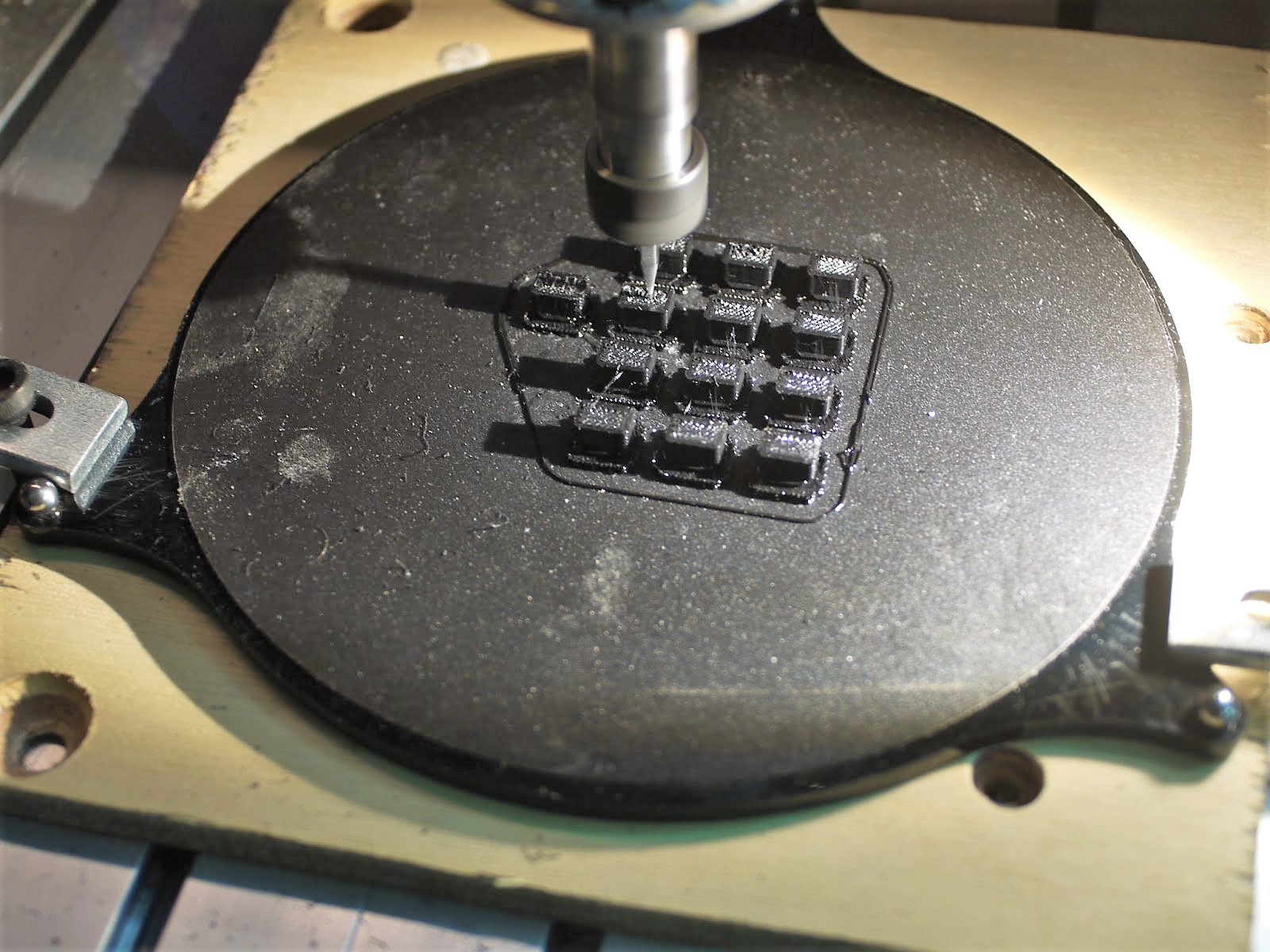
That’s a question [arturo182] begins to answer with this custom-molded silicone keyboard for a handheld device. There’s no formal writeup, but the Twitter thread goes into some detail about the process he used to make the tiny qwerty keypad. The build started by milling a two-part mold from acrylic. Silicone rubber was tinted and degassed before injecting into the mold with a baster. The keys are connected by a thin membrane of silicone, and each has a small nub on the back for actuating a switch.

There’s clearly room for improvement in this proof of concept – tool marks from the milling process mar the finish of the keys slightly, for instance. There may be tips to be had from this article on silicone keyboard refurbishment to improve the process, but overall, we’d say [arturo182] is well on his way here.

Wire Loop And Amplifier Solve Audio Problem For The Hearing Impaired

Imagine being asked to provide sound reinforcement for a meeting that occurs in a large room, where anyone can be the speaker, and in a situation where microphones would hinder the flow of the meeting. Throw in a couple of attendees who have hearing disabilities, and you’ve got quite a challenge to make sure everyone gets heard.

Such a situation faced [David Schneider] at his Quaker meetinghouse, which he ended up solving with this home-brew audio induction loop system. The worship style of conservative sects of the Religious Society of Friends, as the Quakers are formally known, is “silent worship”, where congregants sit together in silence until someone feels moved to share something. Anyone can speak at any time from anywhere in the room, leading to the audio problem.

Rooms mics and a low power FM transmitter didn’t work because those using radio as aids to hearing the service felt awkward, so [David] decided to take advantage of a feature in the hearing aids worn by some members: telecoils. These are inductive receivers built into some hearing aids to send sound directly to them using magnetic fields generated by a loop in the listening area. [David]’s loop ended up being 240 meters of 20-gauge copper wire in the attic above the meeting room. The impedance ended up close to 8 ohms, perfect for feeding directly from the speaker terminals of an old stereo amplifier. Pumping 160 Watts into the coil allows the hearing-aid wearers below hear the service now.

There’s still work to be done on the input side to improve audio quality, but [David]’s solution is elegant in that it helps those who need it most using technology they already have. And perhaps those who need but don’t yet have hearing aids can roll their own.