Dirt Cheap Dirty Decapping

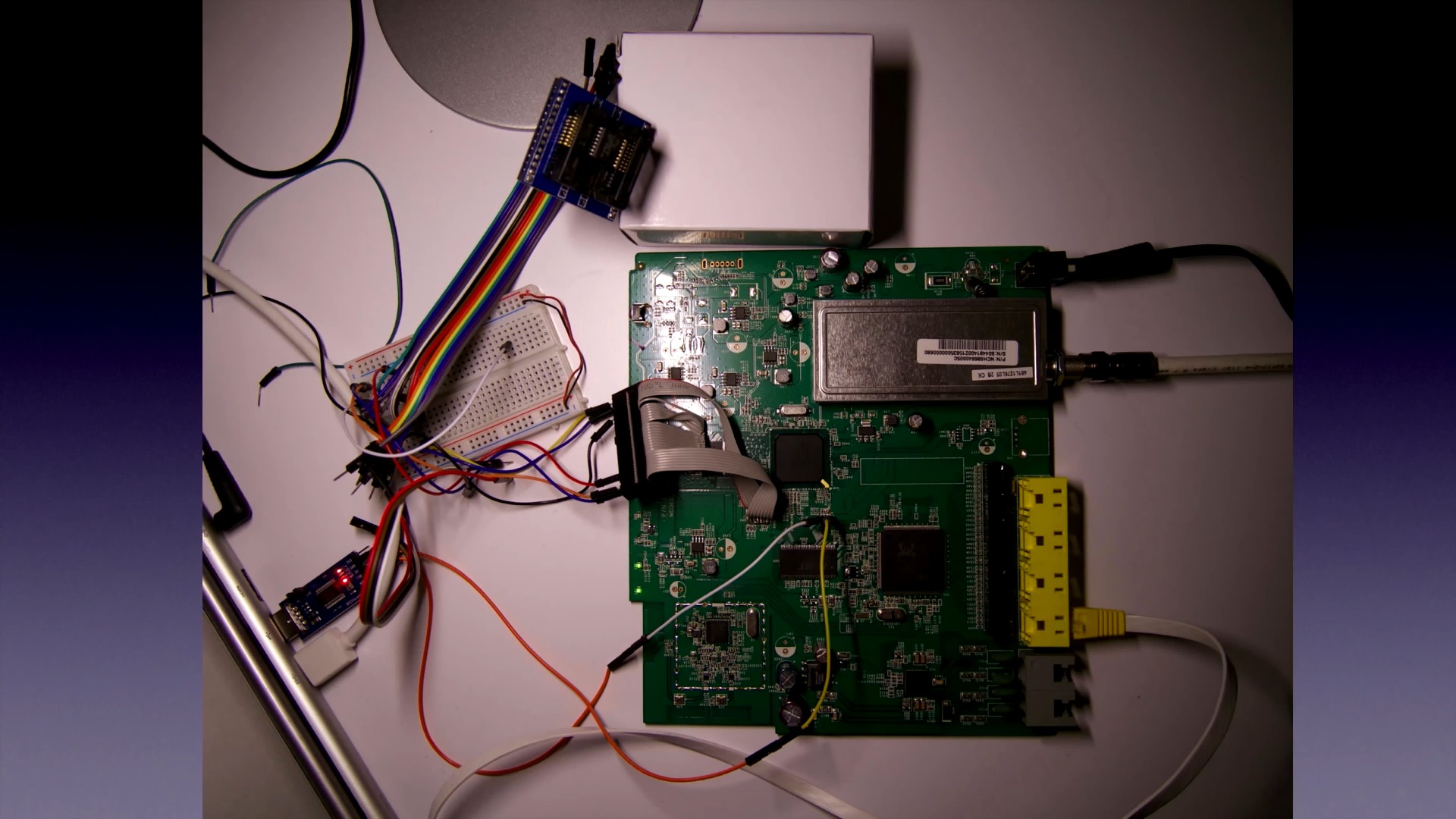
Those tiny black rectangles of epoxy aren’t black boxes anymore. Decapsulating ICs is becoming somewhat common, and if you’re reverse engineering a chip-on-board epoxy blob, or just figuring out if the chip you bought is the chip you wanted, you’ll need to drop some acid. Usually this means finding someone with the knowhow to decap a chip, or having enough confidence in yourself to mess around with fuming nitric acid. Now Dangerous Prototypes has a better solution – Dirty Decapsulation. Send your chip to Dangerous Prototypes, and they’ll melt away the epoxy and take a few pictures of the die hidden inside your chip.

dirty-decappingDirty Decapsulation is Dangerous Prototype’s addition to their array of hacker services including cheap, crappy PCBs and SLA printing service. Dirty Decapsulation follows in the tradition of these other services; it’s not the best you can possibly get, but you’re not paying thousands of dollars for the job.

Right now, Dirty Decapsulation will take a chip, strip off the epoxy, and take a few pictures. These pictures are stitched together, producing a medium quality image of the die. No, you can’t see individual gates, and you can’t see different layers of metal and silicon. If you want that, you’ll need some nitric or a few thousand dollars. Dirty Decapsulation is just to verify the chip’s identity and give a rough idea of the layout of the die.

When The Smart Hits The Fan

A fan used to be a simple device – motor rotates blades, air moves, and if you were feeling fancy, maybe the whole thing oscillates. Now fans have thermostats, timers, and IR remotes. So why not increase the complexity by making a smart fan with an IoT interface?

[Casper]’s project looks more like a proof of concept or learning platform than a serious attempt at home automation. His build log mentions an early iteration based on a Raspberry Pi. But an ESP8266 was a better choice and made it into the final build, which uses an IR LED to mimic the signals from the remote so that all the stock modes of the fan are supported. The whole thing is battery powered and sits on a breadboard on top of the fan, but we’ll bet that a little surgery could implant the interface and steal power internally. As for interfaces, take your pick – an iOS app via the SmartThings home automation platform, through their SmartTiles web client, or using an Amazon Echo. [Casper] mentions looking into MQTT as well but having some confusion; we’d suggest he check out [Elliot Williams]’ new tutorial on MQTT to get up to speed.

Continue reading “When The Smart Hits The Fan”

X-Ray Everything!

We’re not 100% sure why this is being done, but we’re 110% happy that it is. Someone (under the name of [The X-Ray Playground]) is putting interesting devices under an X-ray camera and posting videos of them up on YouTube. And he or she seems to be adding a few new videos per day.

Want to see the inner workings of a pneumatic microswitch? Or is a running pair of servo motors more your speed? Now you know where to look. After watching the servo video, we couldn’t help but wish that a bunch of the previous videos were also taken while the devices were being activated. The ball bearing wouldn’t gain much from that treatment, but the miniature piston certainly would. [X-Ray Playground], if you’re out there, more working demos, please!

How long the pace of new videos can last is anyone’s guess, but we’re content to enjoy the ride. And it’s just cool to see stuff in X-ray. If we had a postal address, we know we’d ship some stuff over to be put under the lens.

We don’t have as many X-ray hacks as you’d expect, which is probably OK given the radioactivity and all. But we have seen [MikesElectricStuff] taking apart a baggage-scanner X-ray machine in exquisite detail, and a DIY fluoroscope (yikes!), so we’re not strangers. Who needs Superman? We all have X-ray vision these days.

Thanks [OiD] for the tip!

3D Printing Hailstone Molds For Science

Hollywood would have you believe that tornadoes are prevalent in the Midwest. We’re much more likely to see hail in the springtime—balls of slushy ice that pelt our roofs and dimple our cars. [Dr. Ian Giammanco] and his wife and fellow scientist [Tanya Brown-Giammanco] have been studying hail at the Insurance Institute for Business and Home Safety’s research lab since 2012. In 2013, their team created over 9,000 artificial hailstones and fired them at a mock-up of  a house in the first indoor full-scale hailstorm.

As fun as it sounds to shoot balls of ice at different things, they did it to better understand the humble hailstone and the damage it can do to insurable goods. Those hailstones from a few years ago were created manually by injecting molds and freezing them. Recently, [the Giammancos] and  have taken a more advanced approach to creating artificial hail so they can study the physical characteristics. They scan actual hailstones in order to create models of them. Then they make a 3D-printed mold and use it in a hail-making machine that uses diffused carbon dioxide to mimic the layering that occurs when natural hailstones are formed.

While it would be nice to be able to control hail, the next best thing is mitigating the damage it causes. The better that scientists understand hail, the better materials will become that can withstand its impact. Perhaps someone can perfect a shape-shifting building material and make it resistant to hail.

35 MPH NERF Darts!

Did you know the muzzle velocity of a NERF dart out of a toy gun? Neither did [MJHanagan] until he did all sorts of measurement. And now we all know: between 35 and 40 miles per hour (around 60 km/h).

foo_thumbnailFirst, he prototyped a single beam-break detector (shown above) and then expanded his build to two in order to get velocity info. A Propeller microcontroller took care of measuring the timing. Then came the gratuitous statistics. He took six different darts and shot them each 21 times, recording the timings. Dart #3 was the winner, but they all had similar average speeds. You’re not going to win the office NERF war by cherry-picking darts.

Anyway, [MJ] and his son had a good time testing them out, and he thinks this might make a good kids’ intro to science and statistics. We think that’s a great idea. You won’t be surprised that we’ve covered NERF chronographs before, but this implementation is definitely the scienciest!

Thanks [drudrudru] for the tip!

Getting Ugly, Dead Bugs, And Going To Manhattan

Back in the 1980s I was a budding electronics geek working in a TV repair shop. I spent most of my time lugging TVs to and from customers, but I did get a little bench time in. By then new TVs were entirely solid-state and built on single PC boards, but every once in a while we’d get an old-timer in with a classic hand-wired tube chassis. I recall turning them over, seeing all the caps and resistors soldered between terminal strips bolted to the aluminum chassis and wondering how it could all possibly work. It all looked so chaotic and unkempt compared to the sleek traces and neat machine-inserted components on a spanking new 19″ Zenith with the System 3 chassis. In a word, the old chassis was just – ugly.

Looking back, I probably shouldn’t have been so judgmental. Despite the decades of progress in PCB design and the democratization of board production thanks to KiCad, OSH Park, and the like, it turns out there’s a lot to be said for ugly methods of circuit construction.

Continue reading “Getting Ugly, Dead Bugs, And Going To Manhattan”

Creating Full Color Images On Thermoformed Parts

In a race to produce the cheapest and most efficient full-color 3D object, we think Disney’s Research facility (ETH Zurich and the Interactive Geometry Lab) may have found the key. Combining hydrographic printing techniques with plastic thermoforming.

You might remember our article last year on creating photorealistic images on 3D objects using a technique called hydrographic printing, where essentially you print a flattened 3D image using a regular printer on special paper to transfer it to a 3D object in a bath of water. This is basically the same, but instead of using the hydrographic printing technique, they’ve combined the flattened image transfer with thermoforming — which seems like an obvious solution!

Continue reading “Creating Full Color Images On Thermoformed Parts”