EZ-Spin Motor Spins “Forever”

Now this isn’t a perpetual motion machine, but it’s darn close. What [lasersaber] has done instead is to make the EZ Spin, an incredibly efficient motor that does nothing. Well, nothing except look cool, and influence tons of people to re-build their own versions of it and post them on YouTube.

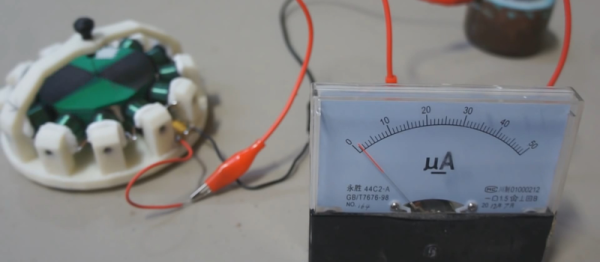
The motor itself is ridiculously simple: it’s essentially a brushless DC motor with a unique winding pattern. A number of coils — anywhere from six to twenty-four — are wired together with alternating polarity. If one coil is a magnetized north, its two neighbors are magnetized south, and vice-versa. The rotor is a ring with permanent magnets, all arranged so that they have the same polarity. A capacitor is used for the power source, and a reed switch serves as a simplistic commutator, if that’s even the right term.

As the motor turns, a permanent magnet passes by the reed switch and it makes the circuit. All of the electromagnets, which are wound in series, fire and kick the rotor forwards. Then the reed switch opens and the rotor coasts on to the next position. When it gets there the reed switch closes and it gets a magnetic kick again.

The catch? Building the device so that it’s carefully balanced and running on really good (sapphire) bearings, entirely unloaded, and powered with high impedance coils, leads to a current consumption in the microamps. As with most motors, when you spin it by hand, it acts as a generator, giving you a simple way to charge up the capacitor that drives it. In his video [lasersaber] blows on the rotor through a straw to charge up the capacitor, and then lets it run back down. It should run for quite a while on just one spin-up.

The EZ Spin motor is absolutely, positively not perpetual motion or “over-unity” or any of that mumbo-jumbo. It is a cool, simple-to-build generator/motor project that’ll definitely impress your friends and challenge you to see how long you can get it running. Check out [lasersaber]’s website, this forum post, and a 3D model on Thingiverse if you want to make your own.

Continue reading “EZ-Spin Motor Spins “Forever””

Shark With Frickin’ LED Tells People Not To Bother You

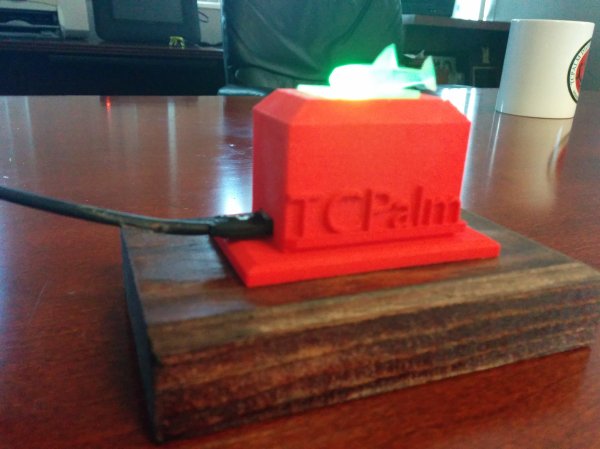
Everybody is busy these days, but sometimes it’s hard to tell. What with teleconferences being conducted over tiny Bluetooth headphones and Skype meetings where we seem to be dozing in front of the monitor, we’ve lost some of the visual cues that used to advertise our availability. So why not help your colleagues to know when to give you space with this shark themed WiFi-enabled meeting light?

Why a shark and not a mutated intemperate sea bass? Only [falldeaf] can answer that. But the particulars of the build are well-documented and pretty straightforward. A Photon runs the show, looking for an Outlook VFB file to parse. An RGB LED is used to change the color of the translucent 3D printed shark based on whether you’re in a meeting, about to step into one, or free. The case is 3D printed as well, although [falldeaf] farmed the prints out to a commercial printing outfit because of the size and intricacy of the parts. He did fabricate a nice looking wood base for the light, though.

There are plenty of ways to tell people to buzz off, but this is a pretty slick solution. For those in open floor plan workspaces, something like this IoT traffic light for you and your cube-mates might be in order.

Portable, DIY Radiography

[Matt] has a background in radiation, electronics, and physics, which means building a device to generate X-rays was only a matter of time. It’s something not everyone should attempt, and [Matt] discourages anyone from attempting anything like this, but if you’re looking for a project with a ‘because it’s there’ flair to it, building your own X-ray machine can be a fun and rewarding project.

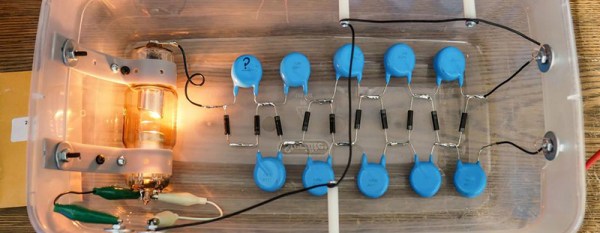
Despite being scary and mysterious, X-rays are a rather old technology that date back to some of the first purposeful experiments in electronics. Most X-ray devices today are built around the same parts they were 100 years ago, namely, a Coolidge tube. Apply a high enough voltage to the Coolidge tube and electrons whizz from cathode to anode, and slam into a heavy metal target. This produces Bremsstrahlung radiation – breakingbraking X-rays – that can be directed to film or an X-ray intensifier screen that fluoresces in visible light when being struck by X-rays.

Aside from a cheap Coolidge tube, [Matt] constructed the rest of his X-ray generator with a voltage multiplier made out of sufficiently derated Chinese caps, a flyback transformer, and a transformer driver originally made for induction heating applications. The electronics were installed in a Tupperware container and insulated with mineral oil.

Being able to generate X-rays is one thing, viewing them is another matter entirely. For this, [Matt] is using an old X-ray intensifier screen from the 60s or 70s. This screen fluoresces blue, not the easiest color to photograph in low-light settings, but enough to capture images of the inside of tools sitting around his workbench. Following in the footsteps of [Roentgen], [Matt] also took an X-ray image of his hand. This is something he doesn’t recommend, and something he won’t do again, but it is a very cool example of what you can do with sufficient knowledge and respect for what can kill you.

Garbage Can RC Car Engine Powers Ridiculous Pencil Sharpener

Christmas has come and gone, and no doubt garbage cans are filling with toys that got but a single use before giving up the ghost. If you scrounge around, you might get lucky and score a busted RC car so you can be like [Mike] and build a completely unnecessary nitro-powered pencil sharpener.

This is one from the [Tim The Tool Man Taylor] “more power” files. To be fair, [Mike] acknowledges as much right up front, and as a learning tool for these super-powerful internal combustion engines, we think it’s a pretty cool project. After dealing with a seized cylinder on what looks to be a VX .18 engine rated at about 1.1 horsepower, [Mike] learns the basics of starting and controlling the engine. Once coupled to a pencil sharpener that clearly isn’t engineered to work at a bazillion RPM and jury-rigging a damper for the clutch, [Mike] fires up the engine and races through a pack of 10 pencils in record time.

As silly as this hack seems, it could come in handy if you decide to go into the colored pencil jewelry market at production levels.

Continue reading “Garbage Can RC Car Engine Powers Ridiculous Pencil Sharpener”

32C3: Beyond Your Cable Modem

[Alexander Graf] gave an absolutely hilarious talk at 32C3 about the security flaws he found in cable modems from two large German ISPs. The vulnerability was very serious, resulting in remote root terminals on essentially any affected cable modem, and the causes were trivial: unencrypted passwords in files that are sent over TFTP or Telnet to the modems, for instance.

While [Alexander] was very careful to point out that he’d disclosed all of these vulnerabilities to the two German cable ISPs that were affected, he notably praised one of them for its speedy response in patching up the holes. As for the other? “They’d better hurry up.” He also mentions that, although he’s not sure, he suspects that similar vulnerabilities are present in other countries. Oh dear.

A very interesting point in the talk is the way that [Alexander] chose to go about informing the cable ISPs. Instead of going to them directly and potentially landing himself in jail, he instead went to the press, and let his contacts at the press talk to the ISPs. This both shielded him from the potential initial heat and puts a bit of additional pressure on the ISPs to fix the vulnerability — when the story hits the front page, they would really like to be ahead of the problem.

cable_modem-shot0012

There’s even a bone for you die-hard hardware hackers out there who think that all of this software security stuff is silly. To get the modem’s firmware in the first place, at minute 42 of the talk, [Alexander] shows briefly how he pulled the flash chip off the device and read it into his computer using a BeagleBone Black. No JTAG, no nothing. Just pulling the chip off and reading it the old-fashioned way.

If you’ve got an hour, go watch [Alexander]’s talk. It’s a fun romp through some serious vulnerabilities.

Mobile Mini Green Recreates Coeur D’Alene’s Floating 14th Hole

Golf is an expensive obsession for some, with course fees on the most memorable and challenging courses running into the hundreds of dollars a game and beyond. If playing one of the most unusual holes in golf is simply beyond your means, there’s no need to fret – just do what [TVMiller] did and build a miniature mobile replica of the famous Coeur d’Alene Resort Floating 14th hole.

The Floating 14th is pretty spectacular as far as golf holes go. With a green located on an island about a hundred yards offshore of beautiful Lake Coeur d’Alene in northern Idaho, there’s little room for error – after all, it’s surrounded by a 49 square mile water trap. [TVMiller]’s replica green recreates the target quite accurately, although we doubt the Jolly Wrencher flag is regulation for championship play. But the best part is the motorized platform and smartphone app that can be used to send the mini green out as far as you feel like practicing. Sure, it could be a tad more realistic if the replica green actually floated, but asphalt fairways are a little easier to come by than Olympic-sized swimming pools.

A fun, tongue-in-cheek project, and we really enjoyed the faux TV coverage of the 2015 Hackaday Golf Championship in the video below. If real golf isn’t your thing, you might want to build a table-top golf course, or play a round of mini golf with a ball-incinerating Portal themed hole.

Continue reading “Mobile Mini Green Recreates Coeur D’Alene’s Floating 14th Hole”

Parts Bin Emergency Lights Deal With Tornado’s Aftermath

Sometimes having a deep inventory of parts in your shop is a pain – the clutter, the dust, the things you can’t rationally justify keeping but still can’t bear to part with. But sometimes the parts bin delivers and lets you cobble together some emergency lighting when a tornado knocks out your power.

It has been hard to avoid discussions of the weird weather in the US this winter. The eastern half of the country has had record warm temperatures, the west has been lashed by storms, and now December tornadoes have ripped through Texas and other parts of the south, with terrible loss of life and wide-ranging property damage. [TheTimmy] was close enough to one massive EF4 tornado to lose power on Saturday night, and after the charm of a candlelight Christmas evening wore off, he headed to the shop. He had a bunch of sealed lead acid batteries from old UPSs and a tangle of 12V LED modules, and with the help of some elastic bands and jumper clips he wired up a bunch of lights for around the house. Safer than candles by a long shot, and more omnidirectional than flashlights to boot.

The power came back before the batteries ran out of juice, so we don’t get to see any hacks for recharging batteries in a grid-down scenario. Still, it’s good to see how a deep parts bin and good mindset can make a positive impact on an uncomfortable situation. We’ve seen similar hacks before, like this hacked cordless tool battery pack or powering a TV with 18650 batteries. Be sure to share your story of epic power-outage hacks in the comments below.