
i have no idea why sites focused around diy electronics have such aggressive comments – Hack a Day applicant
That is weird. What do you think? Comments go!
i have no idea why sites focused around diy electronics have such aggressive comments – Hack a Day applicant
That is weird. What do you think? Comments go!

[Sprite_tm] automated a portion of serial hacking by sniffing out the baud rate using an ATtiny2313 and FT232 breakout board. The firmware assumes 8 data bits, no parity, and 1 stop bit (8N1). This is pretty much defacto among serial ports so it should work well, though some devices do use different settings. The auto detection routine can sniff rates as low as 110 baud and supports non standard rates. Released under GPLv3, the software is also supplied in hex format. [Sprite_tm] has provided great project in past such as Working with VFDs, Controllable bristlebot, and AVR boost converter. Additional information regarding serial hacking after the break.

[WaveRider] is using a type of phase shift keying called BPSK to transmit digital sound and video for remote telemetry. Though a higher signal to noise ratio (SNR) is generally sought after with communications, legal limitations are imposed on total radiated power. To balance the two headed beast, he opted out on frequency shift keying due to binary shift keying’s ability to work with lower SNR. This adds the difficulty of properly reconstructing the digital signal at the receiver. A PLL based carrier regeneration circuit is used to reconstruct the signal. Using the Rabit2000 processor as the host controller on both transmitter and receiver, 96KB/Sec serial data is obtained. On the other side of the spectrum is the Homemade regenerative tube radio.
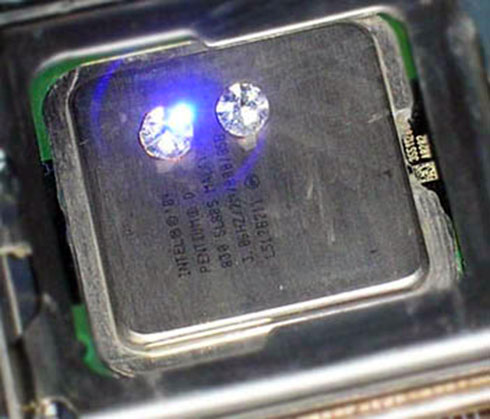
[Jared Bouck] over at InventGeek writes about his experience making his own thermal paste. Diamonds can be up to five times as thermally conductive as silver, the primary ingredient in most popular thermal compounds. He combines 60,000 mesh diamond dust he ordered off eBay with non-conductive silicon grease using a special mixer he constructed to keep down the dust. After some experimentation he achieved a max load temperature of 38 degrees Celsius versus a leading silver paste’s temperature of 57c on the same system.

[RagingComputer] built this 1-wire attic cooling fan. He’s using an Ubuntu server loaded with OWFS to control everything. The 1-wire temperature sensor is interfaced using USB while a serial x10 module sends out commands to be received by another x10 module near the fan. Back in the day we had covered a linux home automation project. We also covered HVAC hacks such as the smart attic fan and a 1-Wire HVAC monitoring system.

The 1-Wire HVAC monitoring system is for residential Geothermal HVAC systems. This project utilizes the so called 1-wire temperature sensor. A single board computer handles the brunt of the work including web accessible trend data. With access to the underling temperatures, the over all system performance may be gauged. Earlier this year we covered a HVAC web enabled monitor that adds an element of control. As the industry adopts modern control architectures, we hope to see more HVAC hacks around.

[Vince Briel] has created an embedded device based on the Parallax Propeller chip that acts as a serial terminal. It takes input from a standard PS/2 keyboard and outputs color VGA. It also has a second serial port to connect to a PC for debugging or programming. He is selling kits and has the schematics available. The board has a lot of hacking potential and it could easily be made into a video game or a Wikipedia browser.
[via RetroThing]









